
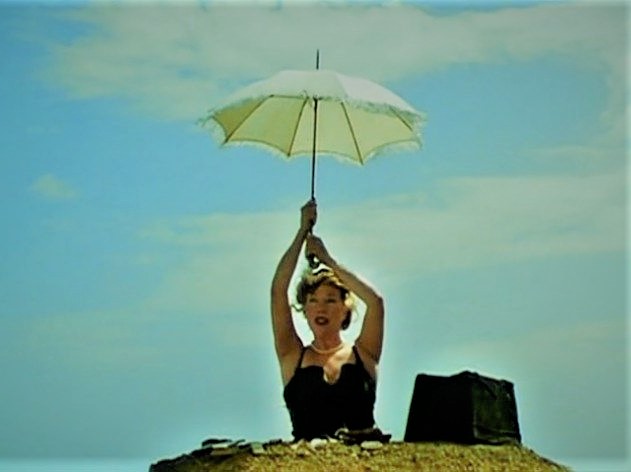
Rosaleen Linehan. Still image from Patricia Rozema’s film, Happy Days. 2000.
- Play title: Happy Days
- Author: Samuel Beckett
- Published: 1961
- Page count: 65
Summary
Happy Days is a two-act play that explores the most basic needs of human existence. The setting is possibly apocalyptic with its ever-beating sun and barren landscape. There are just two characters, Winnie and Willie, but the play is taken up almost exclusively by Winnie’s monologue. Beckett’s heroine is in the quite unusual position of being fixed fast in the ground up to her waist in the opening scene and remains a prisoner throughout in physical terms. The playwright strips away all the accoutrements of life, leaving just a woman’s handbag and a few other props. In the second act, Winnie becomes further submerged. The ‘action’ of the play is confined to Winnie’s daily routine and her monologue, which touches upon her memories, the contents of her handbag, her songs and quotations, and her personal outlook. The title of the play is one of the catchphrases that Winnie uses at specific times.
Ways to access the text: Watching
There is an excellent, full movie version available on YouTube entitled Happy Days (uploaded by Oyunnomin Mod). This version runs for 1hr 17mins, and Winnie is played by Irish actress Rosaleen Linehan.
This play text is not reader-friendly (understatement) due to the extensive stage directions that constantly interrupt the characters’ lines. If you do need to consult a written text, then there are copies available online via the Open Library.
Why watch Happy Days?
Winnie is an indomitable character.
In Happy Days, Beckett presents a surreal situation where a woman is initially half buried in the earth and eventually sinks to her neck with only her head remaining above ground. In this play, the author is inviting us to analyse the meaning of a life and not just how that life was initially shaped, but in Winnie’s case, how ‘a life’ is sustained. There are several ways to interpret Winnie, and not everyone sees this character as strong; however, she is acutely aware of her own predicament and shows astonishing resilience. Happy Days is a minimalist work in a fashion that few authors can achieve. There is no plot per se and no real action as the lead character is rigidly fixed in one spot. Yet, Winnie’s monologue is captivating, frivolous, humorous and thought-provoking. This play showcases an extraordinary character by first stripping away all the norms of daily existence and then displaying what remains. The middle-aged, plump, bourgeoise blonde of the play’s opening scene may eventually surprise readers.
The routines of daily life.
If you watch the play, then you will undoubtedly begin to look upon daily routines in a different light. In Happy Days, routine acts as a sort of anchor. For example, one may interpret Winnie’s daily routine as a link to her past life, her gender role and her sanity, or maybe it is just a way of marking out time or killing time. Winnie, like most people, has a set daily routine. But since it is performed against the conspicuous backdrop of a landscape of sheer nothingness, the reader is being invited to focus more closely on the stages and meanings of the routine. For example, which actions are comforting and which cause distress? It is apparent that her routine is a remnant of a former life, and one may contemplate how such a routine evolves in the first place and why it would persist in a new and unfamiliar environment. For a reader, the idea of a daily routine that offers little space for deviation is simply normal life, but Winnie’s routine makes one suddenly wonder how much of the required discipline is imposed by society and how much is self-imposed?
Post-reading discussion/interpretation.
A middle-class housewife?
How should a reader classify Winnie? Beckett presents her as both an exceptionally ordinary and yet extraordinary figure. To begin, one may list the reasons why a reader could relate to her as a normal character, a familiar type. Regarding her physical attributes, she is a plump woman in her fifties with blonde hair and a large bosom. Her femininity and sexuality are underlined in several ways beginning with her daily routine. The hygiene and beauty routine involves teeth brushing, gum checking, hair combing, lipstick applying, medicine taking and nail filing. This appears not so much vanity as proper personal maintenance. However, when Winnie’s thoughts suddenly create an imaginary scene, then they reveal her personal views of sexuality. The person who represents the third-party view of Winnie is Mr Shower. Yet, he lives only in Winnie’s imagination because as she says, “there floats up – into my thoughts – a Mr. Shower.” This person contemplates Winnie in a slightly demeaning and brutally objective manner: taking note of her bust – “can’t have been a bad bosom … in its day.” He goes on to observe that she is “stuck up to her diddies in the bleeding ground,” and therefore, “what good is she to him like that?”, meaning what good is she to her husband when buried in the ground. As these are Winnie’s own thoughts, one appreciates that her ideas of personal value focus on physical appearance and sexual utility or lack thereof! It is amusing that the man’s name is “Shower – or Cooker,” both of which emphasize the domestic realm. Beckett is openly mocking his heroine as one with a mind that cannot escape domesticity. Then there is the issue of Winnie’s total reliance on Willie, presumably her husband. She can hardly bear the idea of losing him, saying “just to know that in theory you can hear me … is all I ask.” Indeed, her catchphrase of “happy day” is elicited from her by the most minuscule responses from Willie, even by the mere confirmation of his presence. Taking all these aspects into account, if one had to classify Winnie then she is clearly enslaved to the cultural script of traditional womanhood: wife, potential child-bearer, and domestic worker.
However, Beckett also depicts Winnie as the most extraordinary of heroines. One covert hint of greatness comes from the many fragmented quotes provided by Winnie. Even though her memory has become weak, she litters the text with famous literary quotations. For example, from Shakespeare’s plays, “Fear no more the heat o’ the sun” (Cymbeline 4.2.331) and “this bird of dawning” (Hamlet 1.1.175). There is also a distinct phrase from John Milton’s Paradise Lost, “Hail, holy Light” (3.1) Therefore, even though she is a diminished character, she remains somehow powerful and impressive in her state of imprisonment. The most obvious trait of Winnie’s is her exceptional endurance in the face of great adversity. The constant presence of the Browning revolver shows that she is not simply a chatty, idle-minded woman but is consciously counteracting despair. In fact, she had to take the gun from Willie as he had intended to commit suicide. It seems appropriate that this woman with such a merry disposition is the owner of a music box that plays a tune from The Merry Widow operetta. Indeed, singing is how Winnie normally chooses to end her daily routine: a form of defiance even as she sinks deeper into her grave. In Happy Days, Beckett constructs a scene that physically disables his heroine, locking her into the ground, and yet she will not give up. Winnie knows that there is no real hope of relief or escape while laying as she does under a baking hot, unrelenting sun and plaintively asking herself – “shall I myself not melt perhaps in the end.” What Winnie ultimately displays to the audience is how a person’s unconquerable mind may cope by utilising songs, memories, simple daily routines, and optimistic resolve to shore up a great barrier against feelings of despair or self-pity. Therefore, if one blithely dismisses Winnie as the puppet of a cultural script then she counters by showing how she transcends that script, literally turning it into a weapon of defence and survival.
The Ending.
As with many complex works of literature, the ending of Happy Days is not readily understood. The lack of a neat, definitive ending robs the viewer of the satisfaction of having completed the task and understood the play’s message. However, the lack of an ending is exactly what Winnie is struggling with daily, if indeed the timeframe between the “morning” and “evening” bell can be called a day. As viewers, we witness someone suffering, albeit that Winnie puts on a stoical face and defies not just our expectations but the silent expectations of her cruel environment too. One expects death to end the play either by Willie reaching for and using the Browning revolver on her or by the ground finally swallowing Winnie. It seems the ultimate paradox that the play ends in song with Winnie saying “Oh, this is a happy day, this will have been another happy day!” The drama that immediately precedes this finish centres on Winnie’s doubt about Willie’s intentions as he crawls up the mound. She asks, “Is it a kiss you’re after, Willie … or something else.” It is a strange, tense moment because Winnie is at her most physically vulnerable, buried up to her neck now, and maybe her husband will rob her of the only choice she has continually stuck to all this time: to live. However, nothing happens, and her exhausted husband just slides back down the mound. In light of this inconclusive event, the ending seems somewhat absurd because it shows that her husband is now as helpless as she is, and thus the end will come anyway. It appears that Winnie is fully conscious of her fate but will not hasten its arrival. She will eventually greet it with a smile.
The ending of the play prompts one to reflect on the whole of the work. As already discussed, Winnie follows a very structured daily routine that in many respects helps her to make sense of her current existence in a dystopian landscape. While we may become invested in the character of Winnie, she is somewhat of a human marionette that Beckett uses to explore how the last woman alive will cope with the psychological strain of having all the familiar aspects of life stripped away. Winnie herself refers to these reminders as “the old style.” Winnie seems to exist in a loop of almost perfect repetitions. All that changes is her burial depth in the earthy mound. For instance, Winnie says of the parasol that bursts into flames in the hot sun, “the sunshade will be there again tomorrow, beside me on the ground.” Similarly, she says that the little mirror she smashed will be back in her bag tomorrow, intact. Therefore, she is partially forced and partially participates in the overarching routine of her existence, and she will do so until she breathes her last breath. Even if one interprets this as a reflection of the prison of daily life that we all live in, Winnie is a true heroine due to her unflappable poise in the face of unending misery.
Works Cited.
Beckett, Samuel. Happy Days. Grove Press, 1961.
Lehár, Franz. “I love you so.” The Merry Widow. 1905.
Milton, John. Paradise Lost. Penguin Books, 2014.
Shakespeare, William. Cymbeline. Wells and Lilly, 1823.
Shakespeare, William. Hamlet. Cambridge University Press, 2006.
 Why Read Plays