

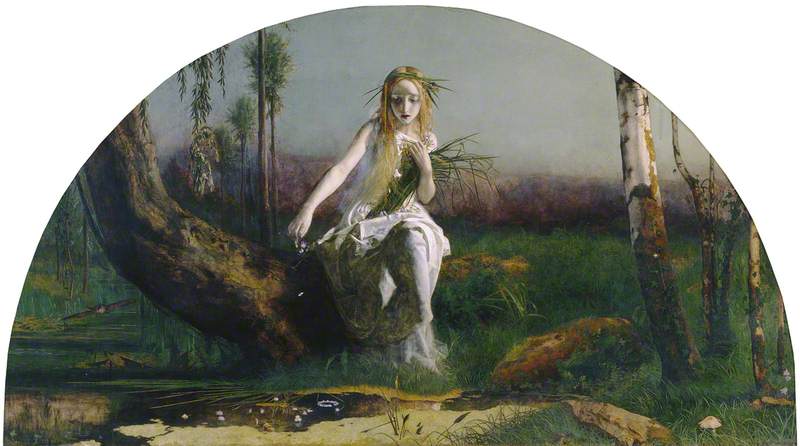
Millais, John Everett. Ophelia. 1851-2, Tate Britain, London.
- Play title: Hamlet (Ophelia’s flowers)
- Author: William Shakespeare
- Published: 1604/1605 (The Second Quarto)
- Page count: 146
Summary
Hamlet is the Prince of Denmark and son to Queen Gertrude and Old King Hamlet (deceased). Claudius, Hamlet’s uncle, has recently married Gertrude and is the new King of Denmark. The ghost of Old Hamlet appears to his son and demands that his death, now revealed as murder, be avenged. Up until now, Hamlet has been a carefree youth, occupied mainly with his studies and his romance with Ophelia. She is the daughter of a senior court advisor named Polonius. Hamlet must now endeavour to expose Claudius’s crime, and for this, he chooses to stage a play named The Murder of Gonzago (aka The Mousetrap). By recreating the scene of his father’s death, Hamlet hopes to reveal the new King’s guilt. Hamlet is helped with this task by his best friend and confidante named Horatio. In this period, Hamlet takes on an “antic disposition” (Hamlet 1.4.192), which means that he acts in a manner resembling madness. Claudius quickly senses danger and has Hamlet shipped off to England, escorted by Rosencrantz and Guildenstern. Hamlet manages to escape and returns to Denmark only to find that Ophelia went insane and died, possibly by suicide. King Claudius hatches a new plan with Laertes (Ophelia’s brother) to kill Hamlet in a rigged fencing match. All goes awry, and Gertrude, Laertes, Hamlet, and Claudius all meet their deaths. The main theme of Hamlet is indecisiveness; the prince becomes ever more entangled in his thoughts and is unable to act upon his dead father’s repeated calls for revenge.
Ophelia is a minor yet memorable character in the play. She is a dutiful daughter and a loyal sister. Hamlet falls in love with her but promptly rejects her as soon as his father’s ghost sets him a task of national importance. Ophelia soon becomes a victim of underhand court stratagems. King Claudius and Polonius employ her as bait to extract vital information from Hamlet. After her father’s death and her breakup with Hamlet, Ophelia begins to act strangely, and her behaviour is quickly interpreted as madness – “poor Ophelia / Divided from herself and her fair judgment” (Ham. 4.5.91-92). Her key scenes in the play include the occasion when she hands out assorted flowers to members of the court and Gertrude’s affecting account of her death in a nearby river.
Ways to access the text: reading/listening/watching
It is extremely easy to find the full text of Hamlet online. I would recommend The Folger Shakespeare but other sources such as Project Gutenberg or the JSTOR website are also good. JSTOR provides an introductory essay to Hamlet by Harold Bloom.
Regarding audio versions of the play, there are multiple free options on the Internet Archive – “BBC Radio presents Hamlet: BDD audio”, which stars Kenneth Branagh, or “Shakespeare Hamlet John Gielgud 1948.” Both recordings are approximately 3.5 hours long.
If you are interested in analyses of specific scenes, then The Hamlet Podcast is an invaluable resource. The scene where Ophelia hands out flowers is discussed in “Episode 126 – Alas, sweet lady, what imports this song?” Gertrude’s account of Ophelia’s death is covered in “Episode 146 – The Envious Sliver Broke.” These episodes have a running time of approximately 10 minutes each.
Film adaptations of Hamlet are too numerous and varied to be listed here. Please go to the IMDB website and read an article entitled “Unfinished: Every Version of Hamlet, Ranked Worst to Best” because this provides an excellent overview from which to make your choice.
Why read Hamlet?
Hamlet is Shakespeare’s longest play and the bane of many students’ lives! However, it is also a fascinating work. Hamlet lives in the shadow of his late father’s reputation, and his inability to avenge his father’s murder adds to his own mounting feelings of inadequacy. As an added complication, the young prince soon becomes obsessed with his mother’s sex life, and he berates her like a teenager who has just discovered that his parent is fallible. Timid Ophelia bears the brunt of Hamlet’s misogynistic anger when he coldly rejects her and acts as if all women are untrustworthy. Rosencrantz and Guildenstern make the rookie mistake of betraying their old friend Hamlet, and they consequently lose their lives. Is Hamlet a cold-blooded psychopath who manages to kill friends and foes alike (all except Claudius), or is he an overly sensitive intellectual who is grappling with an Oedipus complex? Shakespeare presents his audience with an intriguing character who is utterly impotent, suicidal, and perpetually weighed down by his thoughts; but Hamlet is also cunning, deceitful, cold, and sometimes monstrous – like when he jokes about the location of Polonius’s corpse. If the play Hamlet teaches any life lesson, then it is surely that – “one may smile and smile and be a villain” (Ham. 1.5.115). There is more villainy in the play than just Claudius’ evil deeds.
The essay that follows will deal mainly with the character of Ophelia. By approaching an individual theme or character in Hamlet, one breaks down the intimidating barriers of the work’s scope and magnitude.
Post-reading discussion/interpretation
Ophelia’s Fleurs du Mal
Introduction
Ophelia is a celebrated character from Shakespeare’s repertoire of female players. However, her instant recognisability is based on somewhat dubious foundations. She sticks in one’s mind for reasons that may be completely accidental rather than rightfully earned. After all, Hamlet is obligatory reading for most school students, so she is unavoidable in many respects. In her defence, Ophelia delivers one of Shakespeare’s many zingers when she tells Hamlet – “Rich gifts wax poor when givers prove unkind” (Ham. 3.1.111). She is also the only sympathetic female character in the play. For one reason or another, Ophelia perennially catches the imagination of the public in such a way that she has become an instant reference point for spurned love and tragic death. This essay looks at a few aspects of Ophelia’s depiction in the play Hamlet and touches upon the afterlife she has had in paintings. My chief aim is to scour existing criticism and artworks for something surprising about Ophelia, though not necessarily new, which supports her ongoing relevance.
It is challenging to see Ophelia as anything more than an appendage to Prince Hamlet’s story. The only scenes of the play where she holds centre stage, literally or figuratively, are her mad scene and the description by Queen Gertrude of her death. Linda Welshimer Wagner succinctly explains the main problem when one attempts to focus on Ophelia
“Shakespeare artfully controls our thinking of Ophelia and her plight by having no mention made of her aside from “her” scenes themselves. This is, after all, Hamlet’s play; its issues are other than those concerning Ophelia.”
(Wagner 91)
The problem becomes even more apparent if one looks at Ophelia’s death scene. J. M. Nosworthy explains that “It has often been remarked that there is a link between this speech [Gertrude’s] and the death of a Tiddington spinster, Katherine Hamlett, who was accidentally drowned in the Avon on I7th December 1579” (345). Did Shakespeare craft a description of Ophelia’s death scene based on the death of a Ms Hamlett who died in Tiddington, Stratford-Upon-Avon? This was Shakespeare’s local area, and he was a teenager at the time, so it is possible that the memory of Ms Hamlett’s death would have inspired him when writing Hamlet circa 1599. In other words, is everything really about Hamlet, or does it just seem that way? Many commentators have indeed written extensively about Ophelia, but the commentaries usually fall under one of a small selection of predictable headings. C. R. Resetarits summarises the general attitudes to Ophelia as follows.
“The attitude has too often been one of romantic, and sexist, condescension, and most studies have quickly turned to Ophelia’s flowers, madness, death, or nymphomaniac tendencies rather than trying to understand her unique character and how it might function in the play.”
(Resetarits 215)
Resetarits makes a valid point; nevertheless, one should not feel obliged to take up this challenge and discover some new facade for Ophelia. After all, what more can one extract from a character who has been so expertly hemmed in by her author? If one isolates Ophelia from the other characters, then her depiction is certainly slight and her impact limited. Resetarits writes that “Even in the more detailed studies of Ophelia, she has been consistently viewed as the least complex of the principal characters of Hamlet, the least useful” (215). Furthermore, “her actions have not been related to any forward movement of the plot, except, perhaps, inasmuch as they further incite Laertes” (215). I will explore this issue presently. Wagner proposes that “Ophelia has two primary purposes in her ingenuous role – that of providing a convenient hinge for several of Hamlet’s analytical scenes, and of providing the … emotional impact for the audience” (94). Wagner goes on to write that “Shakespeare’s chief dramatic use of Ophelia is in the evocation of pathos” (96). Martha C. Ronk views Ophelia slightly differently – “Ophelia seems to move towards the abstract or emblematic throughout as she is represented as dutiful daughter, beauty, mad woman, drown innocent” (21). If one moves away from the written text for a moment, then one finds that Ophelia has had a surprising second life in the world of art. Kaara Peterson has written about these artworks and comes to the conclusion that – “On the basis of such a large number of these paintings, one might think that she [Ophelia] does nothing else in the play but fall into a brook and drown” (8). This amusing observation underlines the fact that Ophelia is not a fully formed character in the play. Therefore, no commentator can make Ophelia more significant. In truth, it is not necessary to do so. She is defined by her relationship to Hamlet and her tragic death. However, her impact is real and with a brief analysis of a few scenes from the play, plus the role of the artworks, one finds a compelling character who deserves attention.
Ophelia’s Role
As observed by Resetarits, Ophelia is generally not seen as a contributor to the plot of Hamlet. By showing her actual relevance to the structure of the story, one begins to dismantle the idea that Ophelia is little more than a pretty adornment. This is somewhat of a technical point, so it is worth quoting M. H. Abrams’ definition of a plot to begin.
“The plot (which Aristotle termed the mythos) in a dramatic or narrative work is constituted by its events and actions, as these are rendered and ordered toward achieving particular artistic and emotional effects.”
(Abrams 224)
One does not readily think of Ophelia as a woman of action, and one presumes that an act of some kind is required to move the plot forward. Yet she begins to refuse Hamlet’s visits and letters, under the direction of her father. This action appears to precipitate a change in Hamlet for which Ophelia may blame herself. Carroll Camden summarises that “She fears that Hamlet is mad for love, and if so, he is mad for the love that she has been forbidden to give him – she is the cause of Hamlet’s madness” (248). This is the same conclusion avidly promoted by Polonius, Ophelia’s father. These events alone make Ophelia crucial to the plot since Hamlet’s spurned love is a logical and convenient explanation for his odd behaviour, which helps to hide his secret plot to kill Claudius. Furthermore, by spurning Hamlet’s love, Ophelia may have planted the seed of her own tragic downfall because he later rejects her outright, to her utter dismay. After Ophelia’s death and the grotesque squabble between Hamlet and Laertes at her funeral, Laertes is far more amenable to Claudius’s plan to kill Hamlet. Thus, Ophelia’s initial rejection of Hamlet sets the plot on a specific and quite tragic course.
Another angle to consider is that Hamlet’s madness is a strategic affectation, whereas Ophelia’s eventual madness is quite real. Therefore, she takes on the role of Hamlet’s foil in the play: “A character in a work who, by sharp contrast, serves to stress and highlight the distinctive temperament of the protagonist is termed a foil” (Abrams 225). According to Camden, “Throughout the play, indeed, the appearance of Hamlet’s pretended madness is contrasted with the reality of Ophelia’s madness” (249). Hamlet openly considers suicide in his “To be or not to be” (Ham. 3.1.55) monologue but after some agonizing moments of deep thought, he says “conscience doth make cowards” (3.1.85), which indicates that suicide is but a fleeting consideration. Hamlet lucidly contemplates the gravity of a sin like suicide plus the unknown horrors that death may hold. In contrast, Ophelia descends helplessly into madness as exhibited through her odd behaviour. She eventually drowns in unusual circumstances leading to strong suspicions that she committed suicide. The church authorities even refuse her the full rights of a Christian burial service. As the foil of the play, a key aspect of any plot, Ophelia underlines that Hamlet is a steely, determined character who does not crack under pressure.
Ophelia’s other major contribution to the plot is what Abrams calls the ‘emotional effects.’ Wagner explains that “Ophelia is created as an extremely sympathetic portrait from the first scene – a dutiful daughter sweetly counselled by Laertes, the child-like “Rose of May” symbolized by flowers throughout” (96). The character of Ophelia is crafted by Shakespeare in such a way that she induces one’s sympathetic feelings, aka pathos.
“Pathos in Greek meant the passions, or suffering, or deep feeling generally, as distinguished from ethos, a person’s overall disposition or character. In modern criticism, however, pathos is applied in a much more limited way to a scene or passage that is designed to evoke the feelings of tenderness, pity, or sympathetic sorrow from the audience.”
(Abrams 204)
Ophelia is indeed a pathetic figure and one whose vulnerability and subsequent mistreatment are expertly communicated in the text. She is ill-equipped to deal with the pressures of court and is destroyed by a series of actions taken by her father, lover, and king. It is not surprising that she is often seen as flower-like since flowers are traditionally associated with beauty, fragility, and femininity.
The Precursors to Ophelia’s Madness
Upon reading Hamlet, one is struck by the assorted characters’ obsession with finding out the cause of the young prince’s madness. Is it grief over his father’s death, disgust about his mother’s swift remarriage, or his rejection by the fair Ophelia? In contrast, Ophelia’s madness is hardly deliberated upon, and Claudius confidently professes that “this is the poison of deep grief. It springs / All from her father’s death” (Ham. 4.5.80-81). Alternatively, it could be the result of how Hamlet has treated her, which she must have interpreted as the end of their relationship. A third option is to peruse the text for something that may surprise a reader about Ophelia, which links to the many references to flowers. This last approach reveals a link between Ophelia’s sexuality and her death.
Ophelia is seen by her brother and father as a gormless maiden: a girl who will be easily tricked by Hamlet’s hollow words of love. Laertes cautions his sister Ophelia against making her “chaste treasure open /To his [Hamlet’s] unmastered importunity” (Ham.1.3.35-36). Hamlet is characterised here as an oversexed youth who will eventually beguile the young Ophelia into having sex with him. Polonius has a similar view, and he is afraid that his daughter has been paying Hamlet too much attention. When Ophelia says that Hamlet has professed his affection for her, Polonius chastises her, saying “You speak like a green girl / Unsifted in such perilous circumstance” (1.3.110-11). His advice to Ophelia is “Tender yourself more dearly / Or … you’ll tender me a fool” (1.3.116-18). This means that she should value/protect herself, or she will end up making a fool of her father by becoming pregnant. It is a caustic remark from a father to his daughter, but it brings to light a risk that was quite real given the young lovers’ numerous private meetings. Ophelia is obedient to her father’s wishes and distances herself from Hamlet from that point onwards. Subsequently, she is the one who first reports Hamlet’s ‘madness’ to her father (2.1.85-94), and she even supplies him with one of the love letters that Hamlet gave her (2.2.114-16). Polonius, always eager to please the king and queen, uses Ophelia as bait to discover Hamlet’s true affliction – “I’ll loose my daughter to him” (2.2.176). The exact nature of the young lovers’ relationship prior to these changes remains shrouded. By this point in the play, Hamlet has already been visited by the ghost of his late father and he is a transformed man. His attitude to Ophelia also transforms..
Ophelia is subjected to Hamlet’s anger, but this only happens after she attempts to return his tokens of love. He claims he gave her nothing, lied about loving her, and tells her “Get thee ⟨to⟩ a nunnery. Why wouldst thou be / a breeder of sinners? (Ham. 3.1.131-32). This last insult could mean either that Ophelia should take a vow of chastity or work in a brothel since nunnery was also slang for a brothel in Elizabethan England. Hamlet possibly knows that others are eavesdropping on this conversation (Polonius and Claudius), so he is performing for a secret audience, or he is attempting to shame Ophelia since they have likely already had sexual relations. Ophelia, a court advisor’s daughter, has rejected the Prince of Denmark, so, in any case, Hamlet is hurt, defensive and spiteful here. What better way to wound Ophelia emotionally than to refer obliquely to their most intimate moments. Hamlet insults Ophelia again when they are watching The Murder of Gonzago:
HAMLET. Lady, shall I lie in your lap?
OPHELIA. No, my lord.
HAMLET. I mean, my head upon your lap?
OPHELIA. Ay, my lord.
HAMLET. Do you think I meant country matters?
OPHELIA. I think nothing, my lord.
(Ham 3.2.119-24)
When Hamlet refers to ‘country matters,’ he is punning on the c-word in classic Elizabethan style. It is interesting to note that Hamlet’s misogynistic taunts happen just in advance of his meeting with his mother whom he berates for lying “In the rank sweat of an enseamèd bed” (Ham. 3.4.104). Hamlet’s hatred towards Ophelia and Gertrude is expressed in overtly sexualized language, and he manages to conflate their faults (in his opinion) with female sexuality. Women’s sexual appetites are put on trial here, and Hamlet evokes shame and embarrassment in his lover and mother, respectively. Hamlet views sex as something sordid, and his views serve the tarnish Ophelia’s pristine image. After these scenes, there is a prolonged timespan before we see Ophelia again, and she is lost in madness.
The Path to the Willow Tree
When Prince Hamlet is hastily dispatched to England, Ophelia’s world begins to collapse. Her lover has bluntly rejected her, even disowned his past love for her, and he has furthermore grossly insulted her before departing Denmark. Additionally, Ophelia’s father Polonius has just died and receives a rushed, low-key funeral, which is unsuited to his station in life. Ophelia is left to grieve alone since Laertes is still in France. There is abundant conjecture over the root of Hamlet’s madness, but Ophelia’s disordered mind is seen as a symptom of mourning. However, it could be the result of a combination of factors. Wagner writes that “Shakespeare evokes much response for Ophelia and her misery after the death of her father and the loss of her lover” (94). But what if one conjectures that she is pregnant too? For someone to experience a psychotic break, as Ophelia does, normally requires an extreme degree of stress. The question arises – is the loss of a manipulative, meddlesome father, and the departure of an obnoxious lover sufficient stress? The risk of Ophelia becoming pregnant has already been flagged in the text so any resistance to this conjecture comes from an audience’s fixed idea of Ophelia, namely that she is good and rule-abiding.
As previously noted, Ophelia’s madness is crucial to the plot as it is Laertes’ added motivation to make Hamlet suffer for killing Polonius. Upon seeing Ophelia lost in madness, Laertes says “By heaven, thy madness shall be paid with weight / Till our scale turn the beam!” (Ham. 4.5.180-184). If one accepts the plausible reason for Ophelia’s madness, namely stress over an unwanted pregnancy, then the story is altered, and she appears more like an independent character. One significant hint that Ophelia has been used by Hamlet comes when she sings odd, uncouth songs before the queen. One ditty is about St. Valentine’s Day and a young maid who is tricked into giving up her virginity in the belief the man will marry her – but he does not.
Then up he rose and donned his clothes
And dupped the chamber door
Let in the maid, that out a maid
Never departed more
(Ham. 4.5.57-60)
Though distressed in her madness, Ophelia’s ditty about a woman wronged may be her own story too. If Ophelia has fallen pregnant then she is alone because she is also a motherless girl in addition to having lost her father and having an absent brother. This is the kind of overwhelmingly stressful situation that could indeed bring about a mental breakdown. The second significant clue about the cause of Ophelia’s demise is contained in Queen Gertrude’s affecting speech.
There is a willow grows askant the brook
That shows his ⟨hoar⟩ leaves in the glassy stream.
(Ham. 4-7-190-208; emphasis added)
Therewith fantastic garlands did she make
Of crowflowers, nettles, daisies, and long purples,
That liberal shepherds give a grosser name,
But our cold maids do “dead men’s fingers” call
them.
There on the pendant boughs her coronet weeds
Clamb’ring to hang, an envious sliver broke,
When down her weedy trophies and herself
Fell in the weeping brook. Her clothes spread wide,
And mermaid-like awhile they bore her up,
Which time she chanted snatches of old lauds,
As one incapable of her own distress
Or like a creature native and endued
Unto that element. But long it could not be
Till that her garments, heavy with their drink,
Pulled the poor wretch from her melodious lay
To muddy death.
This highly visual description of the young woman’s death has been painted by many leading artists over the last two centuries. The typical image is one of a youthful dame surrounded by an array of brightly coloured, beautiful flowers. The reality is quite different. For instance, Karl P. Wentersdorf highlights the connection between the flowers and Ophelia’s madness – “Crow-flowers, nettles, daisies, and arums are indeed an unlikely combination of flowers for a maiden’s coronet, and this is precisely what Gertrude implies when she describes the garlands as “fantastic”’ (416). The illness in Ophelia’s mind is imprinted on the scene and the assorted flowers, even the type of tree she falls from, all have important meanings.
Ophelia falls to her death from a willow tree, which is significant since the so-called weeping willow is associated with spurned lovers and unrequited love. Martha C. Ronk explains the symbolism of the individual flowers: “The nettles are associated with pain, poison or betrayal; the daisies with forsaken love. The crow-flowers perhaps symbolize dejection; the phallic purples signal the causal association between sexuality and death” (26). This is far from being a pretty garland; it is rather a key to uncovering Ophelia’s distress. Many writers have focused on what Gertrude calls ‘long purples,’ which she mentions have a cruder name too. Wentersdorf has done extensive research to identify these flowers and he has narrowed it down to two likely options: “Orchis mascula” or “Arum maculatum” (414). For the first one, “Its English name, Fool’s Stones, could be the “grosser name”’ (414). Regarding Arum maculatum, “the most striking feature of the flower is the long purple spadix, and this feature has widely been regarded as phallic in appearance” (415). The below pictures exhibit the phallic and testicular shapes of both flowers, thus explaining their sexual suggestiveness

Orchis mascula Arum maculatu
If one now looks at Gertrude’s description with fresh eyes, then one sees an unhinged young woman who falls to her death from a weeping willow and who does not even resist death since she is too melancholy. Surrounding her are the tangle of odd weeds and phallic-looking flowers that she had been binding together into a crown for her head. The puzzle is apparently completed with information from Lucile F. Newman’s essay on the flowers that Ophelia hands out at court just prior to her death. Newman explains that Ophelia’s flowers were “Previously perceived as bearers of complex meanings, [but] her references to these herbs and flowers may be better read as a shocking enumeration of well-known abortifacients and emmenagogues” (227). Dwyer supports this reading by explaining that “modern readers may not realise that most of the plants mentioned by Ophelia were widely known and used in Elizabethan England to induce abortions and control fertility” (6). Ronk writes that “the emblematic flowers which she [Ophelia] gives away and which surround her at death signal her participation in deflowering; her snatches of song suggest fragmentation of character” (24). Thus, one has a wholly different reading of Ophelia’s circumstances; she is a young woman who has missed her period, maybe several, and now walks about holding flowers known to bring on an abortion. Most likely pregnant, or at least fearing it, she takes herself to the river and ends her life.
Newman’s article entitled “Ophelia’s Herbal” was published in 1979, so this is far from a new reading of Ophelia’s circumstances. Nonetheless, it is not the mainstream reading, so it helps to broaden Ophelia into a more substantial character in the play. By interrogating the significance of the specific types of flowers, as done by Newman, one shatters the relentless objectification of Ophelia that occurs in the play. She is no longer Laertes’s naive sister (Rose of May), but a grown woman with overwhelming problems.
The extra information does not make her any less a source of pathos in the play. Thus, the alternative reading of Ophelia does not disrupt the interpretative guard rails that Shakespeare has laid around this character. Resetarits sums up Ophelia’s role quite well as follows:
“Ophelia stood out to me, stood out singularly and solidly, as an empath – a person highly receptive to the emotions of others, who actually functions as a receptacle of those emotions. In Hamlet she functions in this capacity not only for playwright and audience but also within the play for the other characters”
(Resetarits 215)
Ophelia allows herself to be misdirected by her father because she is obedient and loyal to him. As a direct result, Hamlet shuns her and demeans her with various insults before disappearing to England. Laertes condescends to his sister by hypocritically lecturing her on vices, which he indulges with abandon himself. She makes no retorts and instead endeavours to understand each man’s advice, even the insults. This is the classic view of Ophelia as a submissive and apathetic girl who absorbs the wrongs of others. On the other hand, she could be a well-disguised risk-taker who is sexually active and vibrant – a person of action. Her death is no less tragic in either scenario. Ophelia’s true story is hidden behind what others project onto her, and that makes her an eternally problematic character.
Hughes, Arthur. Ophelia. 1852, Manchester Art Gallery, Manchester.
Ophelia in the Art World
The art world has provided Ophelia with a second life. However, the image with which one is presented is unfalteringly consistent. Kaara Peterson has made the observation that Ophelia’s “portrait has been painted with such consistency that she has become something of a visual cliché” (2). She also points out that “Ophelia is always elusive despite the fact that she is so “present” in artworks” (2). This is largely because Queen Gertrude’s verbal account of the girl’s death, rather than an actual death scene, is the basis for all the paintings. One easily forgets that Ophelia’s death is a recounted story instead of an event in the play. Ophelia is a character of great plasticity: she becomes what an artist/audience wants her to be. Similarly, in the play, Gertrude presents an account of Ophelia’s death in one way, namely a tragic accident, whereas the gravediggers speak openly of suicide. The young woman’s story is malleable enough to accommodate a few distinct interpretations. Like Resetarits observed, Ophelia is shaped by our emotional response to her, and this is part of what creates her.
Conclusion
After more than four hundred years of literary existence, it is unlikely that we will find a truly groundbreaking reinterpretation of Ophelia. What surprises one is that some twentieth-century interpretations, like Newman’s, are already there to helpfully disrupt one’s fixed ideas. As outlined in this essay, Ophelia is far more important to the plot than most commentators are willing to concede. Additionally, she may have a story of her own that is quite relevant for a modern audience – namely, that she is pregnant. This is particularly salient in the 21st century where abortion rights, which were once believed to be sacrosanct, are being reversed. Students find little of interest in perfect characters since they are utterly unrelatable figures. An advantage to viewing Ophelia as a rule breaker is that she is no longer confined to a centuries-old, now almost petrified idea of her as a dutiful, virginal, passive maiden. The flowers with which Ophelia has so long been associated; they also have conflicting messages. In countless academic essays and paintings too, the flowers have been seen as/used as prettifying props that cover over the unsettling ugliness of madness and suicide. However, maybe Ophelia was actively using her fleurs du mal to abort a baby Hamlet. The picture is no longer comfortably pretty and serene.
Works Cited
Abrams, M. H. A Glossary of Literary Terms. 7th Edition, Heinle & Heinle, 1999.
Camden, Carroll. “On Ophelia’s Madness.” Shakespeare Quarterly, vol. 15, no. 2, 1964, pp. 247–55. JSTOR, https://doi.org/10.2307/2867895.
Dwyer, John. “Garden Plants and Wildflowers in Hamlet.” Australian Garden History, vol. 24, no. 2, 2012, pp. 5–34. JSTOR, https://www.jstor.org/stable/24918848.
Newman, Lucile F. “Ophelia’s Herbal.” Economic Botany, vol. 33, no. 2, 1979, pp. 227–32. JSTOR, http://www.jstor.org/stable/4254050.
Nosworthy, J. M. “The Death of Ophelia.” Shakespeare Quarterly, vol. 15, no. 4, 1964, pp. 345–48. JSTOR, https://doi.org/10.2307/2868091.
PETERSON, KAARA. “Framing Ophelia: Representation and the Pictorial Tradition.” Mosaic: An Interdisciplinary Critical Journal, vol. 31, no. 3, 1998, pp. 1–24. JSTOR, http://www.jstor.org/stable/44029808.
Resetarits, C. R. “Ophelia’s Empathic Function.” Mississippi Review, vol. 29, no. 3, 2001, pp. 215–17. JSTOR, http://www.jstor.org/stable/20132191.
RONK, MARTHA C. “Representations of ‘Ophelia.’” Criticism, vol. 36, no. 1, 1994, pp. 21–43. JSTOR, http://www.jstor.org/stable/23116623.
Shakespeare, William. Hamlet from The Folger Shakespeare. Ed. by Dr. Barbara A. Mowat and Paul Werstine. Folger Shakespeare Library. https://folger.edu/explore/shakespeares-works/hamlet
Wagner, Linda Welshimer. “Ophelia: Shakespeare’s Pathetic Plot Device.” Shakespeare Quarterly, vol. 14, no. 1, 1963, pp. 94–97. JSTOR, https://doi.org/10.2307/2868164.
Wentersdorf, Karl P. “Hamlet: Ophelia’s Long Purples.” Shakespeare Quarterly, vol. 29, no. 3, 1978, pp. 413–17. JSTOR, https://doi.org/10.2307/2869150.
 Why Read Plays