
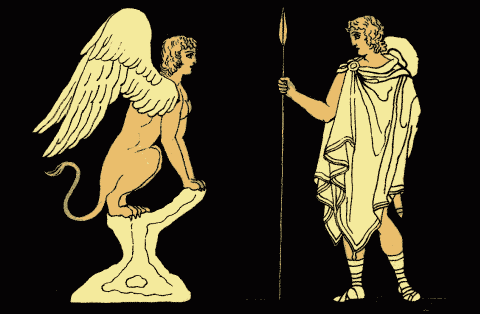
Oedipus and the Sphinx.
- Play title: Oedipus Rex or Oedipus the King.
- Author: Sophocles
- Written/first performed: around 430 BC.
- Page count: 95
Summary.
Oedipus Rex tells the ancient tale of King Oedipus of Thebes. At the beginning of the play, the city is ravaged by a strange plague. A group of citizens ask the help of their King who previously saved the city from the horrors of the Sphinx. King Oedipus, hoping to end his people’s misery, seeks the advice of the oracle in Delphi. The oracle reveals that the unsolved murder of the former king, Laius, is the true cause of the plague. The murderer must be cast out and only then will the city be returned to health. By tirelessly seeking out the original murderer, Oedipus unknowingly reveals that he is at the heart of his city’s troubles. The intricately detailed plot of the play reveals how Oedipus’ childhood in Corinth with his parents, King Polybus and Queen Merope, is connected to his new life in Thebes with Queen Jocasta, widow of the former king, Laius. The primary themes of the play are personal identity, prophecy and fate.
Ways to access the text: reading.
The text of the play is freely available online but please note that there are many different translations from the original ancient Greek. For example, on Project Gutenberg, one can find a translation in rhyming verse by Gilbert Murray under the title, “Oedipus King of Thebes.” Project Gutenberg also has a translation in blank verse by F. Storr under the title, “Oedipus the King.”
I chose an online PDF file of “Oedipus the King” translated by Robert Fagles, which is available by searching “yale.imodules.com Oedipus Rex.” This is a scanned copy of a printed text and is easy to read from the screen. None of the sources listed above have footnotes and they are not essential for reading.
Why read Oedipus Rex?
The Oedipus complex.
By using the myth of Oedipus as an example, Dr Sigmund Freud revealed a dark truth within all of us. In 1899, Sigmund Freud’s book The Interpretation of Dreams was published, and the world was introduced to the Oedipus complex. The section of the book where Freud refers to Oedipus is entitled “Dreams of the Death of Beloved Persons.” First, Freud explains that such a dream, when accompanied by distressing feelings, actually reveals our hidden wish for the person’s death! However, the wish is not necessarily a present wish and may date from the past. When such dreams concern our parents, we are most likely to dream of the death of a parent of the same sex, for example, a son dreams of his father’s death. The explanation provided by Freud links directly to the fact that a child’s sexuality begins to develop relatively early. In general, children are spoiled or indulged by the parent of the opposite sex (mommy’s little soldier), and thus the parent of the same sex becomes what Freud calls an “obnoxious rival” (316) for such affections. The parent of the same sex is the disciplinarian more often than not. In this example, the boy would wish for his father’s death. As children do not understand death, they readily wish it on those who deprive them of their desires. Whether one accepts this theory or scoffs at it, Freud asserts that it is a perfectly normal phase of childhood development.
Freud explains the continuing potency of the myth of Oedipus by this link to infantile psychology: basically, it is something that affects us all. He also compares Oedipus’ tortuous road to the truth as analogous to the process of psychoanalysis (Freud 321). In short, Oedipus enacts as an adult a wish that most of us secretly harbour as children, and therein lies the true terror of this play. This summary is relevant to the reader, despite any opinions about Freud’s theories, primarily because it enhances one’s understanding of the play. Freud’s theory will surely echo in the reader’s thoughts when Queen Jocasta says to Oedipus, “Many a man before you, in his dreams, has shared his mother’s bed.”
The domino effect.
The events that are of main concern to King Oedipus are predominantly in the past and therefore irreversible. Oedipus is like an investigator who slowly uncovers details about his own origins, and these discoveries shed quite a different light on the circumstances in which he currently lives. When one considers how each individual event seems to determine the subsequent event then the final pattern revealed is best described as the result of a domino effect. However, this makes the plot of Sophocles’ play seem simple, which it certainly is not. What is of interest to the reader is the explanation that applies to the apparent domino effect: is it fate or chance? When past events are lined up neatly and therefore have the appearance of a pattern, does this mean that a pattern truly exists? And what of Oedipus’ personal character? Surely the kind of man he is determines what he does because otherwise, he is just a puppet of the Greek gods. As Henry James once said, “What is character but the determination of incident? What is incident but the illustration of character?” (Abrams 224). What appears to be a domino effect of horrible choices and actions is the glue that holds a reader’s attention and makes the play such an absorbing read.
Post-reading discussion/interpretation.
Does Oedipus deserve such punishment?
What crimes does Oedipus knowingly commit that warrant his total destruction at the play’s end? He openly admits that “the blackest things a man can do, I have done them all.” He is referring to being his “father’s murderer” and his “mother’s husband.” Yet, he committed these outrages against his parents without any knowledge that they were in fact his parents. Additionally, while murder is obviously a crime regardless of the biological relationship of the parties involved, the killing of King Laius is complicated because it begins as a roadside scuffle that tragically escalates.
To understand the situation clearly, it is best to begin by scrutinizingthe four separate prophecies listed in the play. These prophecies outline the taboo acts, indeed criminal acts, that Oedipus carries out. First, Creon is sent to the oracle to discover the cause of the Theban plague, and Apollo’s response is that old King Laius’ killer has not yet been brought to justice. Secondly, Tiresias (the seer) is asked to assist, and he astonishes Oedipus by saying, “You are the murderer you hunt.” Thirdly, Queen Jocasta reveals to Oedipus what the oracle once prophesied for King Laius: “doom would strike him down at the hands of a son.” Finally, there is the prediction that the oracle revealed to the youthful Oedipus that caused him to flee his home in Corinth: “You are fated to couple with your mother [and] kill your father.” However, if one considers these events from Oedipus’ perspective then the following points are all true: King Laius had been killed long before Oedipus ever came to Thebes; Tiresias’ visions seem like nothing more than naked treachery to Oedipus; Jocasta’s example of the prophecy about Laius is given as evidence that such prophecies are actually unreliable; and lastly, Oedipus intentionally fled his homeland because he wished to spare his parents, King Polybus and Queen Merope. Of course, this is the saga from Oedipus’ unique perspective and not that of an audience who knows the truth. Nonetheless, it is important to emphasise that all of Oedipus’ actions were carried out in ignorance of the true facts.
How is one to legitimately allocate blame? Apart from Oedipus’ own retrospective feelings of shame, what separate, objective criteria may one use to accuse him? There are certain actions taken by Oedipus during his life that may explain how he has displeased the gods and earned their punishments. The Greek gods were notoriously capricious, fickle and unjust. However, condemning a man to realize his faults only in the aftermath rests uneasily with any reader. One must search a little deeper for answers. Oedipus’ most apparent transgression is his hubris, which presents a direct challenge to the authority of the gods. When the distressed Theban citizens seek salvation from the plague, Oedipus confidently says, “You pray to the gods? Let me grant your prayers.” This statement creates a binary split between Oedipus’ power and the separate power of the gods and implies they are equal. Oedipus’ reign as king is preceded by that of King Laius and followed by the reign of King Creon; these other kings pay respect to the oracle and heed the advice of the gods. Laius and Creon work in tandem with the otherworldly powers, not in opposition to them. In stark contrast, Oedipus seeks to openly discredit the oracle’s messages, which are guidance directly from Apollo. Then there is the separate issue of Oedipus’ rage. When he met King Laius and the royal entourage on the road, one man tried to shoulder Oedipus aside with the result that Oedipus “killed them all – every mother’s son!” Oedipus’ volcanic temper is exposed on two further occasions. First, Oedipus condemns Creon to death based on the belief that he is a traitor, despite having no evidence to support the accusation. Second, Oedipus bursts into Queen Jocasta’s bed chamber while wielding a sword, presumably intent on murdering her, after finding out the truth of their biological tie. Regicide evidently offends the gods since the plague is the result of Laius’ unsolved murder, yet Oedipus continues to show utter disregard for the royal family including Creon, a former (and future) king, and Queen Jocasta. On the other hand, the precise reason the gods punish Oedipus is never stated. Regarding Oedipus’ fate, Tiresias says that “Apollo … will take some pains to work this out.” In the end, Oedipus echoes this prophecy when he says that Apollo – “ordained my agonies.”
Many commentators have asserted that Oedipus’ downfall is sealed by the murder of King Laius at the crossroads, a location symbolic of making a conscious choice. From this perspective, Oedipus’ actions have unavoidable and justified consequences. This interpretation neatly explains the plague sent by the gods and certainly offers one of the most logical standpoints. There is also a frequently made argument that by sending Creon to the oracle, Oedipus begins to unravel his own past, which leads to his eventual downfall. At the story’s core, it is Oedipus’ knowledge of what he has done, most especially due to his blood ties to Laius and Jocasta, that destroys his life: a life that would otherwise be deemed noble. When the final revelation comes, Oedipus says “Oh god, all come true, all burst to light.” Despite the appealing neatness of this interpretation, there is still another tantalizing explanation as to why Oedipus must suffer, and it is an explanation that covers several generations of the family and not just Oedipus. That explanation is a curse.
If one accepts a curse as an explanation, then the most salient question is who is cursed? Surely, King Laius is cursed as he is to be murdered at the hands of his own son, and Oedipus is then merely the implement rather than the true victim. The first of the four prophecies in real-time, as opposed to the order of revelation within the plot, is when the oracle told King Laius that his own son would murder him. The most probable explanation for Laius being cursed comes from Greek mythology but is absent from the text of Oedipus Rex. The myth is that King Laius kidnapped and raped a young man named Chrysippus, son of the King of Pisa (Gantz 488-492). Then Chrysippus, out of shame for what had happened to him, committed suicide. As a consequence of his defilement of a youth, Laius may have broughta curse from the gods upon his own house. Oedipus is the 2nd generation cursed; he is destined to commit the notorious murder of his own father. Oedipus also unwittingly curses himself when promising to catch Laius’ killer, saying, “My curse on the murderer … let that man drag out his life in agony.” Tiresias instinctively identifies Oedipus as a harbinger of evil, saying, “You are the curse, the corruption of the land!” It is interesting that when Oedipus begins to suspect that he is the much-sought-after killer of Laius, he says, “I think I’ve just called down a dreadful curse upon myself.” This statement reveals that the curse has different effects upon the various people involved. Laius’s cursed destiny was to be murdered, but for Oedipus, the curse is to have taboo information revealed, which leads to his self-annihilation. One could also reasonably argue that the gods keep the curse alive by linking the city’s new plague to Laius’ murder because this reopens the investigation of an old crime. The 3rd and final generation to be burdened with this curse is Oedipus’ two daughters, Antigone and Ismene. Oedipus predicts that the girls are doomed to remain unmarried and childless since no one will dare “shoulder the curse” that weighs upon their family. By focusing on the curse, one becomes more sympathetic to Oedipus. One sees him as a victim of something far greater than he is. The curse is a cruel punishment from the gods that takes three generations to run its full course.
In conclusion, it seems impossible to say that Oedipus deserves the punishment he experiences. This is doubtless part of Sophocles’ plan so that the audience will invariably have a strong emotional response to the events depicted. Luckily, the play can support many re-readings and variously nuanced interpretations.
Captain of the ship.
Sophocles introduces the image of a ship in the opening scene of the play. This occurs when one of the priests, who is pleading for Oedipus’ guidance, describes the condition of their city as follows, “our ship pitches wildly, cannot lift her head / from the depths, the red waves of death … / Thebes is dying.” While it is certainly a striking metaphor, the city compared to a ship in a storm, it also seems a strange mismatch because Thebes is an inland city, not a seaport, and therefore these are not seafaring people. Yes, the “red waves of death” are apt for describing a deadly plague, but what if one further interrogates the metaphor? Is it a good and fitting comparison to describe Oedipus as the captain of a ship? The short answer is no for two distinct reasons. First, Oedipus is renowned for his intellect as displayed in his defeat of the Sphinx when he solved the riddle. His leadership is not linked to sea conquests, which would be a learned skill rather than an intellectual gift. Secondly, when Oedipus debates with Tiresias, the blind seer, it is Oedipus himself who is said to be truly blind, “blind to the corruption of [his] life,” and a leader described as blind is evidently not a suitable ship’s captain. Nonetheless, this description of Oedipus captaining his ship to a safe harbour recurs in the play and for good reason. The image is rich in connotations: from strangers in strange lands to homecomings and safety. It reminds one that Oedipus was far away and has finally returned home, but the irony is that he does not know it. In ancient Greece, a cursed person was considered to carry a form of contagion. The safe harbour of home has become polluted precisely because the ship’s captain does not know he is home. The city is ill due to the pollution brought about by the arrival of the cursed individual, Oedipus. When Oedipus urges his citizens to expose the former king’s killer, he also uses a nautical metaphor, “drive the corruption from the land, don’t harbor it any longer.” Therefore, the use of the ship metaphor turns out to be appropriate because it links the plague to the returning traveller.
Indeed, there are many facets to the metaphor used by Sophocles. A comparison that initially appears a mismatch is ultimately very appropriate to describe Oedipus’ dilemma. One key aspect of the story that the metaphor encapsulates is the ambiguous identity of Oedipus who is both stranger and native son simultaneously. It is this dichotomy that leads to the eventual re-interpretation of Oedipus’ sexual relations with Queen Jocasta. When Tiresias is denouncing Oedipus, he says Oedipus’ marriage was indeed, “the lusty voyage home to the fatal harbor!” This reminds one of Dr Freud because the welcoming arms of a loving mother for her child are transformed into something quite perverse – the sexually charged embrace between a mother and her adult son. Whether the ship returns to a fatal or safe harbour relies on our understanding of Oedipus’ double identity, son or stranger. He is neither one thing nor the other but has an unnatural, in-between identity. The Chorus make the point about sexual impropriety even more explicitly, singing, “the same wide harbor served you, son and father both, son and father came to rest in the same bridal chamber.” When Queen Jocasta realizes the true identity of Oedipus, she also uses a nautical reference in her coded warning to him, “You’re doomed – may you never fathom who you are!” Just as in Dr Freud’s process of psychoanalysis, a patient must plumb the depths to fathom who they truly are. Oedipus’ voyage of discovery is widely accepted to be a discovery of his own identity.
Yet, the metaphor is still not fully exhausted by the previously noted references to contagion and Oedipus’ double identity of native and stranger. When Oedipus has been ruined by the fate ordained on him by the gods and by his own resulting self-disfigurement, Sophocles uses the image of the ship once again to give expression to the psychological state of the play’s tragic hero. Blind now, Oedipus feels like his ship is sinking.
“Dark, horror of darkness
my darkness, drowning, swirling around me
crashing wave on wave – unspeakable, irresistible
headwind, fatal harbor.”
(Sophocles 1450-1453)
He fears re-meeting his biological mother and father in the Underworld – “How could I look my father in the eyes / when I go down to death.” The image of a sinking ship captures the psychological hell that Oedipus is currently experiencing. The final destination of Hell is home to the two figures he fears above all others: his biological parents.
Sophocles’ opening image of the ship is eloquently sustained right through the work. The playwright has managed to wring from a single metaphor a host of meanings that help to explain, elaborately and poetically, the plight of King Oedipus’ city, his dual identity as a stranger and native son, his incestuous relationship with his mother, and his final psychological state. The image of a lone hero captaining his ship home has rarely held such a rich cargo of meanings.
Works Cited
Abrams, M. H. A Glossary of Literary Terms. Earl McPeek, 1999.
Freud, Sigmund. The Interpretation of Dreams. Translated by James Strachey, Basic Books, 2010.
Gantz, Timothy. Early Greek Myth: A Guide to Literary and Artistic Sources. The Johns Hopkins University Press, 1993.
Sophocles. The Three Theban Plays: Antigone, Oedipus the King, Oedipus at Colonus. Translated by Robert Fagles, Penguin Classics, 1984.
 Why Read Plays