Machinal

  • Play title: Machinal     
  • Author: Sophie Treadwell  
  • Published: 1928  
  • Page count: 83 

Summary

Machinal is a play by American writer Sophie Treadwell. It is largely based on the trial and execution of murderess Ruth Snyder who was the first woman to be sentenced to death by electrocution in New York State. Treadwell’s work is not divided into acts like traditional plays but is told instead in nine episodes. Each episode shows how the central character of Helen Jones, simply referred to as Young Woman, struggles with the progressively challenging and ever-changing roles that society imposes upon her. Treadwell’s own words from the play’s introduction offer the best summation of the story: “The plot is the story of a woman who murders her husband – an ordinary young woman, any woman.” The protagonist, Helen, is a sensitive, anxious woman who grapples with life until she finally commits a horrible crime. A defining feature of the work is Treadwell’s use of expressionist techniques. For instance, there are onstage and offstage sounds of various machines ranging from office equipment to riveting tools on a construction site. Treadwell explained the title Machinal as “machine like,” and it may also be rendered as mechanical or automatic.   

Ways to access the text: reading  

The text of this play is not difficult to source for free online. For example, the webpage ciaranhinds.eu/pdf/machinal.pdf has a scanned copy of the play.  

Advice to readers – the first episode of the play is 12 pages long and not particularly reader-friendly due to short exchanges of highly repetitive dialogue, but this occurs only in the first episode. A persevering reader will later appreciate why the playwright uses this artistic effect to begin the work. The rest of the play is indeed reader friendly.   

To my knowledge, there is no audiobook version of the text.   

Why read Machinal? 

Reasons to Murder One’s husband  

It is not a spoiler to reveal that the play’s female protagonist murders her husband. Even if a reader skips the play’s introductory notes, it can easily be guessed from the parallel with Ruth Snyder’s story. The pressing question is why the character of Helen Jones murders her husband. Treadwell presents Mr George H. Jones as a successful businessman who provides his wife with a lovely home and even financially supports her elderly mother. Mr Jones is not depicted as having any of the stereotypical flaws that would account for a wife’s revenge; he is not a drunk, a wife-beater, or an adulterer. The one thing that truly disgusts Helen Jones is her husband’s “fat hands,” but this is surely no justification for murder! Treadwell’s depiction of Mr Jones is captivating as he is, in many respects, a nobody. Yet his murder is the pivotal point of Helen’s life. If the playwright depicts a responsible, benign husband, then surely the motive for murder rests elsewhere. The presence of a motive that is not linked to the victim, but may be found elsewhere, is the abiding message of this play. Will a reader discover that Helen is a monstrously selfish and cold-blooded killer like the media depiction of Ruth Snyder, or perhaps there is some broader societal problem that drives Helen to her crime?  

9 Defining Episodes  

Treadwell presents an audience with nine individual, self-contained scenes to communicate the play’s full story. In the playwright’s own words, “The plan is to tell this story by showing the different phases of life that the woman comes in contact with, and in none of which she finds any place, any peace.” The phases of Helen’s life that Treadwell is referring to include both the normal and the unusual. Helen is a single working woman, daughter, wife, mother, adulteress, lover, obedient wife, defendant, and condemned woman. The striking element of Treadwell’s words is that Helen never has a sense of place or peace. She is always somehow alienated or at least feels alienated from the first four phases/roles that most women would experience in life (listed above). One may also focus on Treadwell’s decision to use “episode” to name the scenes. For instance, a woman ‘having an episode’ has the connotation of someone acting out or misbehaving: often because of feeling overwhelmed. Indeed, in all nine episodes of the play, Helen never conforms to societal expectations and often displays high levels of anxiety. Therefore, one may interpret each episode as an encapsulation of specific challenges in that life-stage role, for example, the role of a daughter in “At Home.” In this way, one comes to understand why Helen reaches the emotional crisis that she does at the play’s conclusion.   

Post-reading discussion/interpretation  

Expressionism.  

Machinal is a much-lauded example of expressionist drama. M. H. Abrams describes how “The expressionistic artist or writer undertakes to express a personal vision – of human life and human society. This is done by exaggerating and distorting what, according to the norms of artistic realism, are objective features of the world, and by embodying violent extremes of mood and feeling.” As an impressionistic style is therefore quite distinctive, it is worth analysing how it may contribute to a reader’s better understanding of a playwright’s chosen topics. It is noteworthy that expressionism does not have prescriptive rules, and this is also evident in Treadwell’s play. She addresses the true-life story of Ruth Snyder, which suggests a realistic approach that expressionistic artists generally rejected. However, there are other topics that Treadwell addresses in an attention-grabbing, expressionistic style, namely, an ever more modernized, technological society and the role of women within that society. One may view the Snyder story as a necessary anchor to the real world in a predominantly expressionistic play. Indeed, Treadwell prepares the reader for a decidedly subjective depiction of the world in the introduction when she describes her main character as “essentially soft, tender and the life around her is essentially hard, mechanized.” As a result, one witnesses a protagonist who experiences great difficulty manoeuvring the normal phases of life because she views these phases as “mechanical, nerve nagging.” This essay will explore Treadwell’s impactful, impressionistic style and how it serves to communicate the life experiences of Helen. To determine which aspects of the play deserve special focus, one may follow a guiding quote by Abrams: “Expressionist dramatists tended to represent anonymous human types instead of individualized characters, to replace plot by episodic renderings of intense and rapidly oscillating states, [and] often to fragment the dialogue into exclamatory and seemingly incoherent sentences or phrases.” As such, characterization, emotional states, and dialogue are key factors for understanding an expressionistic drama. 

The play opens with “Episode One – To Business” and this is arguably the most impactful scene due to its impressionistic style. Regarding characterization, Treadwell gives the office staff no names, so they are identified only by their tasks such as “adding clerk” and “stenographer.” This technique renders the scene universal: it becomes the typical office environment. Yet the playwright chooses to distinguish two characters; the boss retains his proper name of Jones, and Helen is alternately called “young woman” and “Miss. A.” In this way, Treadwell immediately establishes a hierarchy of importance. There are mere staff who remain anonymous workers, then a woman identified by her youth and sex, and finally the boss Jones at the apex of power.  

When one begins to consider the emotional states of the characters, then Helen becomes the obvious focus. Helen’s thoughts are vividly expressed at the end of the first scene via a stream-of-consciousness technique that employs a distinctive telegraphic style: individual words, part sentences, and names – all separated by dashes. This initial scene’s closing monologue of thoughts expresses Helen’s intense doubts about marriage. She craves freedom from the office and her mother too; however, thoughts of marriage trigger her feelings of disgust towards Jones. Her words “something – somebody” will be repeated throughout the play at crucial moments to express her desperate search.  

The third distinctive feature of expressionistic drama is the style of dialogue. In the first scene, the dialogue is staccato and highly repetitive. The key repetitions range from the obsequious “good morning,” which is said to Mr Jones, to the accusatory “you’re late” said to Helen, which is followed by the staff’s chanted, expectant cries for her to provide an “excuse.” As Helen is Mr Jones’s object of desire, she has inadvertently raised her head above the parapet and is now open to criticism. When one inspects the content of the dialogue, it is a tangled mix of mundane office talk and gossip about Miss. A. (Helen) possibly marrying Jones. For example, the filing clerk asks, “What’s the matter with Q?”, which refers to a filing task but covertly refers to Jones’s possible marriage proposal to Helen. The staff responses highlight the secret meaning of the problem of Q: “Has it personality? … has it halitosis? … has it got it?” Similarly, the adding clerk guesses Jones’s income aloud, and the stenographer types a business letter while considering the possible marriage: “Will she have him? This agreement entered into – party of the first part.” The jumbled dialogue alerts a reader to the only topic of interest in the office – will the boss marry Helen? The dialogue also alerts a reader to how business and romance are being melded together unnaturally. In the first scene, Treadwell already manages to distance Helen from the others and shows her story’s importance.   

The special value of the impressionistic technique used by Treadwell links to the oppressive, sombre tone of the scene. By anonymizing the office staff, the playwright depicts practically every office environment imaginable. The workers are akin to worker bees. For instance, the stenographer is the epitome of a conscientious employee because she is punctual and productive; however, she is described as a “faded, efficient woman office worker. Drying, dried.” The description denotes a wasted life. The office sounds, as per the stage directions, are bells, buzzers, and typewriters – all metallic, mechanical sounds that fall harshly upon the human ear. Thus, the environment is unnatural and even soul-destroying. The only topic of conversation, apart from office duties, is Helen. She is the sole person who may eventually escape office life – and forever have “breakfast in bed” if she marries Jones. The repetitive nature of the conversation, like the background machine noises, gives the impression of a grey, unimaginative office environment in every respect. However, Helen is somehow different. The adding clerk says, “She doesn’t belong in an office” and that “she’s artistic.” Treadwell grants Helen a semi-identity as “Miss. A.”/“young woman,” but such titles also highlight a dilemma. Helen is only special because of Jones’s romantic interest in her. Treadwell counters this classification. She draws attention to Helen’s emerging personal identity while also expertly capturing the emotional state of the young woman. The playwright achieves this by showing Helen take two important actions: first, Helen steps out of the crowded subway carriage, and then later in the office, she flinches when Mr Jones touches her shoulder. As such, she symbolically steps out of the unthinking melee of modern society and pardons herself from the rat race. This refers not only to the nameless thousands in subway carriages on their way to work daily, but also, all the “young, cheap and amorous” women like the “telephone girl” who would readily marry a boss like Jones to get ahead in the world. Helen stands apart from the masses. Helen’s closing thoughts succinctly convey her anxiety about wanting to gain freedom from the drudge of office life; yet she has only one escape route, namely marriage to George H. Jones. Her angst-ridden message delivered in the efficient, telegraphic-style text reflects how her life is inescapably shaped by the technology of the era and the men in charge. In some respects, Helen’s escape seems quite illusory. Treadwell’s strategy is to win over the reader as an ally of Helen’s by artistically presenting the world that the young woman inhabits. The chief characteristic of the tone of the first scene is that it communicates how the world feels to Helen. Even though she tries to be herself and unique, she is trapped. The first crucial episode of Helen’s story presents her in a sympathetic light and wins over an audience.

In all, Machinal addresses three distinct yet frequently overlapping topics: a real-life murder case, the modern world, and feminism. The verisimilitude of the drama is most evident in the fact that Ruth Snyder was indeed tried and convicted of murder in New York in 1927. For this reason, it is unnecessary to outline in detail the overall facts of Snyder’s case. The only exception will be major alterations to the story made by Treadwell. The two other key aspects of the story, namely the modern world and feminism, are dependent on the techniques of expressionistic art to gain true communicative force in the drama. The opening scene is exemplary of impressionistic techniques, but the play has nine episodes in total, so it is necessary to provide a broader overview.  

Treadwell named her drama Machinal, which means “machine like,” and this refers to her view of modern life. One prominent expressionistic feature of the work is that the playwright relies heavily on sound to communicate the oppressive, emotionally draining reality of the modern world. When considering the play’s sounds, one must first differentiate those that are consoling to Helen from the other stressful, cacophonous sounds. For example, Helen welcomes the sound of the Negro spiritual song when she is in her prison room.  She says, “I understand him. He is condemned.” She is also pleased by the sound of “Cielito Lindo” (Little Heaven) played on a hand organ, which she hears with her lover Dick Roe. Helen also remembers hearing the sound of the sea as a child when she held a “pink sea shell” to her ear. Treadwell demonstrates via these pleasant, consoling sounds that Helen can indeed experience true calm. This serves to undermine any impression that Helen is “crazy” as her mother labels her or “neurotic” like her doctor says. In particular scenes, the soundscape is crucial to effectively convey Helen’s intense negative feelings. In “Episode Two – At Home,” Helen tries to ask her mother’s advice on marriage, but the scene is characterized by noisy interruptions of all kinds. A multitude of aural stimuli are concurrently active: the radio, neighbours’ voices, the buzzer, her mother’s nagging/complaining and the clatter of dishes. Helen’s tension is first apparent when the garbage man buzzes, and she jumps up from the table (like every night) prompting her mother to chide – “you act like you’re crazy.” In this scene, Treadwell meticulously intertwines the overheard neighbours’ conversations with Helen’s questions to her mother. The neighbours talking points are various: parental control – teenage lovers’ trysts – a husband who does not account for his nights out – a husband’s kiss that is a prelude to unwanted sex. Thus, Helen’s own story, her past, and her foreshadowed future come in echoes through an open window while her mother sits dumbly opposite her, unable to answer the most basic of questions. The neighbours’ overheard conversations are the acoustic detritus of daily life, yet they contain essential common knowledge. Helen’s frustration builds due to her mother’s silence about these everyday issues. A wall of sound frays her nerves while her questions are met with stony silence. 

In “Episode Five – Maternal” the sound of a riveting machine grates on Helen’s nerves. The explanation for the sound is that a new hospital wing is being built. The result will be the “biggest Maternity Hospital in the world” with the obvious connotation of a baby production line. A doctor orders Helen’s nurse to “put the child to breast” while Helen shouts “no,” and the riveting machine sounds in the background. The analogy is that a mother who fails to bond with her child will have it forcibly fixed to her breast just like someone may rivet two pieces of metal together. There is a suggestion that Helen is suffering from postnatal depression, so the analogy of mechanical bonding gives full expression to the doctor’s cruelty. The communicative effectiveness of the scene relies on the odd sound effect. To conclude this brief analysis of Treadwell’s critique of modern, mechanical life by using sounds, one may look to episodes eight and nine: “The Law” and “A Machine.” In the courtroom, Helen’s personal story is slowly being appropriated by journalists and this is communicated by the incessant “clicking of telegraph instruments offstage.” In the final scene, the convicted woman’s speech is cut short on no less than two occasions. Initially, she tries to impart a message to her own daughter, saying “Tell her –,” but she cannot finish as “it’s time” (execution time). Finally, as Helen sits in the electric chair awaiting the moment of death, she tries to speak but cannot finish: “Somebody! Somebod-.” The gradual depletion of Helen’s power of self-expression is first paralleled by the burst of activity from journalists and their telegraphic messages. The electric chair itself is the ultimate machine of the modern world and it shows how Helen may be totally and instantaneously silenced.   

One may classify Machinal as a feminist work due to Treadwell’s apparent sympathy for the female protagonist in various life phases/roles: daughter, wife, mother, and finally condemned woman. Treadwell makes clear that women’s choices in 1920s America were highly restricted. Helen’s despairing plea for “something – somebody” at the close of episode one is never answered, as proven by her last word, “somebod-.” While Treadwell uses sound to great effect to communicate an oppressive, dehumanized, technological force, the main tool used to communicate Helen’s predicament is simply language. Impressionistic dialogue is stylistically fragmented and frequently incoherent. Yet it is not the typography that holds the key but how it reflects the failures of communication in any given scene. One needs to look at more than Helen’s fragmented sentences and her telegraphic style of delivery; there is also irremediable miscommunication between the sexes and between different generations too. In short, Helen’s language fails but not in the conventional sense. The first major example is Helen’s crucial discussion with her mother about marriage. Helen’s full question may be broken down into three segments.   

“All women get married, don’t they?”  

“Oh Ma, tell me! … About all that – love!” 

“Your skin oughtn’t to curl – ought it – when he just comes near you”?  

These questions are somewhat pitiful as they expose Helen’s lack of experience and her resulting vulnerability. Helen’s mother has already decided that marriage is the best option for Helen. The older woman is prejudiced on account of Jones’ position as company Vice-President, and his agreement to financially support his future bride’s ageing mother. While Helen flails about trying to express her thoughts, in quite an emotional state, her questions are still surprisingly clear, for example: “When he puts a hand on me, my blood turns cold. But your blood oughtn’t to run cold, ought it?” Nonetheless, Helen’s mother treats her daughter’s pleas for advice as if they were truly incoherent, illogical and crazy. The responses that Helen receives display the older woman’s obstinate unwillingness to assist in any way: “Tell you what? … Do you what? … See what? The mother has already concluded that a company Vice-President must be a “decent” man and that love does not “pay the bills.” Treadwell highlights that the women are separated by both a generation gap and their colliding world views. Helen has open-heartedly explained her anxieties, but her mother replies with, “nonsense … you’re crazy.” Helen’s frustration at her mother increases exponentially and leads to an emotional outburst – “Ma – if you tell me that again I’ll kill you! I’ll kill you!” This is a defining moment in the play as Treadwell depicts the explosive anger that may emerge from a sense of powerlessness. Plain, normal language has somehow failed Helen. The kernel of the problem is the apparent contrast between a young woman’s expectations of life versus the practical, decidedly anti-feminist views of an older woman. The scene may also be interpreted as a foreshadowing of Helen’s eventual crime of murder. Treadwell’s message is that Helen who is just “an ordinary young woman” faces immense challenges due primarily to the position of women in society. Helen’s language fails because women have no real power in society. The implicit feminist warning is that Helen is an ‘Everywoman,’ and therefore, any woman could end up in the same position.   

The specific failures of language between the sexes are depicted in multiple scenes. “Episode Three – Honeymoon” is an unusual example because Helen says “no” a considerable number of times but never to the question that one anticipates hearing. For instance, when she is undressing in the bathroom and her husband says that he is coming in, she replies, “No! Please! Please don’t.” Mr Jones goes on to declare, “I’m your husband, you know,” and this implies specific marital rights, and therefore, certain requests are deemed redundant within a marriage. As such, Helen’s multiple responses of “no” are in vain since her husband will never ask permission for what he now sees as a right, namely conjugal rights to sexual relations. Helen starts to weep and cries out plaintively for her mother. She realises her powerlessness. Later, when Helen states her daughter’s age in court as being, “she’s five – past five,” then in the context of a six-year marriage it seems the child was conceived on their honeymoon. The honeymoon scene requires a reader to comprehend the failure of language as going beyond the mere spoken word because Helen’s obvious signs of distress and anxiety are also readable.  

Treadwell depicts a more overt example of miscommunication in the hospital. When the nurse makes a note on Mrs Jones’s medical chart that the patient was “gagging,” then the doctor interprets it quite literally, “gagging – you mean nausea.” But the nurse’s ensuing attempt to explain is rejected. The gagging was Helen’s anxious response to her husband’s visit – a strong emotional reaction, which is later given full expression in Helen’s thoughts about the breeding dog Vixen. Helen thinks her lot in life is no better than that of a breeding dog since she was impregnated with a child she did not want. At the close of the scene, Helen says, “I’ll not submit any more” and this apparently refers to non-consensual sex. Treadwell puts the onus on her audience to look at each of these scenes with a more intuitive and less literal eye. Take for instance the use of irony in “Episode Seven – Domestic” when Mr. Jones reads aloud a serious newspaper article to his wife, quoting, “All men are born free and entitled to the pursuit of happiness.” The meaning of the quote in the context of the play is excruciatingly literal: men and only men have freedom. In contrast, Helen’s reality is reflected in the tabloid headlines that she silently reads to herself, “girl turns on gas … woman leaves all for love … young wife disappears,” and these are the solutions she envisages. Finally, in the male environment of the courtroom (a male judge and all-male jury), language is also distorted as it begins to conform to legal requirements. One illustration is that a six-year marriage without a quarrel is unquestionable evidence of a “happy marriage.” In all, Treadwell displays how language fails due to the selfish concerns of an obstinate interlocuter (Helen’s mother), due to an obtusely literal interpretation of a patient’s symptoms (Helen’s doctor), due to an old-fashioned and legally defined environment (marriage). In the final scene, Helen’s speech is fragmented and left unfinished because she is executed.   

Treadwell achieves remarkable success by taking as her topic the media sensation that was the trial and execution of Ruth Snyder and then presenting the story in an expressionistic drama. The playwright takes advantage of the notoriety of the murder as a hook to catch the public’s attention before bringing them on a new journey as she retells the story. As explored, the specific style of expressionism elevates Treadwell’s work, especially as it relates to characterization, emotional states, and dialogue. The playwright manages to communicate uniquely by placing before the audience a vivid impression of how Helen sees the world.  

Sympathy for a Murderess 

Treadwell’s play challenges a reader to have sympathy for the character of Helen Jones. The playwright effectively reframes the Snyder story and presents it to an audience who must adjudicate anew on the crime. While one may indeed sympathize with Helen’s plight, the rhetorical force of the presentation asks that one accept, maybe just tentatively, Helen’s motive for murdering her husband and this aspect of the play bears further discussion. The public came to know the real-life murderer Ruth Snyder only through the intense media attention on the court proceedings. Treadwell elaborately depicts Helen through all her most important life phases thus creating a comprehensive background story. The playwright controls the narrative and as Abrams writes, “the expressionist artist or writer undertakes to express a personal vision – usually a troubled or tensely emotional vision – of human life and human society.” As such, the character of Helen serves a communicative purpose and that is to disseminate Treadwell’s particular perspective on the real-life murder case. In the play, Treadwell depicts how the media take over Helen’s story once it becomes public (as happened to Snyder), and therefore, the playwright is regaining control of the narrative in Machinal. This new presentation of the story means each reader must decide if Helen’s punishment is deserved or unfair.   

It is a salient point that Helen is depicted as having no power over her own story or her direction in life. In the first scene, we are told that Helen’s “machine’s out of order,” and because she is a stenographer, this means her typewriter. Treadwell, who was a journalist herself, would have understood the immense power of the typewriter for a woman. It is the machine that allows one to author one’s own story. Yet Helen only takes down letters dictated by Jones. Helen’s lack of control over her own narrative is most evident during the court case when her defence lawyer defines her as “a devoted daughter, gentlemen of the jury! As well as a devoted wife and a devoted mother!” Although a strong defence strategy, it precludes Helen from ever admitting to an unhappy marriage. The definition not only misrepresents Helen’s life but crucially removes any burden of fault from her late husband and forces one to seek a motive elsewhere. In this example, Helen’s trajectory is determined by her lawyer, but this has been Helen’s plight all along. She has constantly sought “something – somebody” to save her. Helen is eternally seeking a saviour, which indicates her own perceived or indeed actual powerlessness. In an interesting twist, Treadwell depicts Helen as the dupe in the single scene where she appears to gain her freedom, namely, “Episode Five – Prohibited.” What is enlightening about this scene, besides the fact that Helen meets her future lover Richard Roe, is that each of the four men depicted in this scene manipulates another person. (1) A married man named Harry Smith arranges to have sex with the telephone girl. (2) The “middle-aged fairy” seduces a boy. (3) A man convinces his girlfriend to have an abortion. (4) Roe seduces Helen using the cliched line about her being “an angel.” The remark that the gay man makes – “Poe was a lover of amontillado” – is not just about a favourite drink; it is also an allusion to Edgar Allan Poe’s story “The Cask of Amontillado” where a man entombs his friend in a cellar and leaves him to die. Treadwell’s scene “Prohibited” is a masterclass in the entrapment techniques that men use, and this scene highlights the true motive for murder in the play.   

Helen’s motive for murdering her husband is certainly the conundrum of the play, and depending on how one interprets the text, the resulting answer may be different. Deciphering the true motive has an enormous impact on one’s sympathy or lack thereof for Helen. There are two main avenues of possible speculation. Helen’s motive is either her affair with Roe, the motive accepted as true in court, or one may look instead to her marital circumstances. Treadwell favours the latter in a sympathetic depiction of Helen.   

If life itself feels mechanical to Helen, then the ominous clicking shut of the mechanism, the ultimate entrapment, may indeed be marriage. Like a business deal, marriage is a legal contract. Helen makes two major mistakes upon entering a marriage with Jones. First, as she tells her mother, “I don’t love him,” and second, she does not know if her disgust toward him will fade away, “You don’t get over that, do you – ever, do you, or do you?” The subsequent challenges of Helen’s marriage are not stated outright. However, marital rape is strongly inferred by her “helpless, animal terror” on her honeymoon night and by the fact that she later bears Jones’s child. Any mention of marital rape is problematic as it is anachronistic in the context of 1920s America: a crime that did not yet exist in law and possibly not in social consciousness either. Trauma is suggested in the hospital scene by Helen’s rejection of her newborn child and the fact that her “milk hasn’t come yet,” which is sometimes a result of stress hormones. Helen is eventually shown to capitulate to her role of obedient wife in episode seven, “Domestic” when she provides “rote” responses to her husband’s questions. The problem of dissolving her marriage (divorcing her husband) is a combined problem of financial dependence and a lack of options. Helen married Jones to escape the oppressive office routine, and with the marriage came not only her own financial security but also a monthly allowance for her mother. In 1920s America, a marriage could only be ended with a divorce after one party had been proven to be at fault. The accepted grounds for divorce were abandonment, mental illness, cruelty, or adultery. Therefore, Helen would not only have to admit personal fault to escape her marriage. This would result in an immediate loss of her financial security and her mother’s too. Even though, as stated in court, divorce was indeed the obvious solution to a bad marriage and not murder, Helen’s hyper-sensitivity and associated difficulties made her unsuited to the workplace and highly dependent. Helen decides at some point not to pursue a divorce but to plan a murder instead. 

The idea for the murder weapon comes from Richard Roe and the background story is significant. He describes how he was once taken hostage by “a bunch of bandidos,” and he goes on to justify their murders by stating, “I had to get free, didn’t I?” The simple comparison is that Helen feels utterly trapped in her marriage. The situation is complicated further by her mother’s dependence on Jones’s monthly payments. When Roe speaks of freedom in Mexico, Helen replies, “I’ll never get out of here.” Despite all these stated motivations, it is difficult to excuse Helen’s desperate resort to murder.   

In court, Helen’s affair is accepted as her motive for murdering her husband. The prosecution lawyer introduces Richard Roe’s signed affidavit, which he says supplies “a motive for this murder – this brutal and cold-blooded murder of a sleeping man.” Roe’s affidavit forces Helen to confess to the crime, so the document seals her fate. To digress a moment, Treadwell has changed the original story in a quite conspicuous way here because both Ruth Snyder and her lover Judd Gray were tried, sentenced, and executed in real life. In the play, Roe not only lives free in Mexico, but he betrays Helen by providing the only evidence capable of convicting her. Thus, the hint of betrayal intimated in the bar scene (“Prohibited”) actually happens, but it serves the purpose of arousing our sympathy for Helen. Her ideal man, the ‘somebody’ she had waited for, turns out to be a cad. Furthermore, the general unreliability of Roe displays that the affair as a motive for murder is flawed for three separate reasons. First, Helen visited Roe’s apartment almost daily while still married to Jones but remained undetected and therefore unrestricted in her actions. Secondly, Roe was a self-confessed womanizer who rejected Helen’s talk of a shared future on their first meeting by replying “quien sabe” (who knows), so he was evidently not marriage material. Finally, while the timeline of events is somewhat vague, Roe clearly ended the relationship at some earlier point as he had subsequently moved to Mexico. While the affair proves Helen’s adultery, it is not automatically a motive for murder since Roe offered her no future prospects. To accept the affair as a motive for murder is only credible if one believes that Helen is exceptionally naïve. .    

The actual, or at least most probable, motive for Helen murdering her husband is the trauma of forced submission. This is not limited to what Helen endures in her marriage but may be understood to also include the context of women’s limited rights in that historical era. In expressionistic drama, a distorted representation of the world is used to communicate the character’s emotional state. Nevertheless, the emotional state is true, lived, and has consequences. Helen’s repeated plea for “something – somebody” is a plea for help, a plea for salvation, which is never satisfied. Instead of receiving help, the protagonist is met with increasingly humiliating demands to submit. Helen must submit to her mother’s selfish advice, to her boss’s “fat hands [that] are never weary,” to non-consensual marital sex, to bearing a child, to public betrayal by her lover Roe, and finally to the prison barbers who shave her hair. Helen cries out, “Submit! Submit! Is nothing mine?” Treadwell depicts how a woman who loses all hope of escaping a dire situation may indeed become a killer. Helen explains to the priest the feeling associated with murdering her husband – “when I did what I did I was free! Free and not afraid!” Helen importantly distinguishes between the murder and “that other sin – that sin of love.” Killing Mr Jones makes Helen free; it is a crime she does not repent. A life with Richard Roe is never a true prospect for Helen, but he proves that she is capable of love and that love is indeed possible in life. In the real case, Ruth Snyder, upon hearing that the trial jury would be all men, said the following. 

“I’m sorry. I believe that women would understand this case better than men, and then women have a better sense of justice.”  

Treadwell echoes this sentiment because she places the reader, as best she can, in Helen’s shoes. It is not the cold logic of the situation that determines how Helen acts in this pitiful saga but instead what she instinctively feels are her options.  It is not possible to be sympathetic to a murderess whose only excuse for her crime is an unhappy marriage. Many women would have endured much worse situations than Helen. Similarly, it is not possible to be sympathetic to a woman who kills her husband because she seeks freedom to have an extramarital affair. Yet it is possible to empathize and indeed sympathize with a woman who cannot deal with a situation anymore, who feels utterly trapped and chooses the wrong escape plan. Treadwell’s retelling of the Snyder story presents an ‘Everywoman’ who becomes a killer. Under the wrong circumstances, the housewife who washes the dishes with gloved hands may become the (almost) perfect gloved killer who leaves no fingerprints. Helen’s refrain of “something – somebody” used in court to describe the fictional killers proves that when there was no outsider to help, she resorted to saving herself. It is a cautionary tale about the risks of endlessly making someone submit, leaving them powerless, especially if that someone can be seen as a representative of the entire female sex.  

Works Cited

Abrams, M. H. A Glossary of Literary Terms. 7th ed., Earl McPeek, 1999.

“Gray to Seek Trial Outside of Queens.” New York Times, 26 March 1927.

Treadwell, Sophie. Machinal. Nick Hern Books, 2003.
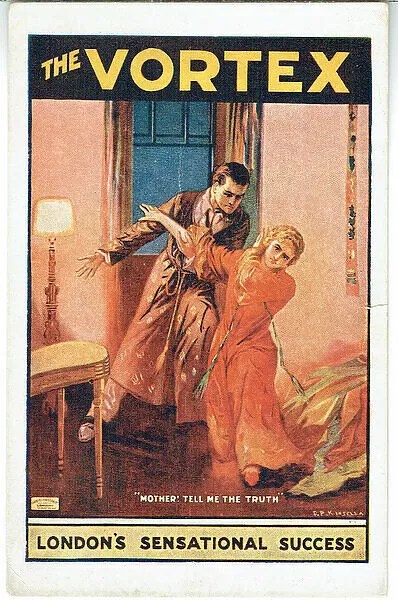
The Vortex

  • Play title: The Vortex     
  • Author: Noel Coward  
  • Published: 1924  
  • Page count: 106  

Summary

Noel Coward’s The Vortex is a period melodrama that was originally published in 1924. Many of Coward’s later plays are more famous, but this first, major hit was decidedly risqué in its day. The play tells the story of the Lancaster household, which includes Florence the narcissistic matriarch and Nicky her musically talented but confused son. Florence Lancaster dates a string of young, male admirers and that causes scandal due to her married status. In this work, Coward captures the lifestyles of rich, selfish, vain people who attend the theatre and opera, have multiple residences, drink cocktails in the afternoon, and are driven in chauffeured cars. The dramatic events of the play revolve around Nicky’s recent engagement with a girl called Bunty and how this affects his mother’s relationship with her current beau named Tom. The themes of the play include drug abuse, parental responsibility, and homosexuality.    

Ways to access the text: reading/listening. 

Coward’s play is available online via the Internet Archive under the title “The Vortex: Noel Coward.”  

However, if you would prefer to listen to an audiobook version, then one is available on YouTube. The title of the audiobook is “Vortex – Noel Coward – BBC Saturday Night Theatre” and the running time is 1hr and 29mins.  

Why read/listen to The Vortex? 

1920s Melodrama  

Even though melodrama is a term that may be used derogatorily, it also captures the sensational pop of champagne corks and the zing of catty one-liners in this work! Coward’s play evokes a bygone era of English, upper-class privilege, and the author fills each scene with exaggerated characters and thinly veiled taboo subjects. If you like cut-glass accents and witty repartee, then this is the play for you. Admittedly, the work has aged, but this may be viewed in a positive light because the world that Coward describes is practically alien to a modern reader and, therefore, even more entrancing. As an example of Coward’s wit, the character Pawnie is introduced with the innuendo-laden title of “an elderly maiden gentleman.” Pawnie gives embodiment to the overweening vanity and male effeminacy that are core topics in the play. It is possible to encapsulate the overall tone of the play by quoting Pawnie’s succinct description of Nicky – “he’s divinely selfish; all amusing people are.” Coward explores a world of artifice that is shown to be unsustainable because, in the end, the truth shatters everything in a most dramatic manner.   

A Neglectful Mother  

Florence Lancaster is not the maternal type. She is almost fifty but still feels quite young and is considered attractive by men half her age: men whom she often dates. In modern terms, one could say that she is a liberated woman. However, in the era of 1920s England, her behaviour is considered scandalous and invites widespread gossip. Coward depicts a woman who is unfaithful to her husband but more importantly, in terms of the play’s plot, she is neglectful of her son Nicky. Coward lays the blame on Florence for everything that goes wrong. Florence does not conform to the socially approved gender role of the caring, affectionate mother and she also fails morally. Coward masterfully constructed the entire final scene, which depicts a volcanic confrontation between mother and son, without once naming the core problem. This was due to censorship issues and/or the moral sensitivities of the time. However, the constant side-stepping and dogged refusal to name what Florence is really being accused of, due to her neglect, is ultimately quite fascinating.   

Post-reading discussion/interpretation  

A Young Man’s Habit 

Nicky Lancaster is a drug addict. The initial hints that something is amiss come from his perpetually jittery manner. However, Coward provides Nicky with several masks in the play. The identity that is revealed is frequently not what one expects. To begin, one may consider two of Nicky’s overlapping masks: the neurotic and the drug addict. As Nicky is depicted from the start as slightly neurotic in temperament, it is not immediately evident that he is also a user of hard drugs such as cocaine. For example, the introductory description of Nicky is as a man who “is tall and pale, with thin, nervous hands.” Then, soon after Nicky confesses himself to be “hectic and nervy,” he overreacts to a comment made by Bunty with an unexpected, angry outburst, saying, “Shut up – shut up.” Also, when he plays the wind-up gramophone for his family and friends, he invariably “plays the records too fast.” Even though these are substantial hints at a subtext, it is not until his friend Helen takes a “divine little box” from his pocket when searching for a match that the secret is outed, at least to her. The drug is not named but is most likely cocaine. In a later, private discussion, Helen confronts Nicky by saying, “I should give up drugs if I were you.” Apparently, Nicky’s habit had not gone unnoticed because Helen had suspected it for some time. Yet the salient point here is that the signs need to be read correctly in order to identify the underlying issue. Nicky defends himself against Helen’s warnings, saying, “I only take just the tiniest little bit, once in a blue moon.” The topic is effectively dropped until the final scene when Nicky confesses to his mother by way of showing her the “small gold box,” which Florence recognizes as drugs and then promptly throws it out of the window. The keystone of Coward’s plot is that one problem may easily camouflage another, and not even a mother may know the truth. Masking is a motif in the play.   

In terms of a sensational twist to the story, the idea of a young musician returning from Paris with a cocaine habit, especially in the 1920s, is indeed shocking. Yet the revelation does not contribute to the plot in any significant manner except to explain the young man’s pallid looks and generally overwrought demeanour. Drug addiction does not explain why Nicky’s engagement ends abruptly nor does it explain his confrontation with his mother. An inspection of the play’s dialogues confirms these points. Astute audiences may suspect that Nicky uses drugs based on the various early clues, but what about the more frequent hints indicating that Nicky is gay? After all, this topic is never broached. Therefore, one needs to consider what taboos Noel Coward could openly discuss in his work and which needed to remain unspoken. Coward is obviously substituting the taboo that he could tentatively speak of, namely drugs, and leaves Nicky’s homosexuality as an inferred truth. This strange substitution of one taboo for another within the plot leads to an imbalance, an incongruity in the story, unless one deciphers Coward’s full meaning. It is also necessary to digress here and state that what is blatantly clear to a modern audience may have been far more obscure for a 1920s audience. It is crucial for Nicky to make some big revelation in the story, to be truthful about himself, if he is to expect his mother to reciprocally confess her mistakes. It was likely impossible for Coward, both from a censorship aspect and a commercial viewpoint, to have a play’s central character out himself as homosexual in the 1920s. Therefore, drug addiction is used to mimic the shocking confession that is undoubtedly required to bring the narrative to its crisis moment. One theatrical mask obscures another: the confessed drug addict shrouds the hidden homosexual. In moralistic terms, there were many perceived commonalities between drug users and homosexuals in the early 20th century: licentiousness, selfishness, and eventual ruin. The playwright employs a very fitting ruse. 

The evidence of Nicky’s homosexuality, like his drug use, is based on shrewd observation. There are numerous early clues such as Nicky’s good friend John Bagot to whom he reads his mother’s letters. This act of sharing displays a level of intimacy between the men. The surname Bagot is also strongly indicative of a derogatory term for gay men (faggot), which was spelt with one ‘g’ in America in the 1920s when Coward himself had visited New York. Noel Coward was a gay man, so he was far more likely to have been familiar with slang terms for the gay community. On the other hand, why would Coward allude to such a derogatory term? Coward’s sly reference to a derogatory term would have functioned as an ironic in-joke for fellow gay men in the audience. The dialogue between Tom and Bunty is the strongest indication that Nicky is gay and that he is perceived as such. For instance, Tom is wholly unaware of the romantic relationship between Nicky and Bunty when he first arrives at the Lancaster household. At one point, Bunty monopolizes Tom in conversation and Nicky unexpectedly storms out, which Bunty explains as jealousy. Tom misconstrues the situation, saying, “Why… is he …?” The inference here is that Nicky is attracted to Tom, and therefore, is a homosexual. This assessment is confirmed by Tom’s further innuendos such as his references to Nicky as “that type” and “that sort of chap” with the closing comment of “you know – up in the air – effeminate.” At precisely this moment, Bunty laughs and says, “I’ve just realized something,” which is apparently that her fiancé is a gay man. When Bunty finally breaks off the relationship with Nicky, she says, “You’re not in love with me, really – you couldn’t be!” Nicky is resigned to the breakup and admits that he is not facing up to things properly: homosexuality is never actually mentioned.  

Noel Coward, as a playwright and gay man, had an unenviable challenge in writing The Vortex. In this play, he must commit a form of subterfuge using language in order to explain the problems of gay life. For example, he cannot use any explicit term to denote Nicky’s homosexuality, and yet the playwright’s aim is clearly to convey to readers the kind of perpetual entrapment that gay men felt. Nicky is unable to face the truth of his sexuality when confronted by his fiancé, and he is even unable to fully admit it to himself. One presumes that he would have married Bunty had she not ended the relationship. A major element of Coward’s subterfuge is the technique of psychological projection. By way of illustration, when Nicky is arguing with his mother about her numerous lovers, he says, “It was something you couldn’t help, wasn’t it – something that’s always been the same in you since you were quite, quite young -?” Nicky is evidently referring to himself here and his sexuality. In the next line, Nicky says, “I’m nothing – I’ve grown up all wrong.” Such an admission from Nicky underscores that Coward’s play is more than just a melodrama; it is a play that valiantly struggles to express something that could not legitimately be said publicly at that time. The play expertly depicts Nicky’s utter confusion and resulting self-hatred, yet the playwright was barred from expressing a plain truth in 1920s England – the truth that Nicky is gay. 

When the play was written, drug-taking and homosexual practices were both seen as wilfully habitual acts. As such, Nicky’s ruination, in either case, would have been perceived as his own choice. There was, however, a distinct difference between how these two ‘habits’ would have been penalized. The English law covering drugs was the “Dangerous Drugs Act 1920,” which continued to treat substance addiction as a medical problem. On the other hand, the law that covered homosexual practices, namely the “Criminal Law Amendment Act 1885,” meant gay men could face imprisonment for up to two years. This law became known as the “Blackmailer’s Charter” because it put gay men in such a vulnerable position. In the context of the play, Nicky is supported by Helen and later by his mother when he reveals his drug habit. It is not clear how either of these women would have reacted if he had said he was a homosexual. This does not mean that they do not suspect or even know it – the problem is a public admission of homosexuality and the subsequently unavoidable repercussions. Additionally, drug use was considered to be a habit that was curable under medical supervision: homosexuality was not. Coward masks Nicky’s homosexuality, depicting him instead as a drug addict, yet the truth emerges from the playwright’s constant use of ellipses and innuendo. These literal gaps (is he …?) and constant hints (up in the air – effeminate) are what the truth must be constructed from given the restrictions of the era. Ultimately, it is an admission that counts, but Nicky can only safely admit to using drugs but never to the bigger taboo. Coward will not and possibly cannot name the young man’s true habit because it is sexual and therefore guarantees ruin. One can reasonably assert that the playwright’s career would also have been seriously tainted or ended had his play been more explicit. Few plays deliver a message so clearly as Coward’s does, yet simultaneously say nothing at all.     

Hamlet’s Mother 

Noel Coward’s The Vortex has a climactic final scene where an angry son confronts his mother about her sexual conduct. For many readers, this scene may appear oddly familiar and that is due to its remarkable similarity to a scene from Shakespeare’s Hamlet where the young prince confronts his mother, Queen Gertrude. Both situations are defined by anger that tilts towards outright rage. Nicky says to his mother, “I’m straining every nerve to keep myself under control … if you lie to me and try to evade me any more – I won’t be answerable for what might happen.” Similarly, Hamlet tells Queen Gertrude, “Sit you down; you shall not budge; / You go not till I set you up a glass / Where you may see the inmost part of you,” and the vehemence of his orders make her fear that he will murder her. What is most immediately striking about both scenes is the moral disgust of a son at his mother’s sexual liaisons. In each case, the son looks for and finally gains a promise regarding future behaviour from his mother. Queen Gertrude is induced to feel shame over her hasty marriage to old King Hamlet’s inferior brother Claudius, and she also promises to keep Hamlet’s secret (that he is not mad but very sane and cunning). In Coward’s play, Nicky commands that his mother will not “have any more lovers … you’re going to be my mother for once,” and Florence finally submits, saying, “Yes, yes – I’ll try.” While the two scenes are quite similar, an added connection may be established by reference to Sigmund Freud. It was Freud who diagnosed Hamlet’s Oedipal complex in his book The Interpretation of Dreams, which reveals the young prince’s desire to sleep with his mother. When one considers Coward’s play, it is also a young man’s sexual urges that are in question (Nicky’s). Coward re-creates a scene from Hamlet as a means of exposing what Florence is really being accused of, and that it relates directly to her son’s sexuality. 

One may quibble about Coward’s use of such an iconic scene from a great play to make a point in a melodramatic work. Yet the playwright does bring the scene into the 20th century. There is a cocaine-addicted son, apparently homosexual, threatening his mother in her bedroom late at night on the same day that his fiancé has broken up with him. In the case of Hamlet, Freud explains the prince’s prurient thoughts. Hamlet ponders about how his mother lays “in the rank sweat of an enseamed bed.” Freud explains this fascination as evidence of his sexual desire for his mother and his jealousy of her current lover, King Claudius. To explain Nicky’s sexual dilemma, one may extract clues from the similarities between the plays’ scenes. The crucial question in The Vortex comes when Florence asks Nicky, “What are you accusing me of having done?” and his strange answer is “Can’t you see yet! … look at me.” The implication is that Nicky’s ‘problem’ is clear for all to see. This suggests that Nicky cannot hide his sexuality, and there is evidence to support this as Tom and then Bunty have concluded that he is not the marrying type. Coward provides his audience with a well-crafted and content-rich scene between Nicky and his mother. For example, if Nicky’s sexuality can be ‘read’ then surely his mother would have noticed long ago. After all, she is close friends with Pawnie who is depicted as an indiscreet, elderly homosexual. Florence’s ignorance of her son’s sexuality is questionable because when Nicky declares that he has “a slight confession to make” then her response is first to gauge the gravity of it by repeating “confession?” but then she swiftly says, “Go away – go away.” Florence may not want to hear what she already knows. Nicky’s problem, as has already been established, cannot be named, so drug use suffices as the confession. The informative parallel with the Shakespearean scene may be understood as follows – Hamlet obsesses over his mother’s sex life and chastises her, but the secret of the scene is that he is sexually attracted to his mother, whereas Nicky obsesses over his mother’s sex life and chastises her, but the secret of the scene is that he is homosexual and seeks the root cause of his sexual affliction. In both Shakespeare’s and Coward’s dramatic scenes, a young man is being forced to confront a quite taboo element of his sexuality, and in each case, his mother somehow holds the key to the problem.  

As Sigmund Freud diagnosed Hamlet’s Oedipal complex then it seems apt to consult the psychologist’s writings once again regarding Nicky. It is true that Freud’s work is outdated to some degree, especially regarding homosexuality, however, it offers an important guide to academic discussions on sexuality around the time Coward wrote The Vortex. In “Three Essays on the Theory of Sexuality” (1905), Freud makes some helpful observations, for example, he clearly links neuroticism with homosexual feelings. The link between Nicky’s neurotic personality and drugs has already been explored, so it is of interest that Nicky’s neuroticism also hints at his sexuality. Therefore, a characteristic of Nicky that is discussed in the play and is most evident in the climactic scene, is a clue to the sexual subtext. Freud also notes that “inverts [homosexuals] go through in their childhood a phase of very intense but short-lived fixation on the woman (usually on the mother) and after overcoming it they identify themselves with the woman and take themselves as the sexual object.” If one considers Nicky’s idealisation of his mother, then it can indeed be traced back to childhood. Nicky recounts one special memory to Bunty: “I can remember her when I was quite small, coming up to say goodnight to me, looking too perfectly radiant for words.” The intense argument between Nicky and his mother shows that he no longer idealises her, but he once did, and Freud’s theory refers to those important formative years and the crystallization of sexual orientation. The fight between mother and son highlights one specific aspect of Nicky’s sexuality. We are told of how Nicky finally realizes that the gossip about his mother has always been true, and he even witnesses her make a “vulgar disgusting scene” when Tom breaks off the relationship. Nicky, like Hamlet, has been obsessing about his mother’s sexual relations. Therefore, it is not a coincidence that Coward depicts Tom and Nicky as the same age because, consequently, Florence becomes Nicky’s rival in love when it comes to the attention of another male, namely Tom. This links back to Tom’s initial impression of Nicky and the suggestion of sexual jealousy. Just as Hamlet is envious of Claudius’s sexual relations with his mother, Nicky is jealous of his mother’s sexual relations with the “athletic” and masculine Tom.    

To explain Nicky’s impulses, one may look to Freud’s book entitled Sexuality and the Psychology of Love. Freud writes of homosexuals, “The typical process … is that a few years after the termination of puberty the young man, who until this time has been strongly fixated on his mother, turns in his course, identifies himself with his mother, and looks about for love-objects in whom he can re-discover himself and whom he wishes to love as his mother loved him.” This point about a boy identifying himself with his mother is peculiar to Coward’s scene between Nicky and Florence since Hamlet identifies instead with his mother’s lover, Claudius. Nicky truly seems to feel that he and his mother are exceptionally alike. His character reflects hers, so he excuses her behaviours, saying – “you’ve wanted love always – passionate love, because you were made like that – it’s not our fault.” The key quote in the play comes when Nicky says of himself and his mother, “We swirl about in a vortex of beastliness.” Their only chance is to accept the truth. However, the truth that Nicky seeks is not a truth that he can express. The closest one gets to naming his sexual ‘problem’ is by way of its apparent causes: his mother’s neglect of her parental duties, her shallow vanity, and her endless string of affairs. In the coded speak of 1920s England, Nicky is blaming his mother for his homosexuality, which means his ruination. Indeed, there is an air of impending doom and disgrace when Nicky references his father and says, “I’m nothing for him to look forward to – but I might have been if it hadn’t been for you [Florence].” Looking forward suggests a career, marriage, and children, but old Mr Lancaster will not see any of these rewards because his son is gay.  

The play ends immediately after the dramatic bedroom scene. The resolution that has been agreed upon is that Florence will try to fulfil her, up until now neglected, role of mother. Like Hamlet who was furious at his mother because of his own unspeakable sexual urges, Nicky’s fight with his mother is equally characterized by obvious sexual repression: the inability to accept or even name the true source of the anger. One may highlight a final parallel between the plays. Queen Gertrude promises to keep Hamlet’s secret, and Florence likewise understands her son’s secret and co-operates for that reason. Secrecy is secured through a process of guilt, shaming, and a need for damage control. Coward’s play is an early example of the nature versus nurture debate on same-sex attraction. The playwright’s strong emphasis on ‘nurture’ is clear and was indeed supported at that time by such eminent psychologists as Dr Freud. The play is a snapshot of English society in a quite different era. The parallels between Hamlet and The Vortex reveal the fascinating subtext that Coward creates.  

Works Cited  

Coward, Noel. The Vortex. Ernest Benn Limited, 1924.  

Freud, Sigmund. Sexuality and the Psychology of Love. Collier Books, 1963.  

Freud, Sigmund. The Interpretation of Dreams. 3rd ed., Seven Treasures Publications, 2008. 

Freud, Sigmund. Three Essays on the Theory of Sexuality, David De Angelis, 2018.  

Shakespeare, William. Hamlet. Penguin Books, 2005. 

Teff, H. “Drugs and the Law: The Development of Control.” The Modern Law Review, vol. 35, no. 3, 1972, pp. 225-241.

John

  • Play title: John   
  • Author: Annie Baker  
  • Published: 2016  
  • Page count: 114 

Summary

Annie Baker’s play, John, is an unusual mix of realism and the supernatural. The setting is a Bed & Breakfast in Gettysburg, Pennsylvania. The characters Elias and Jenny stay at this guest house owned by a woman named Mertis, where they also meet her elderly, blind, friend Genevieve. As the play progresses, we learn that Elias and Jenny have relationship problems, that Genevieve has a fascinating story to tell, and that Mertis is a more complex character than she at first seems. At the surface level, the play charts the course of a tumultuous, romantic relationship, but Baker adds many complications, most obviously the suggestion of supernatural, possibly ghostly forces. The final line of the play conclusively answers at least one major question for readers.  

Ways to access the text: reading. 

As John is a recently published play, it is difficult to source for free online. However, the play is available on Scribd which offers a 30-day free trial.

Baker is a contemporary playwright, and the text is inexpensive so purchasing the work is also recommended.   

Why read John? 

Fantastic dialogue.  

Not all plays are reader friendly, but this play reads so smoothly that it is an absolute pleasure. It is relevant to note here that Annie Baker won the Pulitzer Prize for drama in 2014 for her play, The Flick. It is indeed because Baker is so skilled a writer of dialogue that she manages to insert so many strange events and revelations without disrupting the play’s flow or alienating the reader. For much of the work, our attention is drawn to the disagreements of the young couple. Many of the tetchy exchanges are minor but serve to fully outline the characters of Elias and Jenny. However, there are other episodes like Genevieve’s gripping revelation of bizarre experiences from her past that serve to alter the mood. Also, Mertis has a knack of asking probing questions that turn ordinary conversations into something fantastic, often not fully intelligible. However, even if one cannot find easy answers to all the mysterious events, Baker’s expertly crafted dialogue keeps one glued to the text.  

Mysteries without answers.  

This play offers a reader a challenge of sorts, but the challenge is not obligatory. By challenge, I mean the selection of unexplained events that occur during the play along with eclectic references, for example, to literary works, composers, and philosophies. One may suggest that the play demands an erudite reader, but that is not correct because the play offers full satisfaction at various levels of understanding. Another point that is quite relevant for the reader – it seems that it would be impossible to find a comprehensive explanation for all the mysterious events of the play. Therefore, one may approach the work without any fear of misinterpreting it. The story of the young couple is interesting in itself, and one finds out a major secret at the end. Other aspects of the play will leave one pondering the meaning for days afterwards. In summary, the play offers a core story that all readers will appreciate but then goes on to complicate that story. It is certainly not a play for the type of reader who must have all loose threads neatly tied up by the conclusion.    

Post-reading discussion/interpretation.  

Elias and Jenny’s relationship.  

Jenny or Elias – to which of these two characters should a reader be sympathetic? This becomes an unavoidable question when reading the play. Elias is Jewish, domineering and demanding. Jenny is Asian, at least based on her surname of Chung, and seems a more empathetic and politer person. Their relationship is clearly in trouble, and they have broken up at least once in the past. While Baker presents Elias as unaffectionate and quite defensive, Jenny is the one who is ultimately depicted as a false person. A reader may retrospectively consider all the times that Jenny had been busy texting her “sister” while simultaneously declaring her love for her boyfriend. She tells him he is beautiful and expresses deep regret over her previous affair with John. In this regard, it seems clear who deserves the reader’s sympathy, at least based on truthfulness. Yet, on the other hand, Elias admits to Mertis that he eventually begins to think of all his girlfriends as “insects”! Such a disturbing admission from Elias makes it difficult, maybe even impossible, for readers to take his side. At the end of the story, it is revealed that Jenny is still in contact with John but who is most to blame for the failure of the relationship between Jenny and Elias? Baker resists giving her audience an easy answer.   

A plausible interpretation of the couple’s relationship is prompted by various references to statues in the play. These references are suggestive of the myth of Pygmalion: an ancient story that may help resolve the mystery of who is to blame. In Ovid’s tale, Pygmalion shunned mortal women because he was revolted by their shameless sexual behaviour, so he carved a statue of a beautiful woman and then fell in love with it. Later, the goddess Venus granted Pygmalion’s wish and the statue miraculously came to life and became his perfect bride (Ovid 232). In Baker’s play, Jenny may be interpreted as the statue since she is indeed described at one point as “stiff as a statue” along with the numerous references to her icy cold hands and feet. There is even a scene where Elias carries Jenny – “he picks her up and carries her, stiffly, like a mannequin, down to the couch and drops her there.” This action mimics the scene where Pygmalion “placed the statue on a couch … and called it his bedfellow” (Ovid 232). Another strong connection to Ovid’s tale is Elias’s made-up story of the man who falls in love with the statue of a beautiful woman. One may find additional references to Ovid’s myth in Mertis’ tale of meeting her 2nd husband, George, where she describes what it was like “emerging from the cold and into the sun.” This description is analogous to a cold statue coming to life. Yet, all these likely allusions to the myth of Pygmalion may be interpreted in conflicting ways. The first interpretation is that Elias does not love Jenny sufficiently to bring her to life in the relationship, so she remains like a cold statue. From this perspective, Elias’s love is inferior to the effusive love that Jenny receives from John. The second interpretation is that Elias is a man who has already lost faith in women just like Pygmalion, and Jenny’s earlier affair simply reinforces such despair. Elias’s reference to the “green insects” (praying mantis?) obliquely refers to sexual matters: suggesting that the male will be coldly sacrificed once his ‘duty’ is done. In an earlier argument between Jenny and Elias, Jenny apparently revealed that John is well endowed, thus sparking unfavourable comparisons and sexual jealousy. Ultimately, it is difficult to say if Elias is looking for a perfect partner like Pygmalion or simply one who is faithful and truthful. The play’s ending nudges a reader slightly more to Elias’s camp because, even if he is insensitive, he does appear to be faithful.   

Baker’s text is never simplistic. For example, when one reads Genevieve’s story of a domineering, controlling husband named John who took command of her mind, then it is hard to determine if that relationship from the past reflects a current relationship in the play. For instance, is there a hinted parallel between Genevieve’s ex-husband and the controlling Elias? Alternatively, the reference may be to the more affectionate but overly needy John who had/is having an affair with Jenny. When Genevieve says, “Everyone knows someone named John,” it suggests not just a common name, but a type of man. Elias and John both control Jenny in separate ways. John’s incessant texting is certainly a form of control especially since he knows that Jenny is on holiday with Elias. If one concludes that Elias and John are equally bad influences on Jenny, based on Genevieve’s ominous example, then one swaps allegiances again. Maybe Jenny would be far better off cutting her ties with both men. Additionally, we can make a tentative link between the unhappy marriage that Mertis had with her ex-husband, a man who was fatally electrocuted, and the “mind zaps” that Elias is suffering which make him feel as though he is being electrocuted. Elias’s depression is a constant spectre in the background that threatens his stability and the happiness of any relationship he enters. These are the sorts of random, loose threads that may fascinate or frustrate readers. Baker creates tantalizing clues, but they may just be lures to trick us into overreading some of the situations. The playwright pulls us into the familiar loop of what he said/she said, and this cleverly denies the reader the satisfaction of a clean-cut exit in the form of a definitive answer. The final line of the play only resolves the problem if monogamy alone is the deciding factor in a reader’s opinion.

The supernatural elements of the story.  

How should one interpret the supernatural elements of the story? To begin, one may validly ask how reliable are the narrators? Our overall judgement of any character will normally determine our levels of scepticism or trust in the information they provide us. For instance, Jenny is an adult woman who is so afraid of her old dolls that she cuts little windows in their storage box so that they can peep out! Her doll obsession is so strong that Elias thinks she has OCD. However, when Mertis asks Jenny if she ever considered selling “Samantha,” the American Girl doll, Jenny’s reply is an emphatic no – “I saved up two years’ worth of babysitting money to buy her.” For a reader, how are Jenny’s two vastly contrasting positions of fear versus material value compatible or even credible? If an object deeply disturbs someone then surely the logical solution is to dump it, give it away, or sell it. Furthermore, how can we give any credence to Jenny’s belief that the doll gets angry? Genevieve’s support of Jenny’s irrational beliefs about dolls is hardly vindication because Genevieve is a self-confessed former psychiatric patient whose full recovery to sanity is questionable. The unreliability of several key characters in the play is a crucial point. However, Baker constructs such a complex intermingling of supernatural elements in the play, presented to us by various characters, that one cannot merely dismiss them all as they must contain some meaning.    

It is helpful to list the supernatural elements of the play to get a better overview. First, the Bed & Breakfast is a former Union soldiers’ hospital where amputated limbs were reputedly tossed out of the windows, and the bedrooms seem haunted to this very day. Then there is the fantastical tale of how Genevieve’s former husband took possession of her soul and spirit. Also, Jenny tells her own strange but amusing story of how the universe made love to her when she was high on drugs. Elias takes a picture of a ghost, or maybe it is just a blur. Then one can add to the mix: Christmas tree lights that flicker on and off a bit too sporadically; a piano that plays by itself or perhaps it’s a trick piano; and a doll that may get angry and take her revenge! Finally, there is talk of “watchers” who are otherworldly and must not be annoyed. This is certainly quite a list for any reader to contend with, and many of these elements may be in the play for their entertainment value rather than on account of their meaningfulness.

Yet, a fascinating aspect of the play is how Baker occasionally underpins whimsy with something more meaningful. One prime example is when Mertis declares that she is a Neo-Platonist. A cursory introduction to Neo-Platonism is that it is a pagan, Greek philosophy in which the highest level of being is called ‘the One.’ This may correlate with the idea of the “watcher” that is discussed in Baker’s play. In Neo-Platonism, there is a strict hierarchy of beings with ‘the One’ at the apex, from which emanate all things that exist and to which all things eventually return. When Genevieve went blind and no longer had any pressing concerns about her body or the opinions of others, she began to lead a more thoughtful life. This is an example of a life that is in line with Neo-Platonist philosophy because Genevieve turned away from the sensual world and began to focus more on her inner self. There also appear to be connections between the teachings of Neo-Platonists and other aspects of the play such as Genevieve’s “disturbing connection with the soul of every person and every object that had ever existed.” Neo-Platonism is pantheistic in nature, so there is indeed a belief that God is present in all things. One should also pay attention to Mertis’ comments about her “matter.” This denotes her assortment of decorative dolls and figurines on one level, but in philosophical terms, the word “matter” refers to the universe. The idea that an inanimate object like a doll may be imbued with some essence of its godly creator is a salient point in the play. Neo-Platonism is a difficult philosophical field with a long and complex history, but some basic background information is certainly helpful for understanding the play. The main point is that Baker constructs a solid base for some of the strange events by referencing a whole philosophy of life.   

The American Girl doll, Samantha, is an unusual but dominant focal point in the play. It is possible to utilise the doll to partially explain some of the mysteries of the story. To begin, one may scrutinise the two quotes that introduce the play. The first substantial quote is from a short story by Heinrich von Kleist, and the second quote is a short Latin phrase from Marcus Tullius Cicero who was a Roman statesman and scholar. Von Kleist’s short story is called “On the Marionette Theatre” and it considers the elegance of puppets’ movements compared to those of human dancers who are often too self-conscious to achieve equally graceful movements. Interpretations of von Kleist’s story abound, for instance – the more conscious people become of their own separate identities then the more isolated they become from one another. If the quite mismatched Jenny and Elias are performing a dance of love, then their extreme efforts to make it work prove to be the dance’s downfall. One may begin to see further links with the doll, Samantha, when one notes that von Kleist writes that “grace … appears to best advantage in that human bodily structure that has no consciousness at all – or has infinite consciousness – that is, in the mechanical puppet, or in the God” (26). The assertion that the puppet and the God are equal regarding grace is important for interpreting Baker’s play. The introductory quote from Cicero translates as “never less alone than when alone.” Cicero’s quote is quite relevant because Jenny never feels truly alone since Samantha always is watching her! While both quotes direct a reader to focus on the doll, Samantha, they still require considerable unpacking.

An interpretation of the play may be constructed as follows. The doll, Samantha, symbolizes the God-like presence of the “Watcher” of whom Mertis often speaks. The “Watcher” is a seemingly unavoidable presence. One may recall that when Jenny first sees Samantha in the B&B, she concernedly remarks, “it’s really freaking me out … I feel like she found me.” When Mertis later asks Jenny, “do you ever feel watched,” then Jenny responds with an emphatic yes. Jenny explains that as a child she used to lock Samantha in a cupboard, “so I wouldn’t feel her watching me.” This feeling of being watched has persisted into Jenny’s adult life. The most apparent explanation for Jenny’s current self-consciousness is a feeling of guilt, especially since we know of her previous affair. She suffers mental turmoil even when alone due to a history of telling lies and living in fear of being found out. To phrase it differently, Jenny is constantly being pricked by her own guilty conscience. However, we must expand on this idea because Jenny has always felt watched since early childhood. It is possible that a young Jenny was also accused of telling lies: maybe about her dolls and their special powers. If one returns to the von Kleist quote on puppets and gods then the doll symbolizes a higher force (Pagan or Christian) whom one should pacify by leading a good life, a life that will gain one grace when grace is understood in a semi-religious sense. If Jenny led such a life, then she would not be trapped in her solipsism and feelings of guilt but would have a sense of existing in the community of man. In this light, the play is thoroughly rooted in the teachings of Neo-Platonism, yet one cannot help feeling that the “Watcher” when understood in this way is oppressively moralistic since it is Jenny’s guilt in childhood and adulthood that prompts the squirming, uncomfortable feeling of being watched.    

The next part of this interpretation concerns Cicero’s quote, “never less alone than when alone.” One can see how this reflects the previously explored idea of Jenny being watched by a puppet/God. When Mertis uses the quote over the phone to Genevieve, she links it to Cardinal John Henry Newman, a theologian and saint of the Catholic Church. This puts a decidedly Christian spin on the quote. Later, Jenny uses almost the exact same phrasing as Cicero, “less alone in my alone-ness,” when describing how the universe made love to her when she was stoned. In response to Jenny’s story, the phrase that immediately comes to Mertis’ mind is “Deep Calling Unto Deep,” which though left unexplained in the play, is a quote from the Bible, psalm 42:7. It is a reference to the mental turmoil experienced by David when he is caught in a storm. One explanation for the links between these various quotes is that Jenny finally feels less alone in the world and more at peace with herself but only when high on drugs. This means that there is, temporarily, no judgmental “Watcher.” Yet, Mertis’ somewhat strange reply to Jenny’s story is to quote a biblical passage that uses the metaphor of a storm to describe just how overwhelming an experience of mental turmoil can be for someone. Therefore, one senses that mental turmoil of some sort is Jenny’s normal, non-stoned, everyday existence. Cicero’s quote when used in a Christian context refers to a connection with one’s God, for example, when one is all alone in quiet contemplation or prayer. The difference between Jenny’s normal state of anxiety and a peaceful state is apparently due to life choices. The anxiety that Jenny feels concerning the doll reveals something that is rooted in psychology rather than the supernatural. In summation, the message is about living a good life.

The above interpretation is long and convoluted but has attempted to decipher some of the trickier elements of the play. As previously noted, Neo-Platonism is a large area of study and has been treated superficially here. Baker tends to avoid moral judgments in the play, so it is best to focus on how the doll symbolizes a god-like presence that wants Jenny to live a good life for the sake of her own inner peace rather than traditional, Christian morals. One positive aspect of the interpretation is that the doll, Samantha, begins to look less like a horror-movie prop and more like the key to the story.   

Works Cited.

Baker, Annie. John. Theatre Communications Group, 2016.

Ovid. Metamorphoses. Translated by Mary M. Innes, Penguin Books, 1973.

The Bible. Authorized King James Version, Oxford UP, 1998.

Von Kleist, Heinrich. “On the Marionette Theatre.” The Drama Review: TDR, Translated by Thomas G. Neumiller, vol. 16, no. 3, 1972, pp. 22-26.

The Glass Menagerie

  • Play title: The Glass Menagerie  
  • Author: Tennessee Williams   
  • First performed: 1944     
  • Page count: 116 

Summary 

The Glass Menagerie was Tennessee Williams’ first big theatrical success. It is a play about the Wingfield family who live in a small apartment in St. Louis during the 1930s. The family unit consists of an abandoned, middle-aged mother named Amanda and her two adult children: Tom, a budding writer, and Laura, a mildly disabled and ultra-shy girl. Williams gives this play a solid historical context by referencing hardship and poverty in the American lower-middle classes in the 1930s. He also notes specific international events like the bombing of Guernica in Spain. However, this is not a work of realism but is described instead as a “memory play.” Tom is the main narrator, and the events described are his recollections of his family. While Tom is headstrong and independent, Laura is socially awkward and does not thrive. The central story is about how Amanda, an old-fashioned Southerner, becomes increasingly desperate to find a suitable “gentleman caller” for Laura in the hope of an eventual marriage. The glass menagerie of the title is a collection of delicate glass figurines owned by Laura.

Ways to access the text: reading/listening  

There are multiple online sources for this text. For example, there is a PDF file of the play text on the educational website http://www.pval.org. Alternatively, you may source the text via the Open Library (registration needed). The Open Library version is more reader-friendly due to the page formatting.

There is a full audiobook version of the play on YouTube. The recording is divided into two files with a total running time of 1hr and 46mins. However, please note that these have been recorded from an original vinyl record and there is, at times, a distinct scratching sound on the 2nd file. The file names are listed below.

“Tennessee Williams – The Glass Menagerie (Act One)” 

“Tennessee Williams – The Glass Menagerie (Act Two)”  

Why read/listen to The Glass Menagerie? 

A Dependent Daughter.  

Amanda Wingfield’s daughter Laura is quite a distinctive character but primarily for what may be seen as negative characteristics. She is mildly disabled on account of a permanent limp, but shyness is her overriding disability. Tennessee Williams is said to have based Laura on his own sister Rose, and it may explain why this character holds such a significant role in the play. Williams explores, from a mother’s perspective, the problem of having a reclusive daughter. Although Laura sometimes goes out in public, her social ineptitude means that she is known by very few people. This makes her ever more vulnerable to the influences within her family especially since she is accommodating and generally passive. One of the key dilemmas of the play is Laura’s uncertain future. The socio-economic backdrop of 1930s America serves to exaggerate the pressures on this already struggling family. Williams explores how someone as loved as Laura is by her family, may still be subjected to certain cruelties by her apparent protectors. In the opinion of Mrs Wingfield, a dependent daughter has only two choices: a career or marriage. Laura is pushed towards both solutions respectively.

A Play Made of Memory.  

In the opening scene, the play is presented as a memory of Tom. Tom is essentially the narrator of, and a character in, his own story. This frames the play in a most self-conscious manner; it is the theatrical staging of the personal and therefore wholly subjective memory of one single character. This is intriguing for at least three reasons. For instance, Tom secretly functions as a mouthpiece for the playwright who is processing the Williams family history. As a memory, the play’s action is also curiously located in the past even though it happens before our eyes on stage. Finally, the nature of memory calls into question the truth/reliability of the events depicted. Indeed, Williams highlights many of these issues in the play’s introduction.

One witnesses the replaying of an extended personal memory of Tom. One should therefore attune one’s focus to the subtle differences between generic events (mealtimes or habitual arguments) and standout scenes involving life-changing events. The first is the reel tape of home life but the second category involves memories charged with high emotion and thus branded into the mind’s vaults. Is Tom even present in all the scenes he describes? What level of artistic licence is being employed by Tom? Finally, why is the protagonist so obsessed with this memory? The answers to these questions lurk within the text.

Post-reading discussion/interpretation

A Pawn in a Game.  

Even though Laura is the chief focus in the play, she is contradictorily just a pawn in a game. The game is a battle for dominance between Amanda and Tom: each in pursuit of quite contrasting individual wishes. In the absence of Mr Wingfield senior, Amanda expects Tom to continue financially supporting the family, and Laura’s dependence makes this arrangement appear unending. Laura’s prospects directly impact the lives of her mother and brother. Tom pessimistically describes Laura as “terribly shy” and a girl who “seem[s] a little peculiar to people,” whereas Amanda optimistically says that her daughter is “lovely and sweet and pretty.” Each stakeholder in Laura’s future expresses a bias based on their own underlying fears. The family is generally protective of Laura, but specific familial actions are not devoid of cruelty. Laura’s shyness and reserve make it difficult for her to express any contradictory views, despite witnessing decisions being made on her behalf. Williams fills the text with subtle hints concerning Laura’s predicament. The sources of hurt in Laura’s life are varied: economically depressed societal conditions, unending mother-daughter comparisons, escalating family resentments, and Laura’s exclusion from decision making. Tom as narrator restricts an audience’s focus to his perspective, but Laura’s story is clearly one of disempowerment. Indeed, the strongest evidence that Laura is wronged is Tom’s unquenchable guilt. The play is a merging of his memories, but he is incapable of abandoning these hurtful episodes to the past.

The Wingfield family is enmeshed in the dire societal conditions of 1930s America. This means impoverishment and the concurrent absence of any prospects. Even though The Glass Menagerie is not a work of realism, Williams makes pointed references to the social and economic conditions of the times for reasons that soon become apparent. He describes the Wingfield family apartment as typical of the “vast hive-like conglomerations of cellular living units” in the “overcrowded urban centres” of America. The inhabitants of such neighbourhoods as “fundamentally enslaved.” Slavery may be understood in two distinct ways in the play. First, there are Amanda’s derogatory references to black servants: a memory from her youth in Mississippi. On one occasion when Laura wishes to serve table in their little apartment, Amanda says, “No, sister, no, sister – you be the lady this time and I’ll be the darkey.” However, the era of slaves is long gone, as is the era of black servants for the Southern belle Amanda who must now contend with her impoverished conditions. Even though Williams refers to Amanda’s current social position in America’s lower middle class as “enslaved,” it is arguably the burden of a disabled, socially awkward child that truly enslaves Amanda and, by extension, Tom too. Enslavement indicates the loss of hope, or at best a false and always unfulfilled hope, and this is also true of the Wingfield family. Amanda lectures Tom, saying “Life’s not easy, it calls for – Spartan endurance!” It is this mindset that fuels a covert resentment towards the fragile Laura who is the only family member who does not strive for independence. For Amanda, hope lives only in her Mississippian past when everything was possible: even marriage to the “Fitzhugh boy” who had the “Midas touch.” For Tom, the future alone offers hope in the charming guises of freedom and success. Laura unknowingly cements both figures in a depressing present tense of hardship that neither of them can escape.

The pressures are not just societal; there are also household frictions that serve to hurt Laura. One of the most evident and indeed harshest examples of Amanda’s cruelty toward Laura is the implicit comparison continually made between mother and daughter. Amanda’s worn-out story of the seventeen gentleman callers in one day back in “Blue Mountain” is certainly evidence that she seeks refuge and solace in her own, once-promising past. However, the story also serves as Amanda’s cue to pose the discomfiting question to Laura regarding “gentleman callers.” An embarrassed Laura dutifully replies on one occasion, “I’m just not popular like you were in Blue Mountain.” Apart from being an ego boost to the ageing beauty Amanda, the interplay is clearly hurtful to Laura. It would be possible to dismiss Amanda’s question as just mild teasing except for her conscious insistence that no one in the house ever refers openly to Laura’s disability, not even to Laura herself. By ignoring her daughter’s obvious disability, Amanda puts significant, additional pressure on Laura to achieve the goals set for her regarding admirers and romance. According to Amanda, a girl’s two chief routes in life are marriage and career. Amanda first encouraged her 23-year-old daughter to enrol at Rubicam’s Business School, so marriage was not considered Laura’s best prospect for independence. Unfortunately, Laura’s debilitating self-consciousness, most evident in pressurized situations, causes her to drop out of education (again). Only then does Amanda decide on marriage as an alternative solution. In fact, when Amanda happens upon the idea, it is like a eureka moment: “sister, that’s what you’ll do!” A prospective marriage becomes a desperate last attempt for the family to unburden itself of a dependent daughter. Amanda’s consciousness of her daughter’s predicament reveals the sharp cruelty of the aforementioned mother and daughter comparisons.

It is relatively easy to identify the sources of Tom and Amanda’s thinly veiled resentments toward Laura. Tom is now the family wage earner in the absence of his father who abandoned them years previously. Amanda unashamedly uses Laura’s situation to force Tom to stay in a work environment that he hates. In consequence, Tom must suspend or even abandon his future dreams. Once Amanda discovers that Tom secretly plans to join the Merchant Marine, she strikes a deal with him so that he can leave home – “but not till there’s somebody to take your place,” which means a gainfully employed husband for Laura. The deal initiates an ongoing family conversation on the topic of securing a “gentleman caller” for Laura: something that becomes “an obsession” for Amanda. It is understandable that Tom, a budding writer who settles for work in a shoe factory, may come to resent the burden of his sister’s ongoing dependency. On Tom’s drunken night out, he sees the “coffin trick” performed by “Malvolio the Magician” and later remarks to Laura, “There is a trick that would come in handy for me – get me out of this 2 by 4 situation.” Tom clearly feels trapped in his current circumstances. Williams enhances the symbolism of the apartment’s fire escape by referring to the “implacable fires of human desperation.” Tom indeed exits by the fire escape in the end. In contrast to Tom, Amanda’s reason to resent Laura is, at least initially, less apparent. However, the answer lies in her envisioned shared future with her daughter. Amanda dismissively speaks of unmarried women as “barely tolerated spinsters” and “little bird-like women without any nest – eating the crust of humility all their life!” Amanda then asks the rhetorical question – “is that the future we’ve mapped out for ourselves?” If Laura is destined for impoverished spinsterhood, then it is a destiny she condemns her mother to as well. The power struggle between Amanda and Tom becomes a high-stakes game as both risk their futures. Laura is the anchor that binds both of them to an unsatisfactory, current living situation.

It is conspicuous that Laura is continually excluded from decision making by her family. Laura was likely cajoled or coerced into joining business school as this would explain her deep shame at having dropped out. If extra schooling had been Laura’s original aim, then surely her failure would not have prompted Amanda’s “awful suffering look … like the picture of Jesus’ mother.” It appears that Laura dashes her mother’s dreams rather than her own, or as Amanda puts it “all of our plans – my hopes and ambition for you – just gone up the spout.” In regard to organizing a gentleman caller, Laura is again infantilized by her mother since she is excluded from Amanda’s “plans and provisions.” In fact, Amanda sends Laura to the shops for butter so that she may discuss Laura’s future and the possibility of a gentleman caller with Tom privately. The mother and son have dissimilar characters, and they also hold opposing views about Laura. Tom loves his sister but recognises her obvious limitations while Amanda persists in ignoring the obvious, thus courting disaster. When Tom finally accedes to his mother’s demands and arranges for Jim O’Connor to visit then the proceedings quickly become a mockery of romance. To begin, Jim does not know the “ulterior motives” for the dinner invitation. In fact, he has no knowledge at all of Laura’s existence. Similarly, Laura does not know the identity of the visitor until just before his arrival, and it is unclear whether she even suspects her mother’s master plan. Amanda is quite insensitive to her daughter’s predictable distress: the gentleman caller is none other than Laura’s high school crush. Laura repeatedly asks to be excused from the evening’s proceedings but is denied her request. Amanda’s plan does not accommodate her daughter’s obvious social limitations, and she dismisses the girl’s growing anxiety by saying “I don’t intend to humour your silliness” and “I’m sick, too – of your nonsense!” Laura is finally excused from the charade but only when she stumbles and almost faints at the dinner table (practically sick with anxiety). Despite this glaring faux pas, Amanda persists. She directs Jim to go and sit with Laura after dinner. Amanda even tries desperately to arrange further dates until the news of Jim’s fiancé, Betty, shatters all prospects. The whole evening is an exposition of Laura’s powerlessness.

The two dominant characters, Amanda and Tom, battle over issues of money, freedom, and the future. Laura morphs into a burden that holds each of them back in separate ways. Laura is not like her mother, “possessed of a pretty face and a graceful figure … a nimble wit and a tongue to meet all occasions.” Instead, she is a young woman who lives in her mother’s shadow because she can never live up to unrealistic expectations. The result of the family machinations is that Laura becomes an obstacle to Tom’s future. He is shackled to the family home until he finds someone to replace him as the wage earner and marry his sister. Laura’s predicament seems impossible to solve to the satisfaction of her mother or brother. Tom’s eventual departure is an expression of his frustration. As Laura was apparently based on Tennessee Williams’ sister Rose, one may assume that the depiction, though laden with symbolism, resonates with the life of a tragic figure. Laura never complains so it is for the reader alone to take her perspective into account when judging each scene.

The closing episode of The Glass Menagerie exposes the pitiful truth of the family situation. In a fit of despair, Amanda chastises Tom, saying, “Don’t think about us, a mother deserted, an unmarried sister who’s crippled and has no job!” This description of Laura is for once unadorned by euphemisms thus revealing the harsh yet always present reality. Amanda’s twin hopes for a marriage or career for Laura are shown to be equally unattainable. Amanda’s description of her daughter as “crippled” reveals the potent anger of someone who cannot fix the situation and who relies on her son to burden a responsibility that is not rightly his. Amanda tells the truth, for once, but only when she feels it will weigh Tom down with enough guilt to make him stay – it does not. The Wingfield daughter, Laura, stands at the centre of this family storm and we are never quite sure how much she understands or how much she hurts. If she is indeed as fragile as her little glass figurines, then the hurt is substantial. The Wingfield daughter is a pawn in a game best described as a power struggle for survival between mother and son against the backdrop of a depressed, hopeless economy. Laura loses the most and she does so silently.

“Shakespeare’s Sister.”  

There are several notable references to Shakespeare in The Glass Menagerie. Jim O’Connor who is Tom’s friend and fellow worker at the shoe factory is the man who gives Tom the amusing moniker of “Shakespeare.” The nickname was originally prompted by Tom’s habit of going to the washroom to write poems during slack work periods. To call an aspiring writer who works in a dead-end job by the name of the most famous writer in history can be interpreted in many ways. As a nickname, it is mildly disparaging but also somehow hopeful. In an essay entitled “The Catastrophe of Success,” Williams wrote of his own long struggle before he attained success, namely with The Glass Menagerie. The character of Tom is most representative of Williams as a young, struggling writer and this struggle has artistic dividends in Williams’ view. In this light, Tom’s nickname is a mark of honour because it symbolizes the preparatory work: hard and very valuable work that normally comes before any breakthrough. The references to Shakespeare in the play are, however, more extensive. For example, Laura is referred to as “Shakespeare’s sister” by Jim, and this is clearly an allusion to Virginia Woolf’s extended essay “A Room of One’s Own,” which proposes the hypothetical situation that Shakespeare had a sister. Thus, Tom and Laura respectively become Shakespeare and his unknown sister. Furthermore, Jim refers to the Shakespearean character Romeo when talking about his love life, and Jim quotes a few famous lines of Ophelia’s from Hamlet. Lastly, the memorably named “Malvolio the Magician” whom Tom sees perform, may be a reference to the character Malvolio in Shakespeare’s Twelfth Night. The task for a reader is to make sense of these various references to Shakespeare within The Glass Menagerie.

To begin, one may take a broad overview when seeking links between The Glass Menagerie and Shakespeare. One quickly finds a clear connection between Williams’ “memory play” and Shakespeare’s most famous play Hamlet where the ghost of old King Hamlet, the ghost of the past, implores his son to, “remember me” (1.5.91). Old King Hamlet wants his son to correct an injustice. Therefore, in each case, the play’s chief protagonist, Tom or Hamlet, is forced to look back at events that evoke a sense of responsibility and ultimately guilt. Another parallel between these two plays is that the characters of Laura and Ophelia are both mentally fragile women who are spurned by the men they love. We may now hop to a separate Shakespearean play, Romeo and Juliet, because Jim aligns very well with the figure of Romeo (with whom he identifies) since he is charismatic and very much idealized in Laura’s eyes. Laura’s heartbreak is sealed by Jim’s kiss because this man she adores then goes on to announce his engagement to Betty and declares it impossible to see Laura again. When Jim leaves the Wingfield household in the climactic scene of the play, he says, “So long, Shakespeare! Thanks again, ladies – Good night.” This quote returns one to Hamlet since it echoes Ophelia’s line, “Good night, ladies, good night. Sweet ladies” (Hamlet 4.5.73). The link between the scenes is that Ophelia has suffered a mental breakdown due to the death of her father Polonius and her earlier cruel rejection by her lover, Hamlet; and now we have Laura who also ‘lost’ her father and has been rejected by the one man she loves, Jim. The parallels between The Glass Menagerie and Hamlet are quite strong. One odd point is that Jim speaks Ophelia’s lines and not Laura. One possible explanation is that Laura is repeatedly depicted as virtually voiceless in the story, so we constantly learn of her predicament through others’ commentaries. The focus is nonetheless clearly on a heartbroken Laura with Tom as the Shakespeare-like figure who constructed the entire play from a painful memory. It is also a painful remembrance that is the thorn at the centre of the play Hamlet, forcing the young Prince into mental anguish and indecision.

The reference to “Shakespeare’s sister” is quite interesting in its own right. In “A Room of One’s Own,” Virginia Woolf’s key point regarding this fictional sister is that “it would have been impossible, completely and entirely, for any woman to have written the plays of Shakespeare in the age of Shakespeare” (58). Woolf then goes on to construct just such a woman, writing, “Imagine, since facts are so hard to come by, what would have happened had Shakespeare had a wonderfully gifted sister, called Judith” (58). The fictional biography of Judith is that she is just as talented as her brother William. However, she is barred from educational opportunities on account of the restrictions of the historical era; she is burdened by the expectations of her sex (marriage and domesticity); she runs away from home and tries to succeed as an actress; and finally, she gets pregnant and then tragically commits suicide! This synopsis does an injustice to Woolf’s story, but it makes explicit the kind of comparison being employed by Williams to illuminate the character of Laura. Even in 1930s America, Laura is restricted to just two life choices, and these are marriage or a gender-appropriate career. Yet, much like a solitary writer/artist who has no adequate outlet for her talents, this girl “lives in a world of her own.” It is not clear if Laura is in fact talented, but she certainly has a well-developed imagination as proven by her obsession with the assorted characters in the glass menagerie. Unfortunately, Laura, like Shakespeare’s sister Judith, is obstructed from expressing herself in any manner that does not conform to societal expectations. Jim’s throwaway joke of calling Laura “Shakespeare’s sister” is Williams’ ingenious way of giving us a glimpse of Laura’s potential. A girl walled in by suffocating expectations who lives in a world that is only a shadow of the life possible for Tom.

Tom is the Shakespeare figure in this play, so one must not forget that he artistically shapes the presentation of his own memories. In that case, is this modern-day poet moulding his memories to ameliorate his guilt? Laura’s story does not end as tragically as Judith’s, but we still sense a bleak, unfulfilling future ahead of her. When reading the play, it is of particular note that Tom is conspicuously absent in the scene between Jim and Laura, so it is most definitely a work of poetic imagination on Tom’s behalf. Is it not strange that a girl as fragile as Laura not only receives a kiss from the boy she loves in a fantasy scene but also forgives him when he breaks her prized glass unicorn? After all, the glass unicorn is symbolic of Laura’s delicate character and breaking it surely means a crushing, psychological blow. When Tom previously breaks one of her other glass figurines, Laura is inconsolable and screeches “My glass! – menagerie.” This is the same girl who cannot join the dinner table group due to overwhelming anxiety when Jim is present. Yet Tom as Shakespeare crafts a scene where she forgives a clumsy young man and even gives him her prized possession as a “souvenir.” Also of note is that Laura has no lines at the play’s ending, in fact, no lines after Jim leaves with her good wishes ringing in his ears. As Williams cautions at the play’s opening, “Memory takes a lot of poetic license.” One may even interpret the reference to Laura as “Shakespeare’s sister” as containing two opposing voices – the sympathetic playwright Williams (on account of his sister Rose) and the bristling, overburdened character Tom. In modern America, a frustrated brother would expect Laura to work just as hard as others to succeed instead of allowing a “little defect” to determine her life. Maybe Tom not only envies “Malvolio the Magician[’s]” escape trick but is also like the Malvolio character in Shakespeare’s Twelfth Night: Malvolio was duped to perform a certain role due to his love of a woman, but he eventually realizes that “there was never a man so notoriously abused” (4.2.78). It may seem ironic to debate if Tom seeks to lessen his feelings of guilt in a play defined by guilt. Yet the shaping of memory is complex work. However, in the end, even this modern “Shakespeare” seems unable to quench a memory that haunts him every time he looks in a shop window and sees “pieces of coloured glass.”

Works Cited

Shakespeare, William. Hamlet, edited by T. J. B. Spencer, Penguin Books, 2005.

Shakespeare, William. Romeo and Juliet, edited by Horace Howard Furness, J. B. Lippincott Company, 1913.

Shakespeare, William. Twelfth Night. Hodder and Stoughton, 1908.

Williams, Tennessee. “The Catastrophe of Success.” New York Times, 30 November 1947.

Williams, Tennessee. The Glass Menagerie. Signet, 1987.

Woolf, Virginia. A Room of One’s Own. Read Books Ltd, 2012.

The Quare Fellow

“The Hangman’s Noose” by John Twohig Photography 

  • Play title: The Quare Fellow 
  • Author: Brendan Behan  
  • First performed: 1954    
  • Page count: 91 

Summary  

The Quare Fellow is a comedy-drama by Brendan Behan. The play is set in a Dublin prison, and the focus of the work is the planned execution of an inmate called the Quare Fellow. The list of characters for this work is quite extensive but may conveniently be divided into prisoners, prison officials, warders, a few clerics, and the English hangman (plus his assistant). Through the course of three acts, Behan presents prison life from the perspectives of prison newcomers, recidivists, and prison warders. The time span covered is merely twenty-four hours, and events begin with prisoner speculation about a possible reprieve for one of the two death row prisoners. The Quare Fellow is a name that denotes not only that the central character is sentenced to death, but also that his identity is somehow odd and his crimes taboo. Nonetheless, several of the other prisoners describe the horrific details of the murder at the centre of this drama. Behan’s play is widely recognized by critics as being opposed to capital punishment: judicial hangings were still being carried out in Ireland during the 1950s (Russell 73).

Ways to access the text: reading 

Behan’s works are generally not easy to source online for free. However, there are copies of several of Behan’s plays, including The Quare Fellow, available through the Open Library (registration is needed, but not payment details). The play is reader-friendly but does contain some Hiberno-English and prison slang, which may not be familiar to all readers.   

Unfortunately, there is no audiobook version of this play. The 1962 movie entitled The Quare Fellow is based on Behan’s original play but is an adaptation by Arthur Dreifuss, and the focus of the movie differs from the play.  

Why read The Quare Fellow? 

Capital punishment  

Behan was vehemently opposed to capital punishment (YouTube). The Quare Fellow was certainly influenced by the hanging of a man that Behan knew named Bernard Kirwan who was executed in 1943 (Russell 73). Kirwan’s crime was practically identical to the murder carried out by the fictional Quare Fellow. While some readers may consider capital punishment an anachronistic topic for a play, it is unfortunately still practised in many countries and was obviously in use in Ireland when the play was written. Behan himself served a total of eight years in prison (Russell 75). Therefore, he was intimately familiar with stories of hangings and even some of the victims, and this resulted in a genuinely affecting piece of drama. Importantly, the playwright never reveals the reactions of the condemned man but focuses instead on all those around him. Behan critiques a system in its entirety: the judiciary, government officials, prison workers, prisoners, and even the clerics. The convicted man at the play’s centre remains silent, which symbolizes his utter powerlessness. Within the play, details are provided about hangings that are quite horrifying. Behan impresses upon his audience that society funds such punishments, and he aims to expose the sordid details of a barbaric practice that crucially relies on public support to continue. In short, any system of justice is only as healthy as the society that supports it, and the playwright confronts this rather thorny issue.   

Rotten apples  

A prison should, in theory, hold characters that are basically rotten apples: some more rotten than others but at least all criminals. However, Behan consciously avoids the kind of binary simplicity that suggests that the high prison walls separate the good in society from those who are feared and justifiably locked away. Readers bear witness to highly subjective views expressed by prisoners and warders alike that serve to further muddy the crystal-clear waters of one’s judgment. Not all the prisoners’ crimes are revealed, but we do learn of a murderer, sex offender, petty criminal, smuggler, and embezzler. Yet, the hierarchy of crimes, especially as judged by the prisoners themselves, leads to some confusion. For example, the two murderers are treated entirely differently both by their fellow prisoners and indeed in judicial terms too, hinting strongly at the influence of class distinctions. Then, the sex offender whose specific crime is never revealed expresses his disgust at being housed amongst murderers. The other prisoners treat him as a pariah. However, the sex offender ironically shows respect for the Holy Bible. The petty criminal called Neighbour is clearly a recidivist but has never done anything worse than steal insignificant amounts of money and alcohol. Behan unexpectedly presents this character, who is most familiar with jail, as arguably the most malign figure of the entire play. The playwright is not rehearsing what is nowadays considered an obvious and tired motto – incarceration becomes a school for criminals. He suggests instead that imprisonment inwardly rots a man’s character, and this is an issue that is weirdly separable from actions such as the original crimes themselves. The playwright presents a nuanced depiction of good and bad that is thought-provoking and sometimes challenging.        

Post-reading discussion/interpretation 

The Bog-Man Savage — The Native Beast — The Pig   

Brendan Behan shows how the trajectory of the Quare Fellow’s story is largely predetermined by the context of the times. This historical context includes the newly independent Irish State and the remnants of an old, English class system. An additional contributory factor to the Quare Fellow’s downfall is the propensity of others to negatively classify him as inferior. The playwright relies heavily on the simile of pig slaughter to make several salient points and crucially to expose the injustice of capital punishment.

The Quare Fellow is depicted in a penitential environment during a specific historical era. To fully appreciate Behan’s critique of the Irish justice system of the 1940s and ’50s requires a reader to have a little background information. In the first place, the playwright himself was imprisoned on two separate occasions for Irish Republican activities (Kao 51). This fact exposes his personal disdain for continuing British involvement in Ireland, specifically Northern Ireland. However, in The Quare Fellow, the playwright also strongly hints that the changes from British rule in Ireland to the Irish Free State (meaning a self-governing Southern Ireland), are merely superficial. For instance, the character Dunlavin says, “The Free State didn’t change anything more than the badge on the [prison] warders’ caps.” It is a historical fact that the Irish State inherited and then largely maintained the former British legal system. Along with inherited laws, there were also the old physical structures such as the prisons. In the first act of the play, we are told that the word “Silence” is written on the prison wall in Victorian lettering. This seemingly innocuous observation conjures up images of an environment shaped by the mindset of a former century. It is also historically accurate, as depicted in the play, that the Irish State always employed an English hangman as it had no executioner of its own (The Irish Times). In these respects, Ireland’s criminal justice and correctional systems could be best described as neo-colonial (Russell 90n34) rather than postcolonial. The examples of laws and prisons show that there was no real sense that British influence had been left behind; on the contrary, it was being sustained by native Irish administrators. This background information does not fully explain yet begins to provide a foundation of understanding about why a “bog barbarian” is executed while another murderer is reprieved in the play. Behan, an ex-prisoner playwright, sets about scrutinizing the system in his own country.

Behan opens an important debate about Ireland’s own post-independence class system. Like most playwrights, he prefers to show rather than explain. He employs a series of interesting mirror effects in the play that serve to question the inevitability of certain outcomes. Take for example how Dunlavin and his friend Neighbour are mirrored by the youthful prisoners Shaybo and Scholara. Will the youths experience the same tragic fate of recurring imprisonment? If not, then what precisely will alter the path upon which they are already firmly set? Then there is the prison system itself: originally operated under British rule but which looks strangely unchanged under Irish rule. A flawed, outdated system will continually lead to flawed outcomes unless there is some intervention. Behan exposes a form of stasis in the system that paralyzes any prospect of improvement. The starkest example of mirroring is that of the two murderers who both await death sentences at the beginning of the play. Why do these mirror-image prisoners experience entirely different outcomes? If young prisoners inevitably become old prisoners, and the prison system is sadly emblematic of times past, then why do expectations change regarding two men on death row? The simple answer is intervention, but this intervention seems to be based solely on the disparate class backgrounds of the two prisoners. Behan inserts an ironic twist in the mirror effect that exposes gross discrepancies in prisoner treatment. If Behan were resolving his drama’s plot, then one could accuse him of employing the literary device of deus ex machina; however, he draws attention to the conspicuousness of the twist of fate thus making it a mystery to be solved.

In The Quare Fellow, class appears to tilt the scales of justice. The man who ultimately receives a reprieve, “beat his wife to death with [a] silver-topped cane” and is therefore known as “Silver-Top.” The cane itself has the ambiguous role of the murder weapon and symbol of a superior class. It was a gift presented to the man from the “Combined Staffs, Excess and Refunds branch of the late Great Southern Railways,” which indicates his former professional career and social standing. Silver Top is said to have a “good accent,” and as Dunlavin humorously comments, “That’s a man that’s a cut above meat choppers.” Even though Silver-Top and the Quare Fellow both murdered a single victim (one killed his wife, the other killed his brother), it is the post-murder events that seemingly differentiate the two men. The Quare Fellow scandalously “cut the corpse up afterwards with a butcher’s knife.” Such barbarity would indeed fuel public outrage and influence the original judicial sentence, but it does not conversely explain why Silver-Top is reprieved. Both men murdered their victims in a barbaric manner. The crux of the problem is certainly exposed with the reprieve of Silver Top. The official reprieve is most unsettling and unsatisfactory to a reader as it is not accompanied by an explanation: it is an act of mercy based on criteria invisible to the public. The courts handed down two separate sentences of death by hanging but only one is overturned. The furore around the butchering of a dead body understandably obscures one’s view of how the justice system should work. The way a murderer disposes of a victim’s body is certainly relevant but surely not of primary concern. Behan’s sympathies lie with the sufferings of the living, not the dead. For example, the playwright purposefully shatters the long-held illusion that hanging delivers an almost instantaneous death. One is subjected to the discomfiting discussion on how long it takes a hanging man to die. One may compare this fate with the fate of Silver Top’s wife who undoubtedly died a cruel death too. Therefore, in summation of this point, the two prisoners on death row mirror one another in practically every feature – except for their class. In this fashion, Behan exposes a definite class inequality. The Quare Fellow is not executed solely on account of his barbarity since his crime is no more barbarous than that of Silver Top. However, the Quare Fellow is from the wrong, i.e., the lower class. The continuing presence of such a prejudiced mindset within the Irish justice system also reflected an age-old English perception of the Irish as savage, untrustworthy, and dangerous. But how could such a mindset persist in a newly independent state?   

If subconscious class prejudices exist within the system that Behan depicts, then terminology is a good starting point for an investigation. The derogatory title of “bog-man” is used by prisoners to describe the Quare Fellow, and within this term are echoes of colonial-era, British disdain for the native Irish. The bog stands for everything outside the borders of Dublin’s metropolitan area: the land of the ‘natives,’ and traditionally an area prone to rebellion. The Ireland that Behan describes in the play is not a classless republic but a society still obsessed with class. The prime example is that England is still used as the gold standard by which all things are judged. Prisoner A boasts of having been incarcerated in England as if this were a mark of distinction, and Warder Regan perceptively replies, saying, “There’s the national inferiority complex for you.” Class distinctions also become evident between the prisoners themselves. Prisoner D states that he has a “gold medal in Irish” and is one of “the Cashel Carrolls,” which apparently signify a model Irishman in terms of language skills and genealogy. Yet prisoner D is oddly unable to converse with prisoner C who is a fluent Irish speaker from Co. Kerry, which is in the southwest of the country. One detects a distinct hybrid of Irishness and upper-class superiority in prisoner D. Furthermore, prisoner D has a nephew attending Sandhurst (an English military academy), which suggests that the family may, in fact, be Anglo-Irish: the traditional ruling class in Ireland. Prisoner D also name-drops his influential friends and this supports one’s belief that he moves in powerful social circles. Overall, prisoner D represents conservative, upper-class power in Ireland. He even defends the very penal system in which he is currently incarcerated. To support such a system indicates that it poses no significant threat to him.

Prisoners A and D assert their superiority in several ways including references to England while other prisoners like C and the Quare Fellow are subjected to a negative classification. The most notable term is “bog barbarians.” Dunlavin describes the murder committed by the Quare Fellow as a “real bog-man act.” Prisoners evidently still see themselves as existing within a hierarchy of classes; it is impossible to disassociate this from the residue of English class snobbery in Ireland. The nameless Quare Fellow who comes from the ‘bog’ contrasts with Prisoner D whose identity is founded upon a distinguished family name (the Cashel Carrolls) and possibly an ancient estate too. Behan employs simple terminology to reveal the dividing lines of class that exist even within a prison environment. If classist prejudices persist in such a lowly environment, then it is a problem that riddles all of society.

The converging influences of the state, class system, and devaluing terminology serve to seal the fate of the Quare Fellow. An injustice is revealed in Behan’s play, but the revelation only comes when one comprehends that Silver Top need not die for his heinous crime. It is the reprieve of only one of the death sentences that exposes a stark inequality. Meanwhile, Behan repeatedly confronts us with graphic details of the Quare Fellow’s crime. These details serve to blur our vision of how justice should work. This may seem like a counterproductive tactic by the playwright until one analyses it further. By confronting the gruesome details of the murder, one ultimately gains insight into Behan’s overall message on capital punishment. After all, the main point of the play is the inhumanity of one man taking another’s life: even if it is a judge in a court of law who legitimizes the taking of that life!

Behan depicts a barbarian’s act of murder, or maybe he merely depicts the disposal of a body by the Quare Fellow. The question mark over the murder is reflective of the real-life case of Bernard Kirwan who was sentenced to death based on the discovery of his brother’s butchered corpse (Russell 77n12). As already noted, one never hears the voice of the Quare Fellow so there is never an explanation, admission, or confession. By connecting the murders, one creates a niggle of doubt that is an important introduction to the imagery Behan uses in the play. Behan continually uses the simile of slaughtering a pig to describe the murder itself.  This simile provides vital insights into Irish nationality, infighting, class, dehumanization, and greed.

The playwright underlines the Quare Fellow’s identity as Irish as he strives to partially redeem this figure. This is achieved by references to food. The most recognizable and traditional Irish meal is bacon, cabbage, and potatoes. The foundational link between food and the murder is that the Quare Fellow, a native Irish man, “cut[s] his own brother up and butcher[s] him like a pig.” On the day arranged for the Quare Fellow’s execution, he requests two rashers (pig meat) for his last breakfast. One also learns that he “kicked up murder” when a previous day’s request for the same breakfast was impossible because “some hungry pig ate half his breakfast.” These subtle prompts guide one back to the real-life case of Bernard Kirwan who apparently murdered his brother over a dispute involving the family farm (Russell 77n12). Against such a backdrop, terms like getting one’s cut of things, or being allowed to bring home the bacon transform what may seem like a mindless crime into a crime motivated by unfair treatment. The play opens with a prisoner in the isolation cell singing, “A hungry feeling came o’er me stealing,” and one may broaden this sentiment to refer to impoverished, subsistence farmers in rural Ireland like the Kirwan family. Was the Quare Fellow also deprived of what was rightfully his and then retaliated with awful consequences? Do we not witness something similar when a fellow prisoner eats the food from the Quare Fellow’s plate? Behan’s portrayal of the Quare Fellow, as described through prisoner C’s words, is undeniably sympathetic. Prisoner C speaks with the Quare Fellow in the prison yard and later remarks, “I don’t believe he is a bad man.” The playwright creates a sympathetic figure on death row, so that he may challenge the status quo on capital punishment. Behan’s Quare Fellow is not villainous, but he is unquestionably representative of Irishness given his rural background and traditional diet. As such, the simile of pig slaughter reveals, upon first investigation, a counterargument or at least some amelioration of the image of the savage murderer.    

One may find critiques of other elements of Irish society in the simile too. As James Joyce once wrote, “Ireland is the old sow that eats her farrow” (221). Behan creates his own twist on this theme of self-destructive, Irish infighting primarily through his depiction of the character of Neighbour. Like the sow that eats its own, Neighbour looks upon the convicted man’s open grave and callously says “We’ll be eating cabbages off that one in a month or two.” The grave of the Quare Fellow will soon become the rich soil of the vegetable garden. The idea of feasting on the misfortune of a fellow prisoner exposes Neighbour’s inhumanity. Neighbour even bets his “Sunday bacon” that the Quare Fellow will be hung, thereby inviting other bets on the event. As noted earlier, Neighbour is the archetype of the rotten apple in prison: the one who is morally corroded and goes on to corrode all those around him. Behan also refers to the next generation of Irish people who will become the ones who feast on others’ misfortunes or are feasted upon. For instance, one learns that Scholara’s girlfriend “had a squealer for him” (a term equally attributable to a child or a piglet). If one accepts that flawed judicial systems and bad personal behaviours are cyclical in nature, then Scholara’s girlfriend is now the mother of one of the next generation’s sacrificial victims. This is in keeping with the overarching theme of slaughter. Behan nimbly alternates between a malign individual like Neighbour who openly seeks to benefit from a man’s death and a new generation of lower-class children who have little hope in life. The playwright exposes a cancer in society; a society where one’s neighbour (in name but not spirit) will look to benefit from his fellow man’s downfall. Like Joyce, Behan’s vision of Ireland is quite pessimistic.  

The simile of pig slaughter is a crucial link to the intertwined issues of murder and class. What the Quare Fellow did was truly barbaric. Neighbour describes the crime in graphic detail: “he bled his brother into a crock didn’t he, that had been set aside for the pig slaughtering and mangled the remains beyond all hope of identification.” Even though the dead brother is provocatively compared to a slaughtered pig, Behan is intent on drawing out the comparison so that it is revelatory. For instance, only a ‘beast’ or ‘pig’ could commit such a deed, and this links back to a class hierarchy where the pig refers to someone greedy, dirty, and uncouth: tags that were attached to the Irish well into the 20th century. Is not Behan utilizing this stereotype of the uneducated, savage, bog-man in his portrayal of a murderer? The true intention of the playwright becomes clearer when we witness how the condemned man becomes the one who is sacrificed by the apparatus of the state. Mickser provides a commentary on the hanging: giving details about how they put the “white pudding bag on the head” of the prisoner. White pudding is made of pig meat but without the blood (contrasting with black pudding/blood sausage). This is a covert reference to the original murder, but it is now the murderer who faces a barbaric death. The Quare Fellow is subjected to the same kind of dehumanizing descriptions that one reads of in the original murder. Thus, he is more easily sent to his death. The most chilling, implicit comparison between pig slaughter and the execution is that the other prisoners let out “screeches and roars” at the moment of execution. Such noises mimic the horrendous sounds that a pig would make when slaughtered by traditional methods, namely having its throat cut. Even though this is a bloodless (white pudding) judicial ‘murder,’ it is no less shocking than the black, bloody deed apparently committed by the Quare Fellow. The doubts that linger about the circumstances of the original murder also undermine the belief that justice is being served by hanging the Quare Fellow. It is only when one explores the play in this detailed manner that the true political force of Behan’s condemnation of the death penalty finally becomes clear. 

Works Cited.

Behan, Brendan. The Quare Fellow. Grove Press, Inc., 1957.

“Brendan Behan on Capital Punishment.” YouTube, uploaded by jackgrantham1, 24 April 2009, https://www.youtube.com/watch?v=urH9xUlK1YU.

Joyce, James. A Portrait of the Artist as a Young Man. Penguin Books, 1965.

Kao, Wei H. “Staging the Outcast in Brendan Behan’s Three Prison Dramas.” Journal of Irish Studies, no. 15, 2021, pp. 51-61.

“Last hanging in State 50 years ago today”. The Irish Times, 20 April 2004.

Rankin Russell, Richard. “Brendan Behan’s Lament for Gaelic Ireland: The Quare Fellow.” New Hibernia Review, Vol. 6, No. 1, 2002, pp. 73-93.

The Odd Couple

Wedding Cake photo by Paul Haberstroh.

  • Play title: The Odd Couple  
  • Author: Neil Simon 
  • Published: 1965  
  • Page count: 86 

Summary 

The Odd Couple is a comedy set in the New York apartment of a recent divorcee named Oscar Madison. Each week, a gang of five friends join Oscar for a poker game. On one particular night, Felix Ungar is late for the game, and we soon learn of his marital breakup and resulting personal crisis. The crisis, which serves as the play’s opening scene, prompts Oscar to invite Felix to live with him. The play has three acts that chart the various events: Felix’s initial predicament due to his marriage breakup, the subsequent move into Oscar’s apartment, and finally Felix’s exit from the said apartment. The central theme is friendship, but dissimilar and uncompromising personalities will eventually clash, and this topic is also addressed. Neil Simon’s play is a comedic classic that inspired several movies and a TV show of the same name. Simon also wrote an all-female version of the play in 1985.

   Ways to access the text: reading/listening 

The play text is available online via the Open Library. However, while the play is a fun read, it is much more enjoyable as an audiobook.  

Unfortunately, there is no free audiobook currently available online, but please note that many audiobook websites offer a 30-day free trial. I would recommend the L.A. Theatre Works audiobook of The Odd Couple with actor Nathan Lane narrating the role of Oscar. This is available on Scribd.  

Why read/listen to The Odd Couple? 

An incompatible couple.  

Oscar and Felix are incompatible, and this provides the wellspring of comedy in the play. Both men are divorced/newly separated, and echoes of their previous marriage problems are exposed in their current, shared living situation. The characters are exaggerated types but retain a degree of relatability, which is essential for an audience. Oscar is confident, belligerent, spendthrift, expressive, and carefree, whereas Felix is very much the opposite: nervous, passive, frugal, repressed, and conscientious. The play follows the story of how these two friends embark upon what may be called a ‘marriage of convenience.’ It works for both of them since Oscar saves money, and Felix has a place to stay. Neil Simon cleverly uses parallel situations to emphasize the differences between the two men’s characters. For example, Oscar is late with his alimony payments and has accidentally killed his son’s goldfish, but he jokes that he is not going to commit suicide using the garbage disposal. Yet, this is precisely the kind of hysterical reaction we come to expect from newly separated Felix. Oscar will come to the edge of a nervous breakdown after a mere three weeks of living with Felix. Oscar exasperatedly tells his friend: “it’s nothing you did. It’s you!” The play is full of such fantastic one-liners. Simon based this play on his own divorced brother’s experience of living with a friend.  

Friendship.  

The play comprehensively explores the theme of friendship. The six friends, namely Oscar and Felix plus the four other guys, meet up for a poker game each week. While the game is all-important, it is important only because it offers an opportunity for male bonding which includes jokes, chats, and beers. These all-male nights are an escape for the guys from wives and the worries of life. The poker game is a metaphor to describe a friendship cocoon that weathers all the inevitable challenges of life such as divorce, money problems and mid-life crises! The poker friends, named Speed, Murray, Roy, and Vinnie, all have distinct characters, and the playwright expertly captures the teasing that occurs between pals especially when they are all quite different people. While The Odd Couple is often described as intellectually undemanding entertainment, Simon does keep emphasizing the key point that friends are loyal to one another. At one point, Murray says of Felix, “We all know he’s impossible but he’s still our friend.” The play works because we can all relate to the dilemma of having infuriating friends who still, somehow, remain our friends. At the end of the play, the importance of poker night is re-emphasized because it represents a friendship unit where each individual adds something special.   

Post-reading discussion/interpretation 

A gay marriage.  

Neil Simon takes full advantage of stereotypes of gender and sexuality for comedic effect. Even though much of the play’s humour is based on the differences between Oscar and Felix, it is primarily the fact that they adopt traditional marital roles that accentuates the humour. Felix notably plays the role of the wife. In one sense, this tactic reveals how the play has aged badly, yet it would be difficult to brand it as outright homophobic. What rescues the play from that accusation is the central theme of friendship, which translates into tolerance of each character’s quirks including what could be classified as Felix’s femininity. Also, Simon based the play on his brother and a friend, so it is less likely that his approach to characterization was intentionally cruel or belittling. To dissect the humour of the play may strike some readers as contrary to enjoying it. However, Simon is not subtle in his use of stereotypes: in fact, it is often the audience’s recognition of the stereotypes that secures the laugh. If one wanted to pinpoint the specific unease that helps generate the humour then it is certainly the volatile chemistry between the two main characters, and this comes about because of their new and quite unusual living arrangement. To fully understand how the comedy works, one needs to look at language use, role play, and popular culture references.  

Oscar and Felix enter what may mockingly be referred to as a marital arrangement. When Oscar invites his friend to live with him, he jokingly says, “I’m proposing to you. What do you want, a ring?” This is in keeping with Oscar’s style of humour since he also refers to his poker friend Roy as “pussy cat” and “sweety.” However, Simon sets up the two central characters to fulfil perceptions of traditional gender roles in a far more elaborate manner. One initial example of masculine versus feminine characterization can be seen in the two men’s differing reactions to marital breakup. Oscar goes on a manly drinking binge, but Felix considers suicide, takes pills (probably vitamins), and cries in the children’s toilet. These contrasting depictions serve comedic ends but crucially rely on gender stereotypes. Once Felix has agreed to live with Oscar, he immediately suggests that his contribution to the household will be to “tidy up and cook.” When the two men are sharing the apartment, they inevitably re-encounter the sorts of problems that each had with their respective former wives, Frances and Blanche. Oscar the stubborn slob infuriated his wife just as Felix the fastidious drove his wife demented. Each man now strangely reflects the other man’s previous partner thus making it look even more like a replacement marriage. Regarding sexuality, Oscar is a traditional, red-blooded male who longs for female company, but Felix ruins the single opportunity for romance by making the potential love birds (the Pigeon sisters) cry by reminding them of past relationships! The marital role play is at its most comedic when Oscar arrives home late for the special dinner Felix has cooked, and then the two men truly morph into husband-and-wife characterizations. When Oscar has finally reached his limit, he says, “It’s all over, Felix. The whole marriage. We’re getting an annulment!” It is not by chance that Simon’s play spawned a myriad of spin-offs and copies as there is true humour in the comedic situation that he presents with two men living as husband and wife.   

Yet, one must concede that there is a homophobic edge to the humour at times. While the playwright may not have been in any way homophobic himself, the humour of the 1960s reflects the stigmatization of any kind of sexual difference. Additionally, the playwright constructs his jokes in ways that reveal a strong intent to get the laugh from the suggestion of something sexually taboo. For instance, on one occasion, Oscar asks his friend Murray, the stolid, New York policeman, for money during a poker game. Oscar mock threatens that if he does not get the money then he will tell Murray’s wife that her husband is in Central Park wearing a dress. There are also the popular culture references that are frequent enough to draw a reader’s attention to the theme of what is considered correct, heterosexual, manly behaviour. For example, Oscar refers to the house-proud Felix as Mary Poppins, and there are also two significant references to The Wizard of Oz. Felix is called the Tin Man when he hurts his arm, showing his fragility, and in the last scene, Oscar calls Felix the “Wicked Witch of the North” after Felix removes the “spell.” Apart from Oscar getting his witches mixed up, which helps to confirm his heterosexuality, the multiple references suggest that Felix may be a ‘friend of Dorothy’ which was post-WWII slang for a homosexual male. Also, there is a reference to Felix getting “tea and sympathy” from the Pigeon sisters. This may be a coded reference to a play and subsequent movie both entitled Tea and Sympathy from the 1950s. This play and movie dealt with the theme of homosexuality and involved an older woman putting an effeminate young man on the right path, so to speak. Oscar makes the dubious references about Felix thus situating his friend as the butt of all the jokes. Felix is clearly heterosexual, but the characterization of him as an effeminate fusspot creates enough ambiguity to allow Simon to exploit the situation for laughs.    

There is a steep escalation of friction between Oscar and Felix as they continue to live together. The two men have fallen into a marriage situation that turns out to be as humorous for viewers as it is fractious for them. The core message is that obstinate characters will indeed come to blows unless someone compromises. However, according to friends like Murray, these men have “got the life” and can “go to the Playboy Club to hunt bunnies” if they want. The boring reality of Oscar and Felix’s life together is quite different and is most certainly Playboy Bunny free. Simon slowly builds up to one scene where the relationship between the two men is finally exposed as abnormal, at least in Oscar’s view. The living situation has evolved to the point where Felix constantly talks at (not with) Oscar. In this way, Felix is fulfilling the stereotypical role of a nagging wife, but Oscar admits that “what’s worrying me is that I’m beginning to listen.” It is interesting that at this precise point, Oscar decides they really need female company because as he says, “unless I get to touch something soft … I’m in big trouble.” Any reader who protests that this is an over-reading of the homosexual angle need only observe what Oscar’s breaking point is in the play – namely when Felix tells him, “I’m going to walk around your bedroom.” The argument that leads up to this moment has been about rent and Felix’s rights, and the mock housewife is now about to enter the main bedroom too. In this light, Simon has simply constructed a play about heterosexual men’s covert fears of homosexuality. This is obviously a reductive interpretation. However, when one dissects the humour and tension, a considerable amount of it is based on a less masculine man being made fun of while his friend, Oscar, desperately needs female company because things have gotten too weird for him.     

If Neil Simon is indeed depicting an early form of gay marriage in a politically incorrect manner, then it is nonetheless very witty and amusing. Oscar and Felix remain friends at the end and even jokingly refer to each other by the respective names of their ex-wives. One argument in defence of Simon’s portrayal is that any two people who live together, whether romantically or platonically, will end up adopting specific roles, which will undoubtedly reflect traditional marriage roles. At no point does the reader ever believe that there is anything but plain friendship between the two men. This consequently forces one to analyse what makes, for example, the image of Felix in a kitchen apron so funny as he chastises Oscar for not knowing the difference between a ladle and a spoon. Simon crafted his characters and their situation to amuse an audience and the situation of two divorced/separated men living together was still a little odd in the 1960s, and odd enough to make us laugh even now.   

Works Cited

Simon, Neil. The Odd Couple. Random House, 1966.

Tea and Sympathy. Directed by Vincente Minnelli, Metro-Goldwyn-Mayer, 1956.

The Wizard of Oz. Directed by Victor Fleming, Metro-Goldwyn-Mayer, 1939.  

Travers, P. L. Mary Poppins. Harcourt, Brace and World, 1962.

Under Milk Wood

Anonymous British artist. Oak Forest. 19th century.

  • Play title: Under Milk Wood: A Play for Voices   
  • Author: Dylan Thomas 
  • Written: 1954  
  • Page count: 64  

Summary

Under Milk Wood is a radio drama written by Dylan Thomas. The subtitle of the play is “A Play for Voices,” and it was originally commissioned by the BBC Third Programme. The events of the play span one spring day in the fictional Welsh town of Llaregyb. Thomas relies on two main narrators to set the scene, namely, First and Second Voices. These narrators guide the listener through the evolving nighttime dreamscape and then the subsequent daydreams of the various inhabitants of the town. The play consists of narration, dialogues, songs and monologues. This radio play’s audience is given a privileged view of not just the physical landscape of the Welsh town, but more significantly: a view inside the minds of its inhabitants. The play impresses through the rich, descriptive, and poetic language used by Thomas, which serves to bring the small Welsh community to vibrant life.     

Ways to access the text: Listening/reading. 

As the play was written for voices, it is perhaps best to listen to the original radio recording. This is available on Vimeo under the title “Richard Burton reads Dylan Thomas’ ‘Under Milk Wood’ (1954)”. The length of the recording is 1 hour and 34 minutes.  Alternatively, one may check YouTube where it may also be possible to find the full recording.

If you wish to read the text, it is available online via Project Gutenberg Australia.  


Why listen to Under Milk Wood?   

A pleasurable experience.  

The radio production of the play is a pleasure to listen to and best suited to evening listening. In total, the play consists of 63 individual characters, so there are a host of wonderful actors’ voices. Richard Burton, a Welsh native, takes the prominent role of first narrator and his mellifluous voice adds significantly to the listening experience. Also, it is a testament to Thomas’ writing skills that he managed to create so many rich characterizations, which all stand distinctly apart from one another. The effect is a true sense of a diverse rural community full of rogues, eccentrics, prudes and preachers. To say that the scene is idyllic is a fair assessment. Indeed, the character Mary Ann Sailors sometimes dreams of the Garden of Eden and considers her town to be the “Chosen Land.” The language of the play is noteworthy not alone for being delivered by rich Welsh accents that please the ear but also due to the imaginative and poetic skills of Thomas. For example, Thomas describes how the night moves through Donkey Street – “trotting silent, with seaweed on its hooves,” whereas when the night enters the local bakery, it is “flying like black flour.” Thomas creates equally wonderful analogies when describing the play’s characters by linking their personalities with their environments.   

Entering a dreamscape 

One of the most distinguishing aspects of Under Milk Wood is the initial invitation made to the listener to voluntarily enter an elaborate dreamscape. Since a radio play is a tapestry of voices, it is unhindered by the normal limitations of stage or television productions. A radio play is superbly fluid in its transitions between different scenes and characters. This absence of naturalism is immediately evident and demonstrates to the listener that anything is possible, including great flights of fancy. Guided by the First and Second Voice narrators, the listener is given special, even unusual, access not just to one person’s inner dreams and thoughts but to those of an entire community. It is insufficient to describe the many and varied characters’ soliloquies and dialogues as imaginative because they are truly captivating. What makes the dreamscape of the town’s inhabitants even more interesting is that we get to follow each character as they emerge from sleep the following day. At night, the unconscious mind is immersed in a dream world but one which nonetheless reflects aspects of a character’s everyday life. In the daytime, the conscious mind is dominant, but the remnants of a dream world still play idly beneath the surface. Thomas shows us both domains of night and day. The mind has a cyclical motion of dreams and thoughts that constitute the most fascinating characters.    

Post-reading discussion/interpretation. 

Just a fun play or more?  

What is the plot of Under Milk Wood? This question cuts to the core of what one can learn from the play. Numerous situations within the play certainly do not progress to any sort of conclusion. A few key examples concerning the themes of love and death will adequately demonstrate this point. First, Gossamer Beynon and Sinbad Sailors are each madly desirous of the other, yet neither of them ever finds out this secret. Secondly, Mr Pugh has purchased a book called “Lives of the Great Poisoners” and plans to kill his wife, who is unflatteringly described as his “needling stalactite hag,” but this murder never comes to pass. Thirdly, Lord Cut-Glass with his house full of clocks patiently awaits death, “the Last Black Day,” but death does not arrive. In fact, the list is even longer: Mog Edwards does not marry Miss Price, Mae Rose Cottage does not meet Mister Right, and Polly Garter does not mend her wayward habits. One may partially explain and excuse the lack of action as being due to the play’s restricted time frame of just one day. It is also relevant to consider that one is listening in on characters’ dreams and thoughts that may never translate into physical actions no matter what the timeframe. The omniscient narrators have figuratively opened up the minds of the town’s residents to us listeners. One peeps into the realm of thought and emotion and secret motivation, so there is often no externally perceptible action. As listeners privileged with these insights, we are allowed to gain an appreciation for a selection of well-rounded characterizations. However, if there is no actual plot then surely the play has only mere entertainment value.  

To better understand the play, one must carefully consider what Dylan Thomas has depicted. Let us begin with the town’s unusual name, originally spelt Llareggub. When one reverses the spelling then the result is – “bugger all,” – an ironic name for an idyllic place. Thomas based this fictional town on Laugharne where he lived. The fictional Llareggub is certainly a sleepy town because the only visitor is a birdwatcher to whom Mrs Ogmore-Pritchard refuses accommodation in her guest house. So yes, it seems a mundane place that outsiders may all too easily dismiss as having bugger all to offer. Thus, the value of the place is understood only by its residents. Thomas emphasizes this point using the “voice of a guide-book” as one of the narrators. It describes the town dismissively as a “backwater of life” that only the contemplative may be attracted to visit due to its “picturesque sense of the past.” This contrasts sharply with the Reverend Eli Jenkins’ lifework, namely the “White Book of Llaregyb,” which contains lovingly collected, extensive data and the history of the town. There is even a note of one of its lowliest current residents, Bessie Bighead, a farm worker. It is also the Rev. Jenkins who greets the day with a poem of praise for this little town, and in the evening time he recites his sunset poem – “I ask a blessing on the town.” Thomas is communicating to the listener the value of a sense of community and a sense of place. Mary Ann Sailors, possibly the oldest resident at 85 years, 3 months and 1 day, thinks that her town is “Heaven on earth.” There is indeed something to be said for a place where even the pigs “smile as they snort and dream” in the midday sun. When the Rev. Jenkins says “We are not wholly bad or good / who live our lives under Milk Wood” then we sense that this is a place where eccentricities and misdemeanours are tolerated. What Thomas has created in Under Milk Wood is an ode of sorts to quiet, sleepy Welsh towns like Llareggub. The wonderful revelation of the play is that in a place where bugger all happens, one paradoxically finds the most interesting of stories and people.  

Thomas takes us far from the metropolitan areas of the United Kingdom and back to a place that feels like home for him and many others. As listeners, we are exposed to the townspeople’s quirks and daily rituals in a manner that elevates this way of life into something to be pondered and valued. Only a true cynic would think this anything less than an endearing view of life.    

Sexuality celebrated.  

Considering that Thomas finished writing this play in 1954, it has an exceptionally joyous and liberated view of sexuality. This speaks, in part, to the true relevance of the play. The playwright contemplates the sex lives of his characters and depicts sexual exuberance without prudery or judgment. Aside from the theme of death in the play, sex is the predominant theme encompassing – romance, desire, denial/satisfaction, birth, infidelity, and jealousy. There are certainly multiple aspects to how Thomas looks at sex in this small community. One fascinating contrast is the tension between sexual frigidity and sexual exuberance and how these fit within the cycle of life in Milk Wood. It is not accidental that the most romantically and sexually charged location in this little town is Milk Wood itself, where lovers go at night. As such, the title of the play puts an unashamed focus on the most popular location for lovemaking.    

The sexually restrained are an exceptional group in the community. For example, Jack Black the cobbler is quite interestingly the only one in the community who is said to have nightmares. These consist of his expeditions in dreams, “chasing the naughty couples” in the wood. Thomas is, of course, depicting Jack as a hypocrite who when cobbling Mrs. Dai Bread Two’s shoe, tries not to consider the shapely leg of its owner. Jack also needs to sleep in “religious trousers, their flies sewn up with cobbler’s thread,” evidently to stop his own wandering hands at night. The second, great prude of the town is the widow Mrs Ogmore-Pritchard who wears an “iceberg-white” nightgown and sleeps “under virtuous polar sheets.” She sleeps snugly between the ghosts of her two dead husbands and, therefore, strangely mirrors the licentious Dai Bread with his two wives. When we meet the character of Mrs Ogmore-Pritchard on the second night, she saucily directs her two dead husbands to remove their pyjamas before entering her bed, saying “You must take them off.” Thomas’ humorous message about sexual urges seems clear: even though they may well be resisted or denied, they are nonetheless inevitable and natural.   

In contrast, the sexually liberated of the play are represented by those who feast on thoughts of sex like Sinbad Sailors and Gossamer Beynon and those who have considerable real-life experience like Polly Garter. Thomas’ text consistently refrains from judgement and nudges one toward celebration instead. In fact, the Rev. Jenkins supplies one of the most quoted lines of the play, “Praise the Lord! We are a musical nation” in response to Polly Garter’s song enumerating her extensive list of lovers. This crucial moment communicates an acceptance of human foibles, even by a clergyman. Though Polly must inevitably endure the small-mindedness of her village, she confidently ignores the “dumb goose-hiss of the wives” and carries on, unhindered, in her life of sexual freedom. The depiction of the bubbling sexuality of youth is magnificently captured in the characters of Sinbad and Gossamer. Their language is playful yet also quite explicit. Gossamer thinks of Sinbad and says that she wants to “gobble him up” and hopes that he is “all cucumber and hooves.” The additional reference to Sinbad’s “goat-bearded hands” signals a clear allusion to forest fauns of mythology or even to the more sexual image of the Greek satyr. These images complement the idea of sexual freedom in Milk Wood. The play bubbles with life due to such depictions. 

Finally, there is a convincing depiction of a cycle of life in the play despite the short timeframe of 24 hours. Just as the thoughts and dreams by day and night are cyclical, so too is life itself. Thomas shows this by the juxtaposition of images of childhood kissing games with their adult parallels. The incorrigible philanderer, Mr Waldo, has a dream where his adult misconduct with various women is merged with his childhood memories like when he asked little Matti Richards to “give us a kiss” and she asked for a penny. The dream world, which is not bound by the restrictive logic of time, shows how Waldo was, in essence, always the character that he finally turned into. Later, we witness the children’s present-day schoolyard games when little Gwennie says “Kiss me in Milk Wood Dicky / or give me a penny.” At the end of the play, Mr Waldo and Polly Garter rendezvous in the woods. This clever mix of images and scenes created by Thomas shows consistency in human behaviour and sexual curiosity from childhood innocence right through to adult adventures. The woods are a symbol of the regenerative life force of this community and vibrant sexuality. As the play closes and night falls again, we are told of how “Milk waking Wood” springs to life again!  

Works Cited.

Thomas, Dylan. Under Milk Wood: A Play for Voices. New Directions Publishing Corporation, 1954.

Loot

Kenneth Halliwell. Loot collage poster. 1965.

  • Play title: Loot  
  • Author: Joe Orton 
  • First performed: 1965  
  • Page count: 84 

Summary 

Joe Orton’s play Loot is best classified under the genre of farce. In this work, Orton pokes fun at the establishment in general but takes particular aim at Catholicism and the police force.

The action of the play revolves around two main events: the recent death of Mrs McLeavy and the robbery of a bank next to an undertaker’s premises. All the action of the play occurs on the day of Mrs McLeavy’s funeral. Among the character types caricatured, are the diligent police inspector, Truscott, and the benevolent nurse, Miss McMahon. The plot of the drama deals with Truscott’s humorously slow path to discovering the identity of the bank robbers, as well as the unravelling of the true cause of Mrs McLeavy’s death. The absurdly intertwined relationships of the characters add greatly to the comedy. For example, the widower Mr McLeavy is depicted as the honest Everyman while his son Hal is romantically involved with the undertaker’s driver named Dennis who proposes to Nurse McMahon who herself has already proposed to Mr McLeavy on the day of his wife’s funeral (phew!). The ending, unsurprisingly, defies all normal expectations.

Ways to access the text: listening/reading 

There is a free audiobook version of the play available on the Internet Archive, which has a running time of 1hr and 24mins. A simple internet search for “Joe Orton’s Loot – Internet Archive” will find this audiobook. This is a professional production that was originally aired on BBC Radio 3. 

If you would like to read the text then it is available on the Open Library Internet Archive, however, registration is needed (no payment details required). 

Why listen to/read Loot? 

Likeable scoundrels 

In Loot, the appearance of utter propriety is essential to getting away with murder, so to speak. Many of the chief characters take advantage of this fact while simultaneously exposing themselves as notorious hypocrites. What makes characters like Fay (nurse McMahon) and Inspector Jim Truscott quite likeable, even though they are obvious scoundrels, is that they are wonderfully charismatic villains. These characters present themselves as paragons of society. However, there is a constant and quite amusing jarring effect between what they are saying and what mischievous deeds they are actually conducting. Their rhetoric is captivating, not least because they exhibit a brash confidence and a knowledge of how the world really works, and therefore, they know how to win. In contrast, Orton sets up Mr McLeavy as the honest man who is predictably slavish to the demands of conventional society and whose views seem to be freshly lifted from the newspaper headlines of the day. Orton delights in presenting a world of play where Machiavellian types like Nurse McMahon indulge their immoral tastes, and an audience is understandably seduced by such wanton freedom.    

Undermining the pillars of society (with a laugh)   

Orton’s play, while making his audience laugh, also cleverly undermines the pillars of conventional society. The genre of farce, a subgenre of comedy, is normally focused solely on eliciting hearty laughs from an audience through the depiction of caricatures of recognizable types in absurd situations. While Orton does indeed stick to these guidelines regarding characters and situations, and he certainly provides much humour, he also invests his work with a depth of meaning. The playwright’s sharp intellect is evident in the very witty dialogue. It is also his deliberate intention to critique, even lambast, certain aspects of English society that would still have been considered sacrosanct in the mid-nineteen sixties. The pillars of society in question are law enforcement, religion, and the model citizen. Through observing the characters of Truscott, Miss McMahon, and Mr McLeavy, we grow to suspect that society does not function as smoothly as normally presumed, and that equitable outcomes are often the exception rather than the rule. Orton’s own spell in jail for defacing library books evidently led to his more jaundiced view of society, but this political edge adds rather than detracts from the comedy. 

Post-reading discussion/interpretation 

Confronting taboo subjects  

Loot was first performed in 1965. It is all too easy, especially from a modern reader’s standpoint, to overlook the restrictive society in which Orton worked. The nineteen sixties was a decade of immense societal change in England, and only by viewing Orton’s play against the backdrop of such major changes can one appreciate his daring. For example, Loot deals quite openly with sex; yet in England, it was not until 1967 that homosexuality was decriminalized, abortion became legal, and the Family Planning Act made contraception readily available. A modern reader may enjoy Loot as a rip-roaring farce, but the work does have a distinct vein of black humour that shows Orton’s societal critique and gives his humour some bite. Therefore, the humour is never just whimsical but gains its potency from satirizing an old society that Orton openly challenges. Orton was very much an outsider, and he believed that his own imprisonment for defacing library books, obviously a harsh sentence, was really due to his queer identity. The playwright uses the topics of sex, Catholicism, and death as vehicles to challenge the status quo of English society: a society that was still very classist, conventional, and prudish in the nineteen sixties.

Sexual escapades are a familiar part of farce, yet Orton is making a bold statement by putting sex front and centre for the audience. Loot has heterosexual, bisexual and homosexual characters along with references to child prostitution, rape, necrophilia, and even sex with a doll. In the story, Hal is homosexual and plans to flee to Portugal with his lover, Dennis, a bisexual character who unashamedly sleeps with both Hal and Fay. Nurse McMahon has sex with both Mr McLeavy (the unzipped dress incident) and Dennis, and she finally decides on her future husband based on the size of his bank balance. Although these sexual relations would have been quite controversial in the era of the play’s publication, Orton transgresses much further. For instance, Hal plans to treat Dennis to some fun at a brothel that is run by three Pakistani children! There is also a reference to Hal being present when Dennis apparently raped Pauline Chung. These assorted references to sordid events, reflective of the underbelly of society, are still presented humorously because they are cushioned in the fantasy land of on-stage, theatrical farce. However, Orton is undoubtedly using things that really happen in society in his black humour. He elicits laughter from an audience because there is a sharp edge to the play’s frivolity, and it is the creation of this slight uneasiness that further fuels the laughter. 


Regarding religion, Orton ridicules Catholicism as he perceives it to be part of the establishment and therefore inherently hypocritical. Fay quips about the police, “God works for them. They have Him in their pockets.” As an authoritarian institution, the church is seen as a legitimate target. Orton makes exceptional comedic capital from his offensive on Catholicism because it is such a prescriptive, rule-laden faith. The McLeavy family are depicted as Catholics as is Nurse McMahon. While both surnames sound Irish, McMahon undoubtedly is, and therefore Orton presents this homicidal nurse as someone with a good, Irish-Catholic background. The character of Fay is a superb creation of Orton’s: a woman whose staggering hypocrisy reflects negatively on the teachings of the church she represents. For instance, she wears a crucifix and a wedding ring, but both bear the physical marks of a dispute with a previous husband whom she shot dead. As Truscott says to her after recounting the deaths of her seven husbands – “there’s something seriously wrong with your approach to marriage.” Like any good Catholic, Fay cannot divorce or leave a husband – they must die before she can move on! In another wonderfully comic moment, Fay refuses to return the money to Mr McLeavy that she previously stole from Mrs McLeavy. Instead, she insists that they should marry to avoid scandal. When Dennis reveals to Hal that he had sex with Fay, proving that she is a blemished Catholic, he wryly adds that it happened under her bedroom picture of the Sacred Heart. Orton takes aim at religious authority because just like state authority, it presumes to dictate how people should live. Fay’s lifestyle serves to expose church teachings as impotent and ultimately just tools of hypocrisy. Orton attacks the Catholic Church more venomously than any of the other pillars of society. One prime example is when Hal proposes a name for his future brothel – “consummatum est.” These were the last words of Jesus on the cross, which translate as “it is finished.” Orton’s wordplay involves the English word ‘consummation’ meaning to have sex in a relationship, and the literal translation of the quote, which expresses the relief that something is over. In other words, Orton is using a biblical quote to express an ejaculatory fantasy!

Finally, regarding death, Orton depicts a corpse being continually disrespected. He additionally shows how the venerated object in the coffin, namely Mrs McLeavy’s corpse, may be replaced with bundles of money. This tactic, ostensibly necessary for the plot’s various twists and turns, cleverly highlights the themes of selfishness and greed. Mrs McLeavy’s son Hal is the epitome of a dysfunctional youth: a lad who first refuses to attend his mother’s funeral as it would upset him but who later plans to dispose of her body in a mine shaft or a swamp. These scenes clearly signal that money, not familial bonds, is the ultimate motivation in life. Even Truscott states that “stealing public money is a crime more serious than murder.” When the detective finally discovers the stash of five-pound notes hidden in the coffin, he protests, saying, “Twenty thousand tiaras and twenty thousand smiles buried alive!” The power of the Queen’s image, duplicated on so many banknotes, serves to erase the image of poor, insignificant Mrs McLeavy. However, Orton does not totally abandon the taboo of the dead body, which is itself quite potent. For example, the stripping of Hal’s mother leads to what he calls a “Freudian nightmare.” Furthermore, the body is constantly being moved about the place. The corpse is even dressed in a mattress cover, which makes it resemble a mummy/dummy, and bits of the body get lost such as an eyeball. All these episodes create a scene of profound black humour. Orton anticipates some audience unease during the ‘corpse scenes,’ so he counteracts this reaction by having Mr McLeavy make outrageously comical enquiries about what happened at the funeral parlour when the adjoining bank was robbed. Mr McLeavy solemnly questions Dennis, “Was your chapel of rest defiled?” and upon receiving a negative response, he quizzes further by asking “Human remains weren’t outraged?” The character’s perverse desire to be shocked is identified by Orton as a desire specific to genteel, middle-class people who need it to feel righteous. Most likely, many such people were in the audience of Orton’s play. As Hal says of his father, and by extension the older generation of English people – “his generation takes a delight in being outraged.”

What Orton achieves through his blackly humorous treatment of the topics of sex, Catholicism, and death, is primarily a dismantling of the old guard. He is openly challenging the norms of society. Orton, the enfant terrible of the nineteen-sixties theatrical world, steamrollers through the conventions of what is in good taste and encapsulates his message in a farce.

The police force 

Some commentators consider Jim Truscott to be a parody of Sherlock Holmes or at least of detective fiction in general. Truscott certainly represents a police force that Orton obviously did not respect. Yet Truscott is one of the most engaging characters in the play. This is a man who gives police suspects rabbit punches (blows to the back of the head), assaults them until they are in tears on the floor, and is a smiling cat-kicker to boot. In response, one readily laughs due to the outrageous caricature of the police force. Hilarity is also induced by Orton’s use of dramatic irony. For instance, when Mr McLeavy is confused because a Water Board employee is interrogating him. Another source of amusement is the policeman’s utter disbelief at the gullible nature of the public in general. Mr McLeavy confidently states that the police are there to protect ordinary people, but Truscott responds, “I don’t know where you pick up these slogans, sir. You must read them on hoardings.” Orton establishes a particularly important differentiation in the play between the older and younger generations. People like Mr McLeavy and Dennis’ father accept Truscott’s various false explanations that he is with the Sanitary People or Water Board, whereas the younger generation like Hal, Dennis, and Fay immediately recognise Truscott’s underhand methods. The older generation still retains faith in the integrity of the system including public services, the police, the church, and the law. The younger generation is rebellious, savvy, and unwilling to accept any transgression of their rights. Orton’s message is that people’s compliance with authority, indeed docility of any kind, is merely a sign of stupidity.    

Even though Truscott is what is traditionally termed a ‘bent copper,’ he is nonetheless wholly inadequate in his investigative methods. There are several scenes where, despite the detective’s blatantly unethical behaviour and egregious rule-bending, he is still unable to decipher the clues that lie in front of him. For example, Mrs McLeavy’s eye puzzles the detective for an inordinate period of time before he pulls a mini magnifying glass from his pocket to have an even closer look. Orton presents his audience with a representative specimen of English law enforcement who is too crooked to follow the rule of law and too obtuse to achieve any results – a truly terrifying and hilarious depiction. If one needs a clear indictment of how the English system worked then Truscott’s words to a concerned Mr McLeavy provide it, – “it’s for your own good that authority behaves in this seemingly alarming way.” In the end, Truscott is willing to maintain his silence about the crimes of murder and bank robbery in exchange for twenty-five percent of the criminal proceeds. In a superb final twist, the most law-abiding person, Mr McLeavy, who selflessly helped Truscott with the investigation, is the one to be led away in handcuffs. Orton depicts a topsy-turvy world where abiding by the rules leads to hilarious consequences.

Works Cited

Orton, Joe. Loot. Methuen Drama, 1967.

The Elephant Man

Joseph Carey Merrick’s model of St. Phillip’s church.

  • Play title: The Elephant Man 
  • Author: Bernard Pomerance 
  • Written/first printed: 1979 
  • Page count: 70  

Summary. 

The Elephant Man by Bernard Pomerance tells the story of a person who suffered from a medical disorder that progressively disfigured him. The play is based on the true-life story of Joseph Carey Merrick from Leicester who died aged 27 in the year 1890. The focus of this drama is the transformation of Merrick’s life brought about by the support of Dr Frederick Treves of the London Hospital. Merrick initially made his living as an exhibit in various freak shows in London and Brussels before his move to the London Hospital as a permanent resident. This play may be viewed as a historical drama since it explores the meaning of benevolence in late Victorian London and what effects charity and care had on a recipient such as Merrick. The central theme is normality and how it may or may not be achieved.    

Ways to access the text: Reading/watching. 

The play script is available online via the Open Library and various other sources.  

The play is reader-friendly, however, if you do wish to watch it then the recommended version closest to the original play is a TV movie from 1982 entitled The Elephant Man, which is available on YouTube. This is different from the film version starring John Hurt released in 1980. Pomerance makes an interesting comment in the introductory note to The Elephant Man – “any attempt to reproduce his appearance and his speech naturalistically – if it were possible – would seem to me not only counterproductive, but, the more remarkably successful, the more distracting from the play.” It is important to keep this advice in mind if you do choose to view rather than read the play.   

Why read The Elephant Man 

Dramatization of a true account.  

It seems cliched to recommend a work because it is based on a true story. However, Merrick’s medical condition was so unusual that a replica of his skeleton is still on display in the museum of the Royal London Hospital. Famous books on Merrick include one by his physician, Dr Treves, and one by Ashley Montagu. These texts form the basis of the biographical information for Pomerance’s play. It is relevant for a reader to appreciate that Merrick was a real man with a horrible condition because it adds pathos to the story. Merrick’s condition was formerly thought to be neurofibromatosis but is now believed to have been proteus syndrome. The most striking symptom was bodily disfigurement that consisted of excessive growth of skin and bone in various parts of the body. This left Merrick’s face looking almost alien, made speech quite difficult for him, and facial displays of emotion almost impossible. The circumference of his head measured almost three feet (1 metre) by the time of his death. When one reads the play, it becomes apparent that empathy has a vital role, yet its absence is repeatedly depicted. Knowing that this is a true story makes one consider Merrick’s horrible predicament. He was born a seemingly normal child, but his medical condition later revealed itself and got progressively worse. As true stories go, this one is quite exceptional.   

Death by benevolence.  

Pomerance’s play scrutinises the concepts of personal and societal benevolence and what underpins such attitudes. Upon reading many summaries of this play, one would initially presume that Merrick is saved by Dr Treves either by some medical intervention or through basic kindness and support. Paradoxically, neither of these presumptions is wholly wrong, yet the drama reveals something unexpected. What a reader learns is that Merrick and Treves have almost equal influence on each other, and this is dramatized in their sometimes uncomfortable and challenging interactions. This is not a saccharine tale of how a doctor received a life lesson from a deformed patient; it is an investigation into the often positive but sometimes detrimental results of interference in another’s life. It is up to the reader to decide what eventually kills Merrick. Could it possibly be kindness?   

Post-reading discussion/interpretation. 

Exploitation disguised as charity.  

John Merrick, as we meet him at the play’s opening, is struggling to maintain independence in the most adverse of conditions. He performs in freak shows to earn money and consequently suffers “humiliations, in order to survive.” When he is in Belgium with his manager, Ross, he says, “In Belgium we make money. I look forward to it. Happiness, I mean.” Unfortunately, Ross soon discards Merrick when it is no longer possible to obtain a performance license. Ross additionally robs the deformed man’s life savings. In an ironic twist, Dr Treves had already met John Merrick before this failure in Brussels. Treves had paid Ross “5 bob” for John’s services in London. On that occasion, John was displayed like an exhibit in front of anatomy students, which does not indicate any compassion or empathy on the doctor’s behalf. Indeed, it was because of the disgust of one of Dr Treves’ anatomy students, having learned about how John worked in a freak show, that John had to flee from England. In this light, ever before Dr Treves dramatically comes to the rescue, a reader is fully aware of his less-than-honourable past actions. Upon returning to London from Belgium, Merrick is penniless and vulnerable to an imminent attack from a public mob when he unexpectedly meets Dr Treves for the second time. Merrick, the man who long strived for independence, has been reduced to begging, saying “Help me!” This abject vulnerability is arguably exploited by Dr Treves and the London hospital.  


One may say that Merrick has simply changed masters, from Ross to Treves. For example, Gomm’s letter to The Times newspaper eventually results in sufficient funds “that Merrick may be supported for life without a penny spent from hospital funds.” Yet, Merrick is still held to a contract of sorts, which he mentions in passing to Mrs Kendal. The unwritten contract is not unlike his old contract with Ross: a contract to perform. Under the new contract, Dr Treves expects Merrick to stringently observe the rules. The patient is explicitly made to repeat the phrase “If I abide by the rules I will be happy.” Dr Treves proclaims that he and the hospital will provide “normality” for Merrick. However, they strive instead to make him normal. The demands on Merrick include practising polite conversation, welcoming affluent and influential guests, and responding positively to Treves’ expectations.   

It is necessary to consider the financial aspects of Merrick’s situation. Just as Ross once described Merrick as financial “capital,” Gomm similarly says of Merrick, “he knows I use him to raise money for the London” (hospital). Therefore, Dr Treves’ benevolent actions not only improve the reputation of the hospital, but they result in a financial windfall too. Meanwhile, the doctor publishes several successful papers on Merrick’s medical condition. When Ross returns with a new financial proposition for the quite transformed Merrick, he cynically observes, “You’re selling the same service as always. To better clientele.” Ross once proclaimed Merrick to be a “despised creature without consolation,” This perverse, promotional slogan appealed to the freak show audiences that paid tuppence per ticket. Much later, Gomm addresses a letter to the charitable donors of the hospital to inform them of Merrick’s death, a letter to be published in The Times newspaper. This letter is a true insult to Merrick because Gomm, like Ross before him, manufactures a message that the benevolent public will most gladly consume. The text reads that Merrick “quietly passed away in his sleep” and thus conceals the unsavoury truth that he died of asphyxiation! As such, Merrick is still regarded as “capital.” The paying public must be given what they most desire, namely a feel-good tale, and in return, they will open their wallets and purses.   

It is not reasonable to assert that Dr Treves sets out to exploit Merrick, but it is nevertheless the unfortunate, final result. Financial exploitation is a key issue, but it goes further than that. The two dream sequences of Dr Treves show his own facility for self-criticism, and this is a turning point in the story since the main authority figure realises his mistakes. In one dream, Dr Treves and Merrick undergo a reversal of roles, and Treves is exposed to the callous style of treatment he formerly doled out. Standing before a gawking audience, Dr Treves’ normality is coldly observed and critiqued, including his “vision of benevolent enlightenment.” This vision of Treves has its foundations in Victorian morals and the certainties of a great imperialistic power such as England was at the time. The strongest criticism from Merrick is that Treves is “unable to feel what others feel, nor reach harmony with them. This echoes Merrick’s earlier criticism when the porter, Will, was fired by Treves and Merrick said, “If your mercy is so cruel, what do you have for justice.” Treves was indeed devoid of empathy for Merrick’s situation and went about crudely moulding him into a “normal man,” remaining insensitive to the myriad psychological costs. The final interpretation must be that Dr Treves’ prescribed form of normality is deeply oppressive and leads to the cruel exploitation of Merrick rather than his salvation.   

The church-model metaphor.  

There are several remarkably interesting images and allusions that are repeated throughout the play: the model of St. Phillip’s Church, women’s corsets, and Shakespeare’s Romeo and Juliet. However, it is not possible to consider all of them due to the desired brevity of this discussion, so only the church metaphor will be considered here.    

Pomerance’s introductory note to the work states that “the church model constitutes some kind of central metaphor, and the groping of conditions where it can be built and the building of it are the action of the play.” Once Merrick has seen the real St. Phillip’s, he concludes that “it is not stone and steel and glass; it is an imitation of grace flying up and up from the mud.” In this respect, his church model is an imitation of an imitation as Merrick himself says, and Treves adds that Plato had a similar theory. Indeed, the play presents several episodes where illusion conflicts with reality. To start to unravel the meaning of the church model, one must begin with a working definition of what Merrick means by grace. In its religious sense, a dictionary definition would explain grace as, ‘the unearned favour of God.’ It could also mean ‘elegance of movement’ if one considers the architectural beauty of a church spire reaching high into the sky. In both of these respects, poor Merrick is lacking. He has been made in the image of God, but he quips, “he should have used both hands shouldn’t he” meaning that God did him no favours. Merrick also has a pronounced limp, so he possesses no grace of movement. If the church model is a guiding metaphor, then Merrick is striving to either find or create an environment where he reaches some form of grace. His unfortunate starting point is his painful consciousness of his own incompleteness, his flaws, and his perceived need for transformation.

In the action of the play, Merrick’s gradual completion of the church model parallels his own improvements in speech and manners. At the conclusion of several scenes, he adds yet another piece to the model. It is most significant that Merrick adds the final piece after Dr Treves breaks down and must be consoled by the bishop. Treves compares himself to a gardener who has manipulated nature. He has “pruned, cropped, pollarded and somewhat stupefied” all that is under his care. Dr Treves experiences a crisis because he has made Merrick “dangerously human,” meaning that he has robbed his patient of his unique identity. Treves says, “We polished him [Merrick] like a mirror, and shout hallelujah when he reflects us to the inch.” It is tragic because Merrick was all too willing to conform to the demands of his taskmaster in a desire to reach the elusive status of normality. The “Elephant Man” followed all the rules in a desperate attempt to fit into his new home, and now it seems that the man who decided the rules, Treves, had been wrong all along. The play ends with Merrick’s strange dream of the Pinhead ladies who sing, “Sleep like others you learn to admire.” Merrick had always slept in a sitting position, which was safe for him, so his tragic attempt to sleep like a normal man is the cause of his death. The changes that Merrick hoped would transform him into a man like all others, including his striving for grace, led him on a path of self-destruction. The construction of the church model serves as a foil for his disillusionment. Merrick pursues a model of living normally that betrays him and finally kills him.

Works Cited.

Montagu, Ashley. The Elephant Man, A Study in Human Dignity. Acadian House Publishing, 1971.

Pomerance, Bernard. The Elephant Man. Grove Press, 1979.

Treves, Frederick. The Elephant Man, And Other Reminiscences. Cassell and Company Ltd., 1923.

Happy Days

Rosaleen Linehan. Still image from Patricia Rozema’s film, Happy Days. 2000.

  • Play title: Happy Days
  • Author: Samuel Beckett
  • Published: 1961
  • Page count: 65

Summary

Happy Days is a two-act play that explores the most basic needs of human existence. The setting is possibly apocalyptic with its ever-beating sun and barren landscape. There are just two characters, Winnie and Willie, but the play is taken up almost exclusively by Winnie’s monologue. Beckett’s heroine is in the quite unusual position of being fixed fast in the ground up to her waist in the opening scene and remains a prisoner throughout in physical terms. The playwright strips away all the accoutrements of life, leaving just a woman’s handbag and a few other props. In the second act, Winnie becomes further submerged. The ‘action’ of the play is confined to Winnie’s daily routine and her monologue, which touches upon her memories, the contents of her handbag, her songs and quotations, and her personal outlook. The title of the play is one of the catchphrases that Winnie uses at specific times. 

Ways to access the text: Watching

There is an excellent, full movie version available on YouTube entitled Happy Days (uploaded by Oyunnomin Mod). This version runs for 1hr 17mins, and Winnie is played by Irish actress Rosaleen Linehan.

This play text is not reader-friendly (understatement) due to the extensive stage directions that constantly interrupt the characters’ lines. If you do need to consult a written text, then there are copies available online via the Open Library.

Why watch Happy Days?

Winnie is an indomitable character.

In Happy Days, Beckett presents a surreal situation where a woman is initially half buried in the earth and eventually sinks to her neck with only her head remaining above ground. In this play, the author is inviting us to analyse the meaning of a life and not just how that life was initially shaped, but in Winnie’s case, how ‘a life’ is sustained. There are several ways to interpret Winnie, and not everyone sees this character as strong; however, she is acutely aware of her own predicament and shows astonishing resilience. Happy Days is a minimalist work in a fashion that few authors can achieve. There is no plot per se and no real action as the lead character is rigidly fixed in one spot. Yet, Winnie’s monologue is captivating, frivolous, humorous and thought-provoking. This play showcases an extraordinary character by first stripping away all the norms of daily existence and then displaying what remains. The middle-aged, plump, bourgeoise blonde of the play’s opening scene may eventually surprise readers. 

The routines of daily life.

If you watch the play, then you will undoubtedly begin to look upon daily routines in a different light. In Happy Days, routine acts as a sort of anchor. For example, one may interpret Winnie’s daily routine as a link to her past life, her gender role and her sanity, or maybe it is just a way of marking out time or killing time. Winnie, like most people, has a set daily routine. But since it is performed against the conspicuous backdrop of a landscape of sheer nothingness, the reader is being invited to focus more closely on the stages and meanings of the routine. For example, which actions are comforting and which cause distress? It is apparent that her routine is a remnant of a former life, and one may contemplate how such a routine evolves in the first place and why it would persist in a new and unfamiliar environment. For a reader, the idea of a daily routine that offers little space for deviation is simply normal life, but Winnie’s routine makes one suddenly wonder how much of the required discipline is imposed by society and how much is self-imposed?

Post-reading discussion/interpretation.

A middle-class housewife?

How should a reader classify Winnie? Beckett presents her as both an exceptionally ordinary and yet extraordinary figure. To begin, one may list the reasons why a reader could relate to her as a normal character, a familiar type. Regarding her physical attributes, she is a plump woman in her fifties with blonde hair and a large bosom. Her femininity and sexuality are underlined in several ways beginning with her daily routine. The hygiene and beauty routine involves teeth brushing, gum checking, hair combing, lipstick applying, medicine taking and nail filing. This appears not so much vanity as proper personal maintenance. However, when Winnie’s thoughts suddenly create an imaginary scene, then they reveal her personal views of sexuality. The person who represents the third-party view of Winnie is Mr Shower. Yet, he lives only in Winnie’s imagination because as she says, “there floats up – into my thoughts – a Mr. Shower.” This person contemplates Winnie in a slightly demeaning and brutally objective manner: taking note of her bust – “can’t have been a bad bosom … in its day.” He goes on to observe that she is “stuck up to her diddies in the bleeding ground,” and therefore, “what good is she to him like that?”, meaning what good is she to her husband when buried in the ground. As these are Winnie’s own thoughts, one appreciates that her ideas of personal value focus on physical appearance and sexual utility or lack thereof! It is amusing that the man’s name is “Shower – or Cooker,” both of which emphasize the domestic realm. Beckett is openly mocking his heroine as one with a mind that cannot escape domesticity. Then there is the issue of Winnie’s total reliance on Willie, presumably her husband. She can hardly bear the idea of losing him, saying “just to know that in theory you can hear me … is all I ask.” Indeed, her catchphrase of “happy day” is elicited from her by the most minuscule responses from Willie, even by the mere confirmation of his presence. Taking all these aspects into account, if one had to classify Winnie then she is clearly enslaved to the cultural script of traditional womanhood: wife, potential child-bearer, and domestic worker.

However, Beckett also depicts Winnie as the most extraordinary of heroines. One covert hint of greatness comes from the many fragmented quotes provided by Winnie. Even though her memory has become weak, she litters the text with famous literary quotations. For example, from Shakespeare’s plays, “Fear no more the heat o’ the sun” (Cymbeline 4.2.331) and “this bird of dawning” (Hamlet 1.1.175). There is also a distinct phrase from John Milton’s Paradise Lost, “Hail, holy Light” (3.1) Therefore, even though she is a diminished character, she remains somehow powerful and impressive in her state of imprisonment. The most obvious trait of Winnie’s is her exceptional endurance in the face of great adversity. The constant presence of the Browning revolver shows that she is not simply a chatty, idle-minded woman but is consciously counteracting despair. In fact, she had to take the gun from Willie as he had intended to commit suicide. It seems appropriate that this woman with such a merry disposition is the owner of a music box that plays a tune from The Merry Widow operetta. Indeed, singing is how Winnie normally chooses to end her daily routine: a form of defiance even as she sinks deeper into her grave. In Happy Days, Beckett constructs a scene that physically disables his heroine, locking her into the ground, and yet she will not give up. Winnie knows that there is no real hope of relief or escape while laying as she does under a baking hot, unrelenting sun and plaintively asking herself – “shall I myself not melt perhaps in the end.” What Winnie ultimately displays to the audience is how a person’s unconquerable mind may cope by utilising songs, memories, simple daily routines, and optimistic resolve to shore up a great barrier against feelings of despair or self-pity. Therefore, if one blithely dismisses Winnie as the puppet of a cultural script then she counters by showing how she transcends that script, literally turning it into a weapon of defence and survival.

The Ending.

As with many complex works of literature, the ending of Happy Days is not readily understood. The lack of a neat, definitive ending robs the viewer of the satisfaction of having completed the task and understood the play’s message. However, the lack of an ending is exactly what Winnie is struggling with daily, if indeed the timeframe between the “morning” and “evening” bell can be called a day. As viewers, we witness someone suffering, albeit that Winnie puts on a stoical face and defies not just our expectations but the silent expectations of her cruel environment too. One expects death to end the play either by Willie reaching for and using the Browning revolver on her or by the ground finally swallowing Winnie. It seems the ultimate paradox that the play ends in song with Winnie saying “Oh, this is a happy day, this will have been another happy day!” The drama that immediately precedes this finish centres on Winnie’s doubt about Willie’s intentions as he crawls up the mound. She asks, “Is it a kiss you’re after, Willie … or something else.” It is a strange, tense moment because Winnie is at her most physically vulnerable, buried up to her neck now, and maybe her husband will rob her of the only choice she has continually stuck to all this time: to live. However, nothing happens, and her exhausted husband just slides back down the mound. In light of this inconclusive event, the ending seems somewhat absurd because it shows that her husband is now as helpless as she is, and thus the end will come anyway. It appears that Winnie is fully conscious of her fate but will not hasten its arrival. She will eventually greet it with a smile.

The ending of the play prompts one to reflect on the whole of the work. As already discussed, Winnie follows a very structured daily routine that in many respects helps her to make sense of her current existence in a dystopian landscape. While we may become invested in the character of Winnie, she is somewhat of a human marionette that Beckett uses to explore how the last woman alive will cope with the psychological strain of having all the familiar aspects of life stripped away. Winnie herself refers to these reminders as “the old style.” Winnie seems to exist in a loop of almost perfect repetitions. All that changes is her burial depth in the earthy mound. For instance, Winnie says of the parasol that bursts into flames in the hot sun, “the sunshade will be there again tomorrow, beside me on the ground.” Similarly, she says that the little mirror she smashed will be back in her bag tomorrow, intact. Therefore, she is partially forced and partially participates in the overarching routine of her existence, and she will do so until she breathes her last breath. Even if one interprets this as a reflection of the prison of daily life that we all live in, Winnie is a true heroine due to her unflappable poise in the face of unending misery.

Works Cited.

Beckett, Samuel. Happy Days. Grove Press, 1961.

Lehár, Franz. “I love you so.” The Merry Widow. 1905.

Milton, John. Paradise Lost. Penguin Books, 2014.

Shakespeare, William. Cymbeline. Wells and Lilly, 1823.

Shakespeare, William. Hamlet. Cambridge University Press, 2006.