The Elephant Man

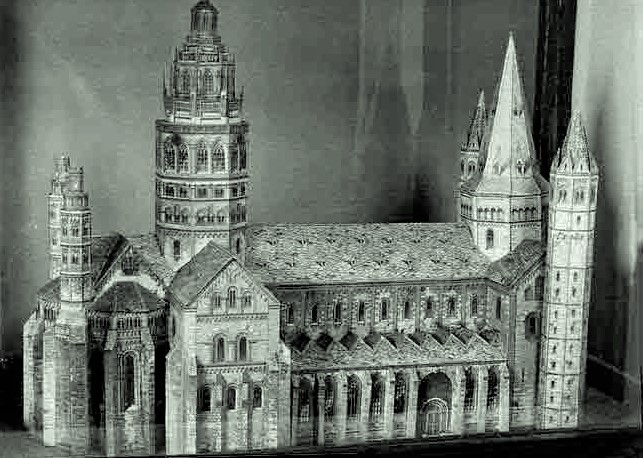
Joseph Carey Merrick’s model of St. Phillip’s church.

  • Play title: The Elephant Man 
  • Author: Bernard Pomerance 
  • Written/first printed: 1979 
  • Page count: 70  

Summary. 

The Elephant Man by Bernard Pomerance tells the story of a person who suffered from a medical disorder that progressively disfigured him. The play is based on the true-life story of Joseph Carey Merrick from Leicester who died aged 27 in the year 1890. The focus of this drama is the transformation of Merrick’s life brought about by the support of Dr Frederick Treves of the London Hospital. Merrick initially made his living as an exhibit in various freak shows in London and Brussels before his move to the London Hospital as a permanent resident. This play may be viewed as a historical drama since it explores the meaning of benevolence in late Victorian London and what effects charity and care had on a recipient such as Merrick. The central theme is normality and how it may or may not be achieved.    

Ways to access the text: Reading/watching. 

The play script is available online via the Open Library and various other sources.  

The play is reader-friendly, however, if you do wish to watch it then the recommended version closest to the original play is a TV movie from 1982 entitled The Elephant Man, which is available on YouTube. This is different from the film version starring John Hurt released in 1980. Pomerance makes an interesting comment in the introductory note to The Elephant Man – “any attempt to reproduce his appearance and his speech naturalistically – if it were possible – would seem to me not only counterproductive, but, the more remarkably successful, the more distracting from the play.” It is important to keep this advice in mind if you do choose to view rather than read the play.   

Why read The Elephant Man 

Dramatization of a true account.  

It seems cliched to recommend a work because it is based on a true story. However, Merrick’s medical condition was so unusual that a replica of his skeleton is still on display in the museum of the Royal London Hospital. Famous books on Merrick include one by his physician, Dr Treves, and one by Ashley Montagu. These texts form the basis of the biographical information for Pomerance’s play. It is relevant for a reader to appreciate that Merrick was a real man with a horrible condition because it adds pathos to the story. Merrick’s condition was formerly thought to be neurofibromatosis but is now believed to have been proteus syndrome. The most striking symptom was bodily disfigurement that consisted of excessive growth of skin and bone in various parts of the body. This left Merrick’s face looking almost alien, made speech quite difficult for him, and facial displays of emotion almost impossible. The circumference of his head measured almost three feet (1 metre) by the time of his death. When one reads the play, it becomes apparent that empathy has a vital role, yet its absence is repeatedly depicted. Knowing that this is a true story makes one consider Merrick’s horrible predicament. He was born a seemingly normal child, but his medical condition later revealed itself and got progressively worse. As true stories go, this one is quite exceptional.   

Death by benevolence.  

Pomerance’s play scrutinises the concepts of personal and societal benevolence and what underpins such attitudes. Upon reading many summaries of this play, one would initially presume that Merrick is saved by Dr Treves either by some medical intervention or through basic kindness and support. Paradoxically, neither of these presumptions is wholly wrong, yet the drama reveals something unexpected. What a reader learns is that Merrick and Treves have almost equal influence on each other, and this is dramatized in their sometimes uncomfortable and challenging interactions. This is not a saccharine tale of how a doctor received a life lesson from a deformed patient; it is an investigation into the often positive but sometimes detrimental results of interference in another’s life. It is up to the reader to decide what eventually kills Merrick. Could it possibly be kindness?   

Post-reading discussion/interpretation. 

Exploitation disguised as charity.  

John Merrick, as we meet him at the play’s opening, is struggling to maintain independence in the most adverse of conditions. He performs in freak shows to earn money and consequently suffers “humiliations, in order to survive.” When he is in Belgium with his manager, Ross, he says, “In Belgium we make money. I look forward to it. Happiness, I mean.” Unfortunately, Ross soon discards Merrick when it is no longer possible to obtain a performance license. Ross additionally robs the deformed man’s life savings. In an ironic twist, Dr Treves had already met John Merrick before this failure in Brussels. Treves had paid Ross “5 bob” for John’s services in London. On that occasion, John was displayed like an exhibit in front of anatomy students, which does not indicate any compassion or empathy on the doctor’s behalf. Indeed, it was because of the disgust of one of Dr Treves’ anatomy students, having learned about how John worked in a freak show, that John had to flee from England. In this light, ever before Dr Treves dramatically comes to the rescue, a reader is fully aware of his less-than-honourable past actions. Upon returning to London from Belgium, Merrick is penniless and vulnerable to an imminent attack from a public mob when he unexpectedly meets Dr Treves for the second time. Merrick, the man who long strived for independence, has been reduced to begging, saying “Help me!” This abject vulnerability is arguably exploited by Dr Treves and the London hospital.  


One may say that Merrick has simply changed masters, from Ross to Treves. For example, Gomm’s letter to The Times newspaper eventually results in sufficient funds “that Merrick may be supported for life without a penny spent from hospital funds.” Yet, Merrick is still held to a contract of sorts, which he mentions in passing to Mrs Kendal. The unwritten contract is not unlike his old contract with Ross: a contract to perform. Under the new contract, Dr Treves expects Merrick to stringently observe the rules. The patient is explicitly made to repeat the phrase “If I abide by the rules I will be happy.” Dr Treves proclaims that he and the hospital will provide “normality” for Merrick. However, they strive instead to make him normal. The demands on Merrick include practising polite conversation, welcoming affluent and influential guests, and responding positively to Treves’ expectations.   

It is necessary to consider the financial aspects of Merrick’s situation. Just as Ross once described Merrick as financial “capital,” Gomm similarly says of Merrick, “he knows I use him to raise money for the London” (hospital). Therefore, Dr Treves’ benevolent actions not only improve the reputation of the hospital, but they result in a financial windfall too. Meanwhile, the doctor publishes several successful papers on Merrick’s medical condition. When Ross returns with a new financial proposition for the quite transformed Merrick, he cynically observes, “You’re selling the same service as always. To better clientele.” Ross once proclaimed Merrick to be a “despised creature without consolation,” This perverse, promotional slogan appealed to the freak show audiences that paid tuppence per ticket. Much later, Gomm addresses a letter to the charitable donors of the hospital to inform them of Merrick’s death, a letter to be published in The Times newspaper. This letter is a true insult to Merrick because Gomm, like Ross before him, manufactures a message that the benevolent public will most gladly consume. The text reads that Merrick “quietly passed away in his sleep” and thus conceals the unsavoury truth that he died of asphyxiation! As such, Merrick is still regarded as “capital.” The paying public must be given what they most desire, namely a feel-good tale, and in return, they will open their wallets and purses.   

It is not reasonable to assert that Dr Treves sets out to exploit Merrick, but it is nevertheless the unfortunate, final result. Financial exploitation is a key issue, but it goes further than that. The two dream sequences of Dr Treves show his own facility for self-criticism, and this is a turning point in the story since the main authority figure realises his mistakes. In one dream, Dr Treves and Merrick undergo a reversal of roles, and Treves is exposed to the callous style of treatment he formerly doled out. Standing before a gawking audience, Dr Treves’ normality is coldly observed and critiqued, including his “vision of benevolent enlightenment.” This vision of Treves has its foundations in Victorian morals and the certainties of a great imperialistic power such as England was at the time. The strongest criticism from Merrick is that Treves is “unable to feel what others feel, nor reach harmony with them. This echoes Merrick’s earlier criticism when the porter, Will, was fired by Treves and Merrick said, “If your mercy is so cruel, what do you have for justice.” Treves was indeed devoid of empathy for Merrick’s situation and went about crudely moulding him into a “normal man,” remaining insensitive to the myriad psychological costs. The final interpretation must be that Dr Treves’ prescribed form of normality is deeply oppressive and leads to the cruel exploitation of Merrick rather than his salvation.   

The church-model metaphor.  

There are several remarkably interesting images and allusions that are repeated throughout the play: the model of St. Phillip’s Church, women’s corsets, and Shakespeare’s Romeo and Juliet. However, it is not possible to consider all of them due to the desired brevity of this discussion, so only the church metaphor will be considered here.    

Pomerance’s introductory note to the work states that “the church model constitutes some kind of central metaphor, and the groping of conditions where it can be built and the building of it are the action of the play.” Once Merrick has seen the real St. Phillip’s, he concludes that “it is not stone and steel and glass; it is an imitation of grace flying up and up from the mud.” In this respect, his church model is an imitation of an imitation as Merrick himself says, and Treves adds that Plato had a similar theory. Indeed, the play presents several episodes where illusion conflicts with reality. To start to unravel the meaning of the church model, one must begin with a working definition of what Merrick means by grace. In its religious sense, a dictionary definition would explain grace as, ‘the unearned favour of God.’ It could also mean ‘elegance of movement’ if one considers the architectural beauty of a church spire reaching high into the sky. In both of these respects, poor Merrick is lacking. He has been made in the image of God, but he quips, “he should have used both hands shouldn’t he” meaning that God did him no favours. Merrick also has a pronounced limp, so he possesses no grace of movement. If the church model is a guiding metaphor, then Merrick is striving to either find or create an environment where he reaches some form of grace. His unfortunate starting point is his painful consciousness of his own incompleteness, his flaws, and his perceived need for transformation.

In the action of the play, Merrick’s gradual completion of the church model parallels his own improvements in speech and manners. At the conclusion of several scenes, he adds yet another piece to the model. It is most significant that Merrick adds the final piece after Dr Treves breaks down and must be consoled by the bishop. Treves compares himself to a gardener who has manipulated nature. He has “pruned, cropped, pollarded and somewhat stupefied” all that is under his care. Dr Treves experiences a crisis because he has made Merrick “dangerously human,” meaning that he has robbed his patient of his unique identity. Treves says, “We polished him [Merrick] like a mirror, and shout hallelujah when he reflects us to the inch.” It is tragic because Merrick was all too willing to conform to the demands of his taskmaster in a desire to reach the elusive status of normality. The “Elephant Man” followed all the rules in a desperate attempt to fit into his new home, and now it seems that the man who decided the rules, Treves, had been wrong all along. The play ends with Merrick’s strange dream of the Pinhead ladies who sing, “Sleep like others you learn to admire.” Merrick had always slept in a sitting position, which was safe for him, so his tragic attempt to sleep like a normal man is the cause of his death. The changes that Merrick hoped would transform him into a man like all others, including his striving for grace, led him on a path of self-destruction. The construction of the church model serves as a foil for his disillusionment. Merrick pursues a model of living normally that betrays him and finally kills him.

Works Cited.

Montagu, Ashley. The Elephant Man, A Study in Human Dignity. Acadian House Publishing, 1971.

Pomerance, Bernard. The Elephant Man. Grove Press, 1979.

Treves, Frederick. The Elephant Man, And Other Reminiscences. Cassell and Company Ltd., 1923.
Happy Days

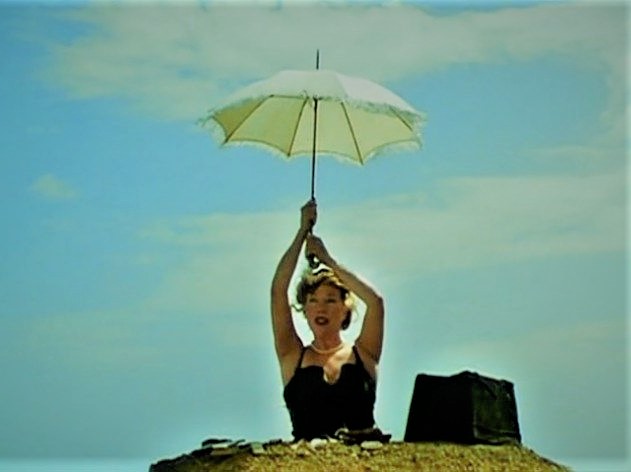
Rosaleen Linehan. Still image from Patricia Rozema’s film, Happy Days. 2000.

  • Play title: Happy Days
  • Author: Samuel Beckett
  • Published: 1961
  • Page count: 65

Summary

Happy Days is a two-act play that explores the most basic needs of human existence. The setting is possibly apocalyptic with its ever-beating sun and barren landscape. There are just two characters, Winnie and Willie, but the play is taken up almost exclusively by Winnie’s monologue. Beckett’s heroine is in the quite unusual position of being fixed fast in the ground up to her waist in the opening scene and remains a prisoner throughout in physical terms. The playwright strips away all the accoutrements of life, leaving just a woman’s handbag and a few other props. In the second act, Winnie becomes further submerged. The ‘action’ of the play is confined to Winnie’s daily routine and her monologue, which touches upon her memories, the contents of her handbag, her songs and quotations, and her personal outlook. The title of the play is one of the catchphrases that Winnie uses at specific times. 

Ways to access the text: Watching

There is an excellent, full movie version available on YouTube entitled Happy Days (uploaded by Oyunnomin Mod). This version runs for 1hr 17mins, and Winnie is played by Irish actress Rosaleen Linehan.

This play text is not reader-friendly (understatement) due to the extensive stage directions that constantly interrupt the characters’ lines. If you do need to consult a written text, then there are copies available online via the Open Library.

Why watch Happy Days?

Winnie is an indomitable character.

In Happy Days, Beckett presents a surreal situation where a woman is initially half buried in the earth and eventually sinks to her neck with only her head remaining above ground. In this play, the author is inviting us to analyse the meaning of a life and not just how that life was initially shaped, but in Winnie’s case, how ‘a life’ is sustained. There are several ways to interpret Winnie, and not everyone sees this character as strong; however, she is acutely aware of her own predicament and shows astonishing resilience. Happy Days is a minimalist work in a fashion that few authors can achieve. There is no plot per se and no real action as the lead character is rigidly fixed in one spot. Yet, Winnie’s monologue is captivating, frivolous, humorous and thought-provoking. This play showcases an extraordinary character by first stripping away all the norms of daily existence and then displaying what remains. The middle-aged, plump, bourgeoise blonde of the play’s opening scene may eventually surprise readers. 

The routines of daily life.

If you watch the play, then you will undoubtedly begin to look upon daily routines in a different light. In Happy Days, routine acts as a sort of anchor. For example, one may interpret Winnie’s daily routine as a link to her past life, her gender role and her sanity, or maybe it is just a way of marking out time or killing time. Winnie, like most people, has a set daily routine. But since it is performed against the conspicuous backdrop of a landscape of sheer nothingness, the reader is being invited to focus more closely on the stages and meanings of the routine. For example, which actions are comforting and which cause distress? It is apparent that her routine is a remnant of a former life, and one may contemplate how such a routine evolves in the first place and why it would persist in a new and unfamiliar environment. For a reader, the idea of a daily routine that offers little space for deviation is simply normal life, but Winnie’s routine makes one suddenly wonder how much of the required discipline is imposed by society and how much is self-imposed?

Post-reading discussion/interpretation.

A middle-class housewife?

How should a reader classify Winnie? Beckett presents her as both an exceptionally ordinary and yet extraordinary figure. To begin, one may list the reasons why a reader could relate to her as a normal character, a familiar type. Regarding her physical attributes, she is a plump woman in her fifties with blonde hair and a large bosom. Her femininity and sexuality are underlined in several ways beginning with her daily routine. The hygiene and beauty routine involves teeth brushing, gum checking, hair combing, lipstick applying, medicine taking and nail filing. This appears not so much vanity as proper personal maintenance. However, when Winnie’s thoughts suddenly create an imaginary scene, then they reveal her personal views of sexuality. The person who represents the third-party view of Winnie is Mr Shower. Yet, he lives only in Winnie’s imagination because as she says, “there floats up – into my thoughts – a Mr. Shower.” This person contemplates Winnie in a slightly demeaning and brutally objective manner: taking note of her bust – “can’t have been a bad bosom … in its day.” He goes on to observe that she is “stuck up to her diddies in the bleeding ground,” and therefore, “what good is she to him like that?”, meaning what good is she to her husband when buried in the ground. As these are Winnie’s own thoughts, one appreciates that her ideas of personal value focus on physical appearance and sexual utility or lack thereof! It is amusing that the man’s name is “Shower – or Cooker,” both of which emphasize the domestic realm. Beckett is openly mocking his heroine as one with a mind that cannot escape domesticity. Then there is the issue of Winnie’s total reliance on Willie, presumably her husband. She can hardly bear the idea of losing him, saying “just to know that in theory you can hear me … is all I ask.” Indeed, her catchphrase of “happy day” is elicited from her by the most minuscule responses from Willie, even by the mere confirmation of his presence. Taking all these aspects into account, if one had to classify Winnie then she is clearly enslaved to the cultural script of traditional womanhood: wife, potential child-bearer, and domestic worker.

However, Beckett also depicts Winnie as the most extraordinary of heroines. One covert hint of greatness comes from the many fragmented quotes provided by Winnie. Even though her memory has become weak, she litters the text with famous literary quotations. For example, from Shakespeare’s plays, “Fear no more the heat o’ the sun” (Cymbeline 4.2.331) and “this bird of dawning” (Hamlet 1.1.175). There is also a distinct phrase from John Milton’s Paradise Lost, “Hail, holy Light” (3.1) Therefore, even though she is a diminished character, she remains somehow powerful and impressive in her state of imprisonment. The most obvious trait of Winnie’s is her exceptional endurance in the face of great adversity. The constant presence of the Browning revolver shows that she is not simply a chatty, idle-minded woman but is consciously counteracting despair. In fact, she had to take the gun from Willie as he had intended to commit suicide. It seems appropriate that this woman with such a merry disposition is the owner of a music box that plays a tune from The Merry Widow operetta. Indeed, singing is how Winnie normally chooses to end her daily routine: a form of defiance even as she sinks deeper into her grave. In Happy Days, Beckett constructs a scene that physically disables his heroine, locking her into the ground, and yet she will not give up. Winnie knows that there is no real hope of relief or escape while laying as she does under a baking hot, unrelenting sun and plaintively asking herself – “shall I myself not melt perhaps in the end.” What Winnie ultimately displays to the audience is how a person’s unconquerable mind may cope by utilising songs, memories, simple daily routines, and optimistic resolve to shore up a great barrier against feelings of despair or self-pity. Therefore, if one blithely dismisses Winnie as the puppet of a cultural script then she counters by showing how she transcends that script, literally turning it into a weapon of defence and survival.

The Ending.

As with many complex works of literature, the ending of Happy Days is not readily understood. The lack of a neat, definitive ending robs the viewer of the satisfaction of having completed the task and understood the play’s message. However, the lack of an ending is exactly what Winnie is struggling with daily, if indeed the timeframe between the “morning” and “evening” bell can be called a day. As viewers, we witness someone suffering, albeit that Winnie puts on a stoical face and defies not just our expectations but the silent expectations of her cruel environment too. One expects death to end the play either by Willie reaching for and using the Browning revolver on her or by the ground finally swallowing Winnie. It seems the ultimate paradox that the play ends in song with Winnie saying “Oh, this is a happy day, this will have been another happy day!” The drama that immediately precedes this finish centres on Winnie’s doubt about Willie’s intentions as he crawls up the mound. She asks, “Is it a kiss you’re after, Willie … or something else.” It is a strange, tense moment because Winnie is at her most physically vulnerable, buried up to her neck now, and maybe her husband will rob her of the only choice she has continually stuck to all this time: to live. However, nothing happens, and her exhausted husband just slides back down the mound. In light of this inconclusive event, the ending seems somewhat absurd because it shows that her husband is now as helpless as she is, and thus the end will come anyway. It appears that Winnie is fully conscious of her fate but will not hasten its arrival. She will eventually greet it with a smile.

The ending of the play prompts one to reflect on the whole of the work. As already discussed, Winnie follows a very structured daily routine that in many respects helps her to make sense of her current existence in a dystopian landscape. While we may become invested in the character of Winnie, she is somewhat of a human marionette that Beckett uses to explore how the last woman alive will cope with the psychological strain of having all the familiar aspects of life stripped away. Winnie herself refers to these reminders as “the old style.” Winnie seems to exist in a loop of almost perfect repetitions. All that changes is her burial depth in the earthy mound. For instance, Winnie says of the parasol that bursts into flames in the hot sun, “the sunshade will be there again tomorrow, beside me on the ground.” Similarly, she says that the little mirror she smashed will be back in her bag tomorrow, intact. Therefore, she is partially forced and partially participates in the overarching routine of her existence, and she will do so until she breathes her last breath. Even if one interprets this as a reflection of the prison of daily life that we all live in, Winnie is a true heroine due to her unflappable poise in the face of unending misery.

Works Cited.

Beckett, Samuel. Happy Days. Grove Press, 1961.

Lehár, Franz. “I love you so.” The Merry Widow. 1905.

Milton, John. Paradise Lost. Penguin Books, 2014.

Shakespeare, William. Cymbeline. Wells and Lilly, 1823.

Shakespeare, William. Hamlet. Cambridge University Press, 2006.

Doctor Faustus

Eugène Delacroix. Mephistopheles Flying, from Faust. 1828.

  • Play Title: Doctor Faustus (The Tragical History of Doctor Faustus)
  • Author: Christopher Marlowe
  • Written: 1588 or 1589
  • Printed: 1604
  • Page count: approximately 45

Summary

Doctor Faustus is an Elizabethan tragedy written by Christopher Marlowe. The play, which is based on the German legend of Faust, exists in two versions: the A-text (1604) and the B-text (1616). It is generally accepted that the A-text is solely Marlowe’s work while the B-text includes another author’s changes and additions. Both versions essentially tell the same story, but scholars advise that they be treated as separate texts.

Faustus signs a deed with the Devil for 24 years of unlimited power in exchange for his immortal soul. The main setting is the university city of Wittenberg, Germany, where Faustus is an eminent scholar. Faustus goes on several fantastic journeys; the episode in Rome receives the most attention. Like most Elizabethan plays, the work has several comic scenes. The central themes explored in the work are those of pride, ambition, and religious faith.

Ways to access the text: reading/listening.

The play is freely available online via Project Gutenberg. The 1604 quarto version includes footnotes, which are particularly important as they provide translations of the various Latin quotes and explain outdated terms and allusions.

There is an audio version of the play on YouTube, entitled, “BBC Radio Drama Doctor Faustus by Christopher Marlowe.” It has a running time of two hours.

Why read/listen to Doctor Faustus?

The first and possibly the best version.  

Doctor Faustus is one of the greatest tales of all time. Marlowe’s dramatization was based upon the German “Faustbuch,” but he was the first to make this story a commercial success on the stage. Innumerable versions of the tale have been told ever since in practically every medium: movies, novels, short stories, operas and even symphonies. Marlowe’s play is not simply about a deal with the Devil, which is a lazy man’s one-line synopsis. It is an engaging and quite complex dramatic work. A man from humble origins goes on to achieve great academic success but his insatiable ambition leads him to make a tragic choice. Only by reading one of the earliest and still most successful versions of the legend will one understand the full implications of a Faustian pact.

A feast for the imagination.

Marlowe’s play is replete with episodes of shapeshifting, invisibility, transportation, and conjuration. Faustus becomes a great master of black magic, so one gets to read fantastic scenes that will fully come to life in one’s mind. It is a wonderful play for a modern reader whose imagination is already stuffed full of fantastic scenes from movies. For example, when Mephistopheles first appears to Faustus, he is so grotesquely ugly that he is asked to change his shape by the terrified mortal. When Faustus soon asks his new servant, Mephistopheles, to supply him with a wife then the results are both amusing and hideous.

A deal that no one can refuse.

At the heart of the play is the deal that Dr Faustus makes with the Devil. It is too simplistic to say that Faustus has been tricked when he signs away his soul. Faustus is an exceptionally intelligent and astute man so the crucial question is how he could sign the deed as assuredly as he does. What Marlowe explores is how Faustus or any one of us will respond when we seem to have attained our wildest desires through a simple deal. What makes Marlowe’s play complex is how he exhibits Doctor Faustus’ psychological response to this agreement as time goes on. One sees how distractions and illusions cloud Faustus’ mind, and one gradually learns what makes this deal so important. If all deals are breakable, then why exactly does the deal at the centre of this play cause such problems? Should one beware of whom one makes a deal with, or is it paradoxically that one should beware of one’s own wishes? The play answers such questions.

Post-reading discussion/interpretation.

Multiple ironies.

Many people would not identify irony as one of the key features of the play. However, it has a vital role. For example, Faustus first practices his magic incantations to “try if devils will obey my hest.” When Mephistopheles immediately appears, Faustus genuinely believes this devil to be under his command. On the contrary, Mephistopheles makes it clear that Faustus’ blasphemous behaviour has put his soul in danger of damnation and that devils naturally rush to such a scene for the potential prize of a soul. This declaration by the Devil’s associate sets the tone for the entire play. Faustus is enamoured with his feeling of power: never fully accepting its false and fleeting nature.

Another major irony is the fact that Faustus signs an agreement with a representative of Hell that consigns his soul to eternal damnation while he simultaneously holds to his belief that Hell is no different from the pagan Elysian Fields (i.e., no punishments). What proof of a fiery Hell would satisfy Faustus if not the physical presence of one of its chief emissaries? Why does Faustus additionally ignore Mephistopheles’ plain admission that he himself is tormented in Hell? This devil even advises Faustus to “leave these frivolous demands” when referencing magic. The tantalizing fulfilment of Faustus’ wildest dreams overwhelms his normal capacity for critical thought, making him vulnerable.

The final and greatest irony is that Faustus’ wish for the power granted by Lucifer eventually thwarts his long-held ambitions instead of fulfilling them. With black magic at his command, Faustus initially declares “I’ll be great emperor of the world.” Despite that, he ends up conjuring spirits of the dead for the entertainment of a real ruler, Emperor Charles V, or getting grapes for the pregnant wife of the Duke of Vanholt, but he never achieves his own goals. In summation, Faustus refuses to acknowledge that the devils always hold ultimate power, that Hell is a real and horrible place, and that his dreams have disintegrated into dust. This is evidence of structural irony in Marlowe’s work; a fallible character, Faustus, fails to gain true insight into the various predicaments he encounters because his reasoning is fundamentally distorted by his prejudiced view. Readers comprehend these situations objectively, and this is how Marlowe communicates Faustus’ brain fog, which was brought about by the intoxicating deal that promised too much.

The unbreakable deal.

Why is the deal that Faustus makes with Lucifer apparently unbreakable? In other words, why must he end up in Hell? There are various interpretations of the play, for example, that Faustus is predestined to be damned, that he loses hope of salvation and despairs, or that he is simply too proud to mend his ways. If one considers Faustus to be predestined for damnation in the religious sense, then the play loses all value as a tragedy because the conclusion holds no surprise. Interestingly, the Chorus open the play by comparing Faustus to Icarus, “his waxen wings did mount above his reach,” which foreshadows his imminent fall. In Faustus’ own last words, he cites fate as the reason for his downfall, “you stars that reigned at my nativity / whose influence hath allotted death and hell.” Nevertheless, it is demonstrated in the play that Faustus has numerous opportunities to break the deal with Lucifer and thereby save himself. The play is deliberately named The Tragical History of Doctor Faustus as he is a man with free will. Therefore, we must consider pride and despair as the key factors in explaining why Faustus does not or simply cannot save himself.

The deal with Lucifer and its potential dissolution are two separate issues. Faustus first signs a legal deed thus promising his soul to the Devil; this is the one-time physical act of putting a blood-wet pen to paper! After this, Faustus proceeds to indulge in a series of misdeeds as part of his new life path that he has consciously chosen. In this respect, the initial signing merely gestures toward but does not actually initiate his slow and tragic descent into Hell. This interpretation explains why any thought of dissolving the deal is not simply a rejection of an old mistake but is instead a rejection of the path he enthusiastically follows for so long. Faustus is an eager minion of Lucifer. To prove his mettle, Faustus blasphemes the Catholic Church, disrespects the Pope in the Vatican, and repeatedly conjures souls from the dead. To renege on the deal would mean the loss of all this power and advantage. However, when Faustus is ultimately faced with Hell as his new home, one may ask why he does not break the deal.

Many representatives of God offer Faustus hope. The Good Angel says, “never too late, if Faustus can repent,” and the Old Man advises Faustus to repent and save himself. At one point, Faustus says “My heart’s so harden’d, I cannot repent.” He despairs at his own litany of misdeeds. The consolations offered by the good side are countered by blood-curdling threats from the evil ones. For instance, the Bad Angel says to Faustus, “if thou repent, devils shall tear thee in pieces,” and Mephistopheles threatens, “I’ll in piece-meal tear thy flesh.” In the end, Faustus feels his wrongs are so injurious to God that he can never be forgiven. He says to his scholarly friend, “Faustus’ offence can ne’er be pardoned.” Before Lucifer comes to collect on his deal, Faustus shudders before a God that he believes can only be punishing, “hide me from the heavy wrath of God.” It is Faustus’ excessive pride and his belief that he has offended God in a way no other man could that seals his fate and blocks his redemption. One must try to understand the psychology of a man who cannot see beyond his sin. A man who, through feeling lost, does indeed become lost.

Works Cited.

Marlowe, Christopher. Doctor Faustus and Other Plays, edited by David Bevington and Eric Rasmussen, Oxford World’s Classics, 2008.