
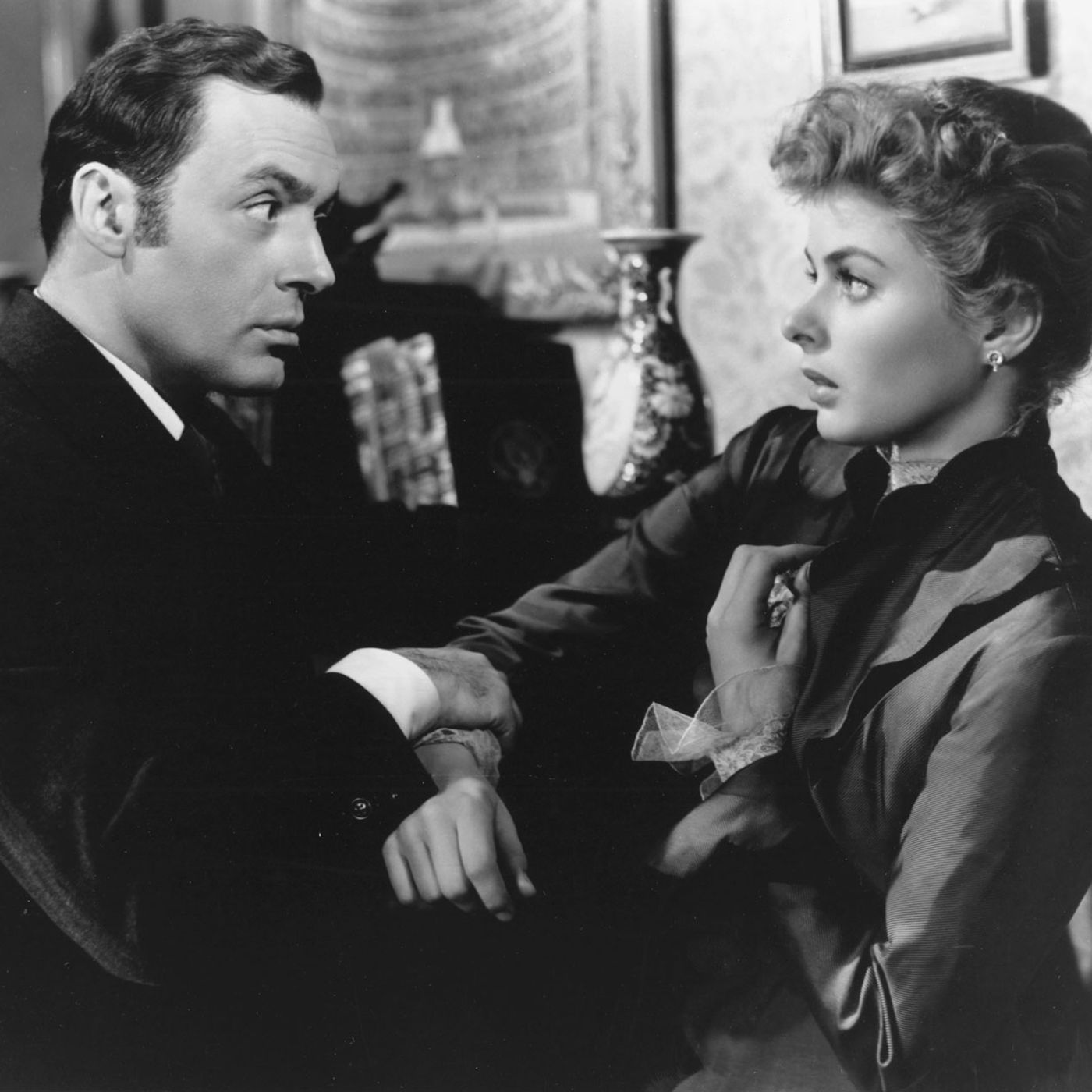
A still image from the 1944 movie Gaslight
- Play title: Gas Light (Angel Street)
- Author: Patrick Hamilton
- Written: 1938
- Page count: 108
Summary
The year is 1880, and the setting is a house on Angel Street, Pimlico, London. Mr and Mrs Manningham have lived in the area for six months now. He’s a quite handsome, middle-aged man, while she is pretty and in her mid-thirties, but she looks quite nervous and pallid of late. They are a middle-class couple with two housemaids named Elizabeth and Nancy. A rumour has already spread in the locality that Mrs Manningham (Bella) is losing her mind. She fears for her sanity too. No one is quite sure what happens behind the closed doors of the house on Angel Street – until Detective Rough arrives on Mrs Manningham’s doorstep one felicitous evening. Revelations about an old murder case, the eternally locked 4th floor of the house, and mysteriously dimming gas lights all lead to a strange discovery. The strangest thing is that Bella somehow knew all along.
Hamilton’s play is aptly subtitled “A Victorian Thriller.” The crux of the story, as one may guess from the well-known title of Gas Light, is that “Under the guise of kindliness, handsome Mr. Manningham is torturing his wife into insanity” (Hamilton 8). The play was the inspiration for director George Cukor’s 1944 movie Gaslight, which starred Ingrid Bergman. The main theme of the original play is relentless emotional manipulation and torture, which one now readily terms ‘gaslighting’ thanks to Hamilton’s work.
Ways to access the text: reading/listening/watching
The text of Gas Light is easy to find online. For instance, the Internet Archive holds a copy. It is also available to current members of Scribd. Please note that the play’s original title was Angel Street, and some sources still list it as such.
There is also a free audiobook of Gas Light on the Internet Archive under the title “Patrick Hamilton: BBC Radio Drama Collection.” This is an anthology, but the running time of the radio dramatization of Gas Light is 1hr and 56mins. English actress Emilia Fox plays the part of Bella.
The 1944 movie adaptation of the play is quite famous and highly rated. However, the movie departs from the play on one crucial point, which leads to a slightly different overall interpretation. Ardent fans may choose to read the playscript first and then watch the movie.
Why read Gas Light?
The most compelling reason to read Hamilton’s Gas Light is that the play subsequently prompted the branding of a specific type of interpersonal manipulation as ‘gaslighting.’ The play is not a finessed work of art but rather a classic whodunnit tale, which is told in sometimes melodramatic fashion. Nonetheless, it is a highly engaging play due to the subject matter. Bella Manningham doubts herself so much that it makes her defenceless: paralysed into utter submission. Hamilton provides captivating depictions of Victorian-era patriarchy, misogyny, mansplaining, and narcissism. The tactics used by Jack Manningham on his wife read like a checklist of gaslighting red flags. It is fascinating to read the text that pre-empted one of the major psychological buzzwords of the 21st century. Few plays can claim to have had the social repercussions of Hamilton’s Gas Light in raising awareness of a specific type of psychological abuse.
Post-reading discussion/interpretation
The Validity of the Victim’s Emotional Lens in Gas Light
Introduction
Paul Cezanne once wrote, “A work of art which did not begin in emotion is not art.”
Gas Light is a startling play for several reasons but chiefly due to Hamilton’s extraordinary insights into the plight of his teary-eyed heroine. He depicts a woman who is highly strung, and who stands right on the edge of sanity. The playwright then gradually reveals a sordid backstory of tricks, lies, and emotional mind games that her husband has orchestrated to bring her to this precarious point. The horror of the play is not the murder of Alice Barlow but rather the more innocuous yet cumulatively unsettling things like footstep sounds, an ultimatum over a grocer’s bill, and a missing brooch. Hamilton describes a Machiavellian plot deliberately built upon the most mundane, everyday transgressions because this makes the game even harder to detect and expose. Unsurprisingly, Bella ends up emotionally frayed, edgy, and dysregulated. The tone of the work is highly emotional, categorizable as melodramatic, but this is a strength rather than a flaw. Amid the sensational, psychological action of the play, Hamilton indirectly divulges why Bella has become so impossibly entrapped in her vile marriage. Gas Light is a classic whodunnit, but Hamilton is also artistically exposing a common horror of everyday life. The play is not only an excellent exposition of gaslighting, but also an exploration of how a woman (or man) may get locked into a horrific situation. The prodding questions of Detective Rough reveal that Bella had repressed key deductions about her domestic situation, but they remain subconscious until someone else validates her opinion. No doubt, Hamilton himself was a victim/perpetrator/observer of gaslighting, otherwise, he could never have delineated the game so perfectly.
Gas Light is part thriller, part horror, and part melodrama. Commercial theatrical works pitched in such a high emotional key may invite scorn more readily than thoughtful criticism – especially when populated by stock characters like the dogged Detective Rough and the stereotypical, cockney housemaid Nancy. However, Bella is pitch perfect as a woman who may be either genuinely unstable or simply frazzled by the secret war of psychological destruction being waged against her. A depiction of an overwrought female heroine can activate repressed, gendered prejudices within an audience, but this works to the play’s advantage. Each aspect of Hamilton’s play – such as the historical setting, the type of abuse, Bella’s family history, and the authoritarian character of her rescuer – is an informed choice. Each element is perfectly complementary to a depiction of a woman about to walk off the edge into an abyss of madness. At first, one is inclined to doubt Bella because she is incapable of composing herself. Her nerve endings tingle painfully at the exact point where she meets the world. Hamilton concocts a dramatic scenario within which one ultimately finds the truth of her magnified emotions. The various building blocks of the play, like the historical setting, reveal various aspects of Bella’s predicament. Hamilton achieves a delicate layering of meaning until his audience finally reaches the realisation that this foray into a whirl of emotion has been an opportunity to adopt, even if reluctantly, the validity of the victim’s lens on the world.
Victoriana of the criminal and literary kind
Hamilton wrote Gas Light in 1938 but set his play in the year 1880 so that he could capture the unsettling mood of an era. His characterization of Jack Manningham is enhanced by implicit references to the crimes and literature of the late Victorian period. Gas Light tells the tale of the brutal murder of Alice Barlow: an elderly lady whose throat was cut in her own home. Such crimes instil widespread fear just as the real-life killers of the late nineteenth century shocked society. Hamilton initially presents an unsolved murder case that is already fifteen years old. An unknown killer walks with impunity through the bustling streets of London; it is an eerie thought. Of course, the most famous unsolved murders of the Victorian era are those of the five women killed in the Whitechapel area of London in late 1888. All of them had their throats cut along with other, almost unspeakable bodily mutilations. However, Jack the Ripper, as he became known, was just one among many killers who never faced justice. For instance, there was the Great Corman Street murder of 1872 where Harriet Buswell “was found in her blood-soaked bed with her throat cut from ear to ear” (Bondeson). Jan Bondeson also writes of a notorious series of killings; “In the 1880s and 1890s, a number of young girls disappeared in West Ham and its environs, some without trace, others being found murdered and raped. In all, there were seven victims from 1882 until 1899.” The most brutal crimes frequently involved female victims like the Thames Torso Murders (Davidson). Between the years of 1884 and 1889, body parts of four separate women were found in various locations in London including Whitechapel, the Thames, and Tottenham Court Road. Hamilton cleverly utilises the pall of fear that hung over London in the 1880s to enhance the atmosphere of his play.
The playwright is also covertly referencing the literature of the time, especially the Gothic novels of the 1880s and ’90s. Jack Manningham is a man with two distinct personalities: a killer but also a seemingly loving husband. In 1886, Robert Louis Stevenson’s novella entitled Strange Case of Dr Jekyll and Mr Hyde was released. Greg Buzwell writes that the “implication that the criminal could lurk behind an acceptable public persona, and that appearances might provide no real indication of the personality within, rendered Jekyll and Hyde a particularly disturbing work during the late 1880s.” Oscar Wilde offered his own variation on this theme with The Picture of Dorian Gray (1891). Dorian is also a secret killer whose identity is perfectly concealed by his good looks and sophisticated manner until a grotesque corpse (of the real Dorian) is found in his attic room. Bram Stoker’s Dracula is yet another example of a mysterious man of dubious background who nonetheless effortlessly accesses London’s elite society while managing to hide his insatiable blood thirst. Like these esteemed literary creations, Jack Manningham is also a creation, but his creator is the cold-blooded killer named Sydney Power. The protective veneer of respectability, a complete fabrication, is almost impenetrable.
Playing a role
Jack Manningham’s double life is ironically revealed in his musings about acting. He shares with Bella that he had a childhood ambition of becoming an actor. During their discussion about the prospect of going to see Mr McNaughton, the celebrated London actor, Jack contemplates anew the “superb sensation. To take a part and lose yourself entirely in the character of someone else” (Hamilton 14). The role of ‘gaslighter’ is analogous to that of a stage actor role, just deadlier. In the ensuing discussion between Jack and Bella about a potential trip to the theatre, Hamilton presents a masterclass of interpersonal manipulation. Bella, who according to her husband, has “been very good lately” (10) is to be treated to a night out. Jack asks Bella if she wishes to see Mr McNaughton in a comedy or a tragedy, and he elaborates that Bella needs to choose whether she wants to laugh or cry (10). It is an ingenious set-up line in the context of this scene because it suggests her active choice to experience an emotional high or low. At the surface level, the question relates to what response will be conjured up in an audience member who becomes engrossed in a powerful stage performance. At another level of signification, the line relates to Jack’s performances in his own home and how he expertly sets the mood and tone of Bella’s days. She has chosen this actor (Jack), so at some level, she has also bought into this ongoing domestic performance (or has she?). For example, Bella is ecstatic upon hearing that Jack will bring her to the theatre but within mere minutes he assumes faux outrage over an apparently missing picture on the living room wall. By the time the argument is over, she has been shamed and humiliated and is feeling faint (23). Bella traverses a whole gamut of emotions – but quite involuntarily. Jack baits her with his charm and an offer of a special treat before demeaning and berating her. Bella’s responses are wholly visceral; she first feels the glow of appreciation and renewed love for her husband and then she becomes confused, unsettled, and upset over the strange accusations that quickly follow. The scene exposes the merciless toying of one individual with another’s emotions in a cruel power game.
The spectre of the madhouse
Gaslighting is “psychological control where the perpetrator will use specific behaviour and tactics over time to gain power by causing the victim to lose their sanity, memory and self-worth” (Guy-Evans). In a 1969 issue of The Lancet (an English medical journal), Barton and Whitehead submitted an article entitled “The Gas-Light Phenomenon.” They directly referenced Hamilton’s play, and their research concerned the question of whether this phenomenon was documented in real-life medical cases. The main conclusion of the article is that “The medical literature does not appear to have many accounts of plots of this type” (Barton and Whitehead, 1258). However, they provide information on a few cases that do concur with Hamilton’s theatrical scenario. One case was of a 48-year-old man who had been married to his wife for ten years and had three children. He was signed into a psychiatric hospital by his general practitioner based on information provided by his wife. She claimed he was mentally ill and had become physically violent too. In contrast, the man “said he had felt tense and depressed for about six months and related this to this wife’s changing attitude towards him” (1259). He explained that his wife had become “cold” toward him and he “described symptoms of anxiety and depression which fluctuated according to his wife’s behaviour” (1259; emphasis added). Indeed, Guy-Evans explains that “Gaslighting can strain mental health and could cause feelings of anxiety, depression, or other mental health concerns.” The man was soon found to have no mental illness, and after twelve days of rest and recuperation, he was deemed well. Like this patient, Bella intuitively responds to her marital environment. She does not set the domestic mood but rather is carried upon it. For instance, she credits her temporarily improved health to the fact that her husband has been “so much kinder lately” (Hamilton 11). Bella specifically recounts a recent night when Jack stayed home and played cards with her like old times, and she “went to bed feeling a normal, happy, healthy, human being” (11). Jack does not accept this theory. Cunning as ever, he speculates whether her medicine has simply begun to work. Each antagonistic comment serves to chip away at his wife’s sense of sanity. The exemplar provided by Barton and Whitehead underlines just how effectively a healthy individual’s mental health can be undermined by a determined gaslighter.
One of the key symptoms of being gaslit is that a person “start[s] worrying that there is something wrong with them or they have a mental illness” (Guy-Evans). This fear is compounded in Bella’s case due to a presumed genetic susceptibility to insanity. She confides in Detective Rough, – “My mother died insane, when she was quite young. When she was my age” (Hamilton 34). Such fears were well founded. In an article entitled “Victorian Women and Insanity,” Elaine Showalter explains, as follows, the medical theory of that era relating to a history of madness in families.
‘A “predisposition to derangement” meant an inherited mental structure, a tyranny of nerve organization which was almost inescapable. Such predisposition was more readily recognised in women than in men.’
(Showalter 170)
Showalter also provides historical accounts of the atrocious conditions in England’s mental institutions in the 18th and 19th centuries. For instance, “In the eighteenth century, visitors to Bedlam paid their pennies to see howling maniacs, naked and chained, alien creatures in whom irrationality and filth had reached the extremes of the recognisably human.” (Showalter 158). When Bella says, “I may be going mad, like my poor mother” (Hamilton 21), she is also unavoidably contemplating the prospect of being involuntarily institutionalized. If one follows Hamilton’s fictional timeline, then Bella was born in 1846, yet “As late as 1844, the Commissioners in Lunacy found lunatics confined in dark and reeking cells, strapped down to their beds or to chairs” (Showalter 158). If Bella ever visited her mother in hospital, then such sights would be ingrained in her memory. By depicting Bella as a woman with a family history of madness, Hamilton accentuates her vulnerability to gaslighting since her fears arise from two distinct sources: subjective experience and seemingly inescapable heredity. The only person that she can rely upon is her husband. This is the same man who cautions her – “If this progresses you will not be much longer under my protection” (Hamilton 21). If Bella is not allowed to live at home on Angel Street, then the only alternative is the madhouse.
Jack Manningham exhibits the power to drive his wife insane; he also has the power to have her locked away in a madhouse, which is his plan. Showalter explains that in Victorian times, “It was easy for fathers, brothers, and husbands to find doctors willing to certify that sexually rebellious women were lunatics” (173-174). There is no indication that Bella has been sexually rebellious; however, “An independent will could be regarded as a form of female deviance dangerously close to mental illness and nearly as subversive as adultery” (174). Female writers of the late 19th century “drew attention to the abuses of the system, and especially to the power that could be exerted by vengeful husbands over erring wives” (174). Jack Manningham’s underhand tactics are aided by a medical system that will easily allow him to disempower his wife and have her locked away. Bella struggles with the combined fears of a horrid genetic inheritance and a subconscious inkling that her husband is deceitful and treacherous. The threat of institutionalization will suddenly be heightened when an uncharacteristically rebellious Bella begins to question her husband.
Gaslighter
Jack Manningham’s motivation to mentally torture his wife may be found in his personality type. Men who engage in gaslighting techniques are typically narcissistic, sociopathic, or even psychopathic. The psychological manipulation named gaslighting is about three key issues: control, lack of empathy, and the desire for a specific goal. Olivia Guy-Evans explains that “Gaslighting is a form of psychological abuse whereby a person or group manipulates one or more people into questioning their sanity and perception of reality.” However, the tactic and the ultimate goal are often difficult to piece together. The goal may be a tangible, material object such as in Hamilton’s depiction, but it may equally be an abstract, sadistic mission to destroy another person. In Gas Light, the audience is soon presented with Jack’s goal, which reveals how disposable his wife has become to him.
Detective Rough asks Bella what precisely has changed in the last six months to make her question her sanity (Hamilton 34). She explains that soon after moving into the new house she began to hear strange noises at night through her bedroom ceiling. Then she noticed how the gas lights faded or flared for no apparent reason. Soon, Bella began to question the workings of her mind and the reliability of her memory since she kept losing objects given to her for safekeeping. Her husband’s rings and cuff links would mysteriously end up in her workbox (sewing kit). Matters escalated when Mr Manningham accused his wife of injuring their little dog’s paw, which was an incident she could neither recall nor fully deny despite her distress over the accusation. Bella is ashamed that she may indeed have hurt her dog, and shame is a key tool of gaslighters. Mr Manningham regularly stirs his wife into emotional scenes through his deployment of false accusations, and then he summons the staff on some whim so that they will witness Bella’s flustered, erratic states. She is embarrassed in such situations. Mia Steiber writes that “gaslighting is often coupled with other tactics such as shaming and any other way to make the victim doubt their own judgment.” Bella becomes progressively less sure of herself. The beginning of Bella’s problems coincides with the purchase of their house. Jack convinced his wife to use her savings to buy the property (Hamilton 31). Mr Manningham evidently begins to gaslight his wife because he has already tricked her out of her inheritance and no longer has any use for her, so he wishes to rid himself of her. The acquisition of the house on Angel Street will allow Jack endless opportunities to find “the Barlow rubies” (74). Bella is demoted to a secondary concern: dead weight to be disposed of efficiently and quickly.
In this horrible scenario, a contributing factor to Bella’s predicament is her social isolation. Mia Steiber writes of how “The perpetrator [gaslighter] will often blatantly lie to the victim, making them feel insecure and alienating them from their friends and family.” In Bella’s case, her husband withheld a conciliatory letter from her family who had previously shunned her due to her marriage (Hamilton 69). Bella wrote to them twice, but her husband hid their response, which included an invite to their home in Devonshire. Separated from her family, Bella’s daily interactions are solely with her husband and household staff. Her vulnerability is enhanced once Mr Manningham begins to undermine her reputation – “The gaslighter may also spread rumors or lies about the victim, subtly telling others that they are emotionally unstable so that people may even side with the abuser without knowing the full story” (Guy-Evans). Mr Manningham first targets the housemaid Elizabeth by telling her “I’m at my wit’s end” (Hamilton 64), before telling her of how Bella’s mother died in a mad-house, and the urgent need to get a doctor to assess his wife. This supports Manningham’s goal, which is that Elizabeth will betray her mistress – “You can testify to what goes on, can’t you?” (65). The request is couched in mock sincerity, but it means certain institutionalisation for Bella. Manningham also hints that Elizabeth will receive a significant financial benefit for her testimony (66). The master’s tactics with Nancy are quite different but no less strategic. He flatters the young girl’s beauty and leads her to believe that he is sexually attracted to her. Nancy is confident, even haughty, and foolishly believes that Manningham is now under her spell – “You’re mine now—ain’t you—’cos you want me” (85). Instead, Manningham simply needs her short-term cooperation to play tricks on his wife. Nancy had been attracted to Manningham from the start, and her gossiping nature had already led to Bella’s public reputation as “the lady who’s going off her head” (29). Detective Rough humorously refers to Nancy as the “leakage in this household” (32), which means rumour-monger. Socially isolated and without allies, Bella will become the defenceless prey to her husband’s evil plan. Hamilton helps an audience to quickly understand gaslighting because he depicts it as a tactic in the Machiavellian arsenal of an avaricious thug like Manningham.
Aiding one’s torturer
In Gas Light, Hamilton brings a somewhat controversial aspect of gaslighting to the fore. In his depiction of the married couple, one begins to wonder why Bella is blind to her husband’s machinations. Paige L Sweet sheds light on this issue by quoting Robin Stern, author of The Gaslight Effect (2007) – ‘gaslighting is a phenomenon of “mutual participation” between “gaslighter” (perpetrator) and “gaslightee” (victim)’ (853). The phrase mutual participation can easily be read as denoting full consent by the victim, which is problematic. However, Hamilton displays with some finesse how this particular and unusual type of consent is provided, namely through the victim’s utter self-doubt and inaction. One also needs to concede that a bond exists between Bella and Jack because they have been married for five years, of which four and a half years have apparently been happy. She still clearly loves her husband and prefers to associate her problems solely with the strange house (Hamilton 34) rather than his behaviour. Psychologist Noosha Anzab explains that “gaslighting can happen in relationships (whether personal or professional). This is because of power dynamics where the victim trusts the gaslighter and is confused by the perpetrator’s behaviour” (Steiber). Not only is Jack the trusted husband of Bella, but his personality type plays a significant role too. Hamilton describes this character as “suave and authoritative, with a touch of mystery and bitterness” (Hamilton 3). Jack never falters, even when telling his wife blatant lies – “The perpetrator will often assert something with such intensity that the victim believes them and questions their own sense of reality” (Steiber). It is more difficult for an insecure woman to question a charismatic, confident man, especially in Victorian times. Moreover, to question him is to risk revealing his false façade and thereby further risk her own well-being.
Despite Bella’s initial reluctance to doubt her husband, their matrimonial situation deteriorates to a point where she must do so. After Manningham has extensively gaslit his wife about the missing wall painting, he pushes it too far when he mentions the grocer’s bill. The manipulative game-playing reaches its climax and Bella, made even more unsure of herself than normal, suddenly retorts in raw anger – “This is a plot! This is a filthy plot! You’re all against me! It’s a plot!” (Hamilton 25). Since Bella has retracted her ‘consent’ by inadvertently revealing the truth, Manningham must raise the stakes. He threatens to hit her, lock her in her room, and adds a future promise to have her seen by a doctor/s. The last threat is directed toward Bella’s biggest insecurity, namely that she has inherited her mother’s mental illness. Soon after this incident, when Detective Rough asks Bella if she suspected that the frightening noises from the fourth floor were her husband, she responds – “Yes—that is what I thought—but I thought I must be mad” (35). Bella’s own investigation about the changing brightness of the gas lamps plus the associated comings and goings of her husband had already led her to a solid, logical conclusion – but one that she could not readily admit to herself. Even though she challenges her husband, it is done when she is at a breaking point, and he responds by doubling down on his threats to her. In simple terms, Bella knew the truth for some time. However, as shown by Hamilton, the situation is so intense that the concept of consent is wholly unsuited to Bella’s predicament.
The little clues
The gas lights, Alice Barlow’s brooch, and the grocer’s bill all hold specific significance in Hamilton’s play. The signals from the gas lights alert Bella to her husband’s duplicitousness, which she greatly fears due to her current, vulnerable state of mind. She somehow knows yet doesn’t want to accept that her husband is betraying her. She is also unclear as to the full nature of the betrayal. Bella’s brooch was a gift from Jack, and the brooch has a secret compartment – “It is a sort of trick … It opens out like a star” (Hamilton 73). Much like the lights, Bella discovers the secret but fails to comprehend that the “beads” (73) hidden within the brooch are actually rubies! Since the brooch was stolen from the corpse of Alice Barlow, it is the only evidence linking Mr Manningham aka Sydney Power to the old lady’s murder. Lastly, the grocer’s bill, a mundane reminder of everyday household expenses, is what threatens to precipitate Bella’s confinement to a mental institution. Bella rediscovers this ‘missing’ bill just as she is about to free her husband from the arms of the law. Up to this extremely late point, Bella still consents to her subjugation due to her denial of her husband’s true character. But the bill proves too much since her husband had used it to threaten her with eternal banishment to a madhouse. She now realises that he deliberately hid the bill, so she finally rebels in the most meaningful way by breaking free of him. Hamilton’s nuanced depiction of the way Bella acquiesces to her predicament reveals that gaslighting is never actually a question of straightforward consent. The little clues show that one can almost fully comprehend the significance of something and yet be missing a final moment of cold realisation and acceptance. Bella only leaves her husband when she understands that his trickery doubles as a confirmation that he never genuinely loved her.
Conclusion
Every aspect of Hamilton’s play is quite precisely crafted. For instance, at the opening of the work, the author introduces us to the scene as follows – “The Curtain rises upon the rather terrifying darkness of the late afternoon—the zero hour, as it were, before the feeble dawn of gas light and tea” (Hamilton 3). ‘Zero hour’ is a military term used to describe the commencement of an operation and it is quite apt to describe Mr Manningham’s assault on his wife’s sanity. The story brings one to Victorian London and introduces Manningham as a sort of Jekyll and Hyde character with a hint of Jack the Ripper too. This ‘gaslighter’ is playing a role; he is an actor who commands the attention of his personal audience of one in a theatre of horrors on Angel Street. Bella, the wife, is an emotionally frail, unknowing participant in a game of wits. Her heredity of madness makes her husband’s taunts all the crueller since she fears the mad house where her mother ended up. For Bella, the truth is always liminal because she only half understands the significance of things due to her heightened emotional state and her husband is constantly undermining her tenuous grasp on reality. In short, Hamilton pits the cool-headed, authoritative, charismatic villain against a highly strung, flustered, eternally uncertain woman. It is a match between rationality and emotion but with an unexpected result.
Inspector Rough is the perfect foil to Jack Manningham but only because he seeks justice. In all other respects, they are the same character: overly confident, high-handed, condescending, and sexist. When Rough methodically lays out his theory to Bella, she responds by saying – “You are so cold. You are as heartless and cold as he is” (Hamilton 50). Bella will ultimately betray her husband on Inspector Rough’s instigation, which underlines her vulnerability to this type of character. Inspector Rough’s motivation is to solve an old murder case and Bella Manningham’s cooperation is essential for this task (53). She is of no particular interest to him beyond the acquisition of his chief goal, which is to arrest the villain named Sydney Power. In a single evening, Inspector Rough warps Bella’s reality in ways that even gaslighting would struggle to achieve; her husband Jack is a murderer, he cheats on her with actresses, the name Manningham is an invention, their marriage is not even legal, and he’s been lying to her so that he can eventually have her committed to an asylum. Once Rough has found the brooch, which proves a link to the murderer, he dismisses Bella by telling her to go upstairs to her bedroom (74). The inspector even slaps Bella across the face in the final scene when she becomes too emotional for his taste. In this light, Hamilton’s play is a stereotypically sexist work, but it isn’t really.
Gas Light is an exploration of the truth contained in what sometimes looks like the irrational, emotional rantings of an unstable woman. It is a call to go against the grain and give credence to a testimony even when it is confused, flustered, and unpolished. As explored in this essay, a myriad of interlocking factors bring a victim of gaslighting to a crisis point. Paige L Sweet has looked at the social characteristics that give gaslighting its power and has determined that “gaslighting is effective when it is rooted in social inequalities, especially gender and sexuality, and executed in power-laden intimate relationships” (852). This perfectly fits Hamilton’s depiction of a vulnerable, married woman in the highly patriarchal society of 19th-century England where a husband’s testimony could easily have her committed to an asylum. In particular, the gender issue is constantly being emphasised in the play. Sweet explains that “The ability to leverage an accusation of ‘crazy’ is gendered. The idea that women are overly emotional, irrational, and not in control of their emotions has a long history” (855).
On the other hand, it is supremely counterproductive to expect that a ‘gaslightee’ will not become emotional after being subjected to prolonged periods of a falsified reality, so to speak. Unsurprisingly, gaslighting usually achieves its essential aim – “Emotional confusion appears to be the base of a gaslighter’s agenda, so this may work well on someone who already does not trust their own judgment” (Guy-Evans). Mr Manningham chooses his wife based on her family history because he expects she will be easier to undermine, and this proves to be correct. Even experts seem to muddle this topic because Sweet writes that – “In gaslighting dynamics, the idea that women are saturated with emotion and incapable of reason is mobilized into a pattern of insults that chip away at women’s realities” (861). This could be read as a plea for the victims of gaslighting to present a cool, confident, coherent account of their experiences. This is nearly impossible since “Those experiencing gaslighting may often feel confused about their version of reality, experience anxiety, or be unable to trust themselves” (Guy-Evans). Hamilton understands this crucial point because he presents a woman who endures a crazy-making experience and, unsurprisingly, ends up “hysterical and with homicidal rage in her eyes” (Hamilton 107). Bella is nonetheless the victor since she holds the power in the end; she literally holds a razor blade beneath her husband’s face and has the choice of freeing him or killing him. She chooses neither. Instead, Bella enacts her revenge by playing mad for her husband: a bitter lesson for the ‘gaslighter’ who had toiled so long to make it happen but now desperately needs her help.
Gas Light is an enduringly popular play on account of its surprisingly insightful depiction of a specific kind of abuse. The heroine is locked in an impossible situation until an authoritative outsider corroborates her account – “It’s true, then! It’s true. I knew it. I knew it!” (Hamilton 35). However, Hamilton is not writing about victimhood, but rather about the truth that often lies hidden in erratic, confused accounts of domestic madness. The cool, composed voice of a male authoritative figure is sometimes just another confidence trick and one that plays expertly on one’s inherent, gendered prejudices.
Works Cited
Barton R., Whitehead J.A. “The Gas-Light Phenomenon.” Lancet, vol. 293, no. 7608, 1969, pp. 1258-1260.
Bondeson, Jan. “Unsolved murders of women in Victorian London.” The History Press, http://www.thehistorypress.co.uk/articles/unsolved-murders-of-women-in-victorian-london.
Buzwell, Greg. “‘Man is not truly one, but truly two’: duality in Robert Louis Stevenson’s Strange Case of Dr Jekyll and Mr Hyde.” The British Library, http://www.britishlibrary.cn/en/articles/man-is-not-truly-one-but-truly-two-duality-in-robert-louis-stevensons-strange-case-of-dr-jekyll-and-mr-hyde.
Davidson, Lucy. “The Most Notorious Murders in Victorian England.” HistoryHit, 29 November 2021, http://www.historyhit.com/the-most-notorious-murders-in-victorian-england.
Guy-Evans, Olivia. “What Is Gaslighting? Examples, Types, Causes, & How To Respond.” SimplyPsychology, 11 October 2023, http://www.simplypsychology.org/what-is-gaslighting.html.
Hamilton, Patrick. Angel Street. Samuel French, 1942.
“Paul Cezanne Quotes on Art” Art Quotes.net, 23 February 2022, http://www.artquotes.net/paul-cezanne-quotes-on-art.
Showalter, Elaine. “Victorian Women and Insanity.” Victorian Studies, vol. 23, no. 2, 1980, pp. 157–81. JSTOR, http://www.jstor.org/stable/3827084.
Steiber, Mia. “What is gaslighting? A psychologist explains.” Russh, 3 May 2021, http://www.russh.com/what-is-gaslighting.
Sweet, Paige L. “The Sociology of Gaslighting.” American Sociological Review, vol. 84, no. 5, 2019, pp. 851–75. JSTOR, https://www.jstor.org/stable/48602118.
 Why Read Plays