Gross Indecency

  • Play Title: Gross Indecency: The Three Trials of Oscar Wilde
  • Author: Moisés Kaufman
  • First performed:  1997
  • Page count: 83

Summary

In early April of 1895, Oscar Wilde took a libel case against Lord Sholto Douglas. At the time, Wilde had been in a longstanding ‘friendship’ with Douglas’s son, Bosie. An offensive note had been left at Wilde’s club by the disgruntled father, which led to the libel action. By late May, Wilde was unexpectedly beginning a two-year prison sentence for acts of gross indecency. Two years of hard labour served at various jails, namely Newgate, Pentonville, Wandsworth and Reading Gaol. Moisés Kaufman’s play provides an overview of this strange course of events that led a celebrated playwright to such infamy and ruin. The work is a mélange of court records, newspaper reports, Wilde’s writings, personal letters, and autobiographical excerpts. Breaking with the unity of time familiar in drama, Kaufman uses material that predates and postdates the numerous legal trials. As a result, the play may be seen as a retrospective view of the true cause of Wilde’s downfall. The core themes of the work include artistry, love, law, and revenge.

Ways to access the text: listening/reading/watching

It is easy to find an online source for this play. For example, it’s available via the Internet Archive and on Scribd (pdf).
There is a 1960 movie entitled The Trials of Oscar Wilde, which covers the same court proceedings, but it’s not the same as Kaufman’s version.
For those interested in a discussion about Wilde’s sex scandal and subsequent trials, please check out The Rest is History podcast (episodes 341 and 342).
I would recommend listening to an audiobook version of the play because this works far better for courtroom dialogues. Everand carries an audiobook version.

Why listen to/read Gross Indecency?

Kaufman’s play touches on several conundrums in Wilde’s life. First and foremost, why does a flamboyant man, who takes young, male lovers, ever risk taking a libel case where he needs to prove that he is not participating in homosexual acts? This leads one to consider Wilde’s love for Lord Alfred Douglas (Bosie) and how it seemingly blinded a highly intelligent man to the harsh realities of the English justice system. Bosie had encouraged the case as a means of avenging his father. Beyond these core topics, the play also considers the idea of a gay identity in 1890s England. Remember, the law punished the act of sodomy, rather than a fixed, recognisable identity. Furthermore, the play looks at the problem of famous people on trial and how political intrigue influences justice.

Post-reading discussion/interpretation

A History of Libel: Wilde, Liberace, and Vidal

Kaufman opens his play with an arresting quote from Wilde’s De Profundis – “The past, present and future are but one moment in the sight of God” (13). The play reflects this stance by providing details of Wilde’s trial, plus prior and much later events for a panoramic, historical context. Taking Wilde’s lead – one should not cower in fear of one’s past. Guilt and shame should not be the preoccupations of anyone, especially not an artist. However, the various reference materials chosen by Kaufman to create the play, from love letters to newspaper headlines, still form the impression of an inevitable, tragic outcome for Mr Wilde. The silver-tongued, Irish playwright had tremendous successes but will always be associated with a humiliating downfall. Yet there are obvious problems with this synopsis. In her review of Kaufman’s play, Sandra F. Siegel wrote the following.

“The tragic life that … Kaufman dramatises, of a man driven by impulses within himself and beyond his control, impulses that drive him to self-destruction, has been the presupposition of Wilde criticism since the turn of the century.” (Siegel 35)

Wilde is seen as an eternally tragic figure and any rearrangement of the details of his life does not free him of this apparently fixed label. Maybe his failure nourishes a perverse interest. William Cohen asserts that “In spite of the frequency with which it has been told, the story of Oscar Wilde’s downfall one hundred years ago has lost none of its capacity to shock, amaze, and distress audiences” (529). Indeed, there was a spate of new plays about Oscar Wilde around the 100th anniversary of his death: Saint Oscar (’89) by Terry Eagleton, The Judas Kiss (’98) by David Hare, The Invention of Love (’98) by Tom Stoppard, and In Extremis (’00) by Neil Bartlett. As Peter Dickinson writes, “Oscar Wilde has, of course, repeatedly been subjected to posthumous conscription by scholars, critics, writers, and artists as the exemplary literary, sexual, and national outlaw” (416). In effect, Wilde’s story serves to answer anachronistic questions. In defence of Kaufman’s particular approach, he aims to show “how theatre can reconstruct history, not as a seamless and unified record of events, but as an amalgam of diverse and conflicting accounts” (Dickinson 422). Nonetheless, the murmured dissent that emanates from the various documents does not considerably change one’s view of Wilde’s downfall.

This essay will look specifically at Wilde’s decision to take the fateful libel case against Lord Queensberry. Instead of a man blinded by love or pride, Wilde emerges as a very public artist who desperately needed to retain his audience’s loyalty. Wilde took a risky decision; he lost, but he could just as well have won. One sees Wilde’s example repeated in some extraordinary libel cases of the 20th century. This is not to say that Wilde set a precedent. In fact, had other gay men paid attention to Wilde’s fate, they would never have dared to press libel charges. However, they felt they had to, and that is the crux of the argument outlined in this essay.

The title of Kaufman’s play refers to three successive court cases involving Oscar Wilde. The first was the playwright’s libel case against Lord Sholto Douglas, which began on the 3rd of April 1895. Due to upcoming, embarrassing testimony involving several male prostitutes, Wilde was quickly convinced to drop the case. In the two following trials, Wilde was the defendant. His displays of bravado and flippancy in the first trial were now being sorely repaid. Too much information had inadvertently been made public. He faced criminal charges of homosexual conduct with men. The jury in the first of these follow-up cases was unable to reach a verdict, but the retrial jury found Wilde guilty of gross indecency. His fate was sealed.

The play contains an intriguing discussion around Wilde’s court testimony. However, it proves to be an elaborate distraction. Kaufman quotes the opinions of Professor Marvin Taylor and George Bernard Shaw, who was Wilde’s contemporary and friend. In Taylor’s opinion, the main charge against Wilde was not sodomy but rather “his subversive beliefs about art, about morality … about Victorian society” (Kaufman 49). Regarding Wilde’s refusal to identify as a homosexual, Taylor asserts that such an identity did not truly exist in Victorian times: homosexuality was seen chiefly as an act. The modern concept of a homosexual identity was not yet socially established. According to Talyor, Wilde was intent on using the court as a forum to expound his intellectual ideas about beauty and art. And, yes, Taylor eventually admits that Wilde told lies to the court by denying any sexual relations with men. Shaw’s defence of Wilde’s actions is far more robust; if Wilde believed that homosexual acts were not morally wrong then he was entitled to plead not guilty. Here one sees a schism emerge between Wilde’s personal sense of morality and the court’s, which is quite unorthodox. Beyond Taylor’s misdirection and mild evasion and Shaw’s semantic gymnastics, there is still one crucial, underlying reason for Wilde’s lies. To be branded a sodomite was a slur from which nobody could recover in 1890’s England. This concurs with Shaw’s plain-spoken view that ‘not guilty’ (54) was really the only viable plea.

Sir Edward Clarke, Wilde’s lawyer, refers to sodomy as “the gravest of all offences” (Kaufman 15). For historical context, convictions for sodomy carried a penalty of death in England up until 1861, which was then changed to life imprisonment from 1861 onwards (Adut 215). In 1885, the Labouchere Amendment “made all homosexual acts of ‘gross indecency’ illegal” (UK Parliament). Thus, sodomy was no longer the only punishable crime; any intimate interaction between two men was now open to prosecution. Prosecutors suddenly had a much easier task in establishing the burden of proof. The new law was soon nicknamed the Blackmailer’s Charter since it exposed gay men to extortion. In conjunction with harsh laws, public opinion was also quite unsympathetic, as Ari Adut explains.

“The Victorians held homosexuality in horror, and Britain stood out at the turn of the 20th century as the only country in Western Europe that criminalized all male homosexual acts with draconian penalties.” (Adut 214)

The stigma attached to homosexual acts is something that Kaufman’s play does not sufficiently address. Quotations from Professor Taylor and George Bernard Shaw obstruct one’s view of a substantial issue: public shaming. At Wilde’s final trial, the judge gave him the maximum sentence, saying, “People who do these things are dead to all sense of shame, and one cannot hope to produce any effect upon them” (Kaufman 79). Wilde had committed acts that were unspeakable and actually unprintable in national newspapers at the time. Therefore, he would be ostracised from respectable society forever. Contrary to the judge’s assertion, Wilde understood public shame all too well. His father Sir William Wilde, a renowned Dublin surgeon, was accused of rape by Mary Travers years earlier. Oscar was just a child at the time. Travers claimed William Wilde had raped her while she was anesthetised with chloroform. Oscar’s mother, Jane, subsequently wrote a libellous letter to Travers’ father and the whole affair ended up in a Dublin courtroom in 1864 (Walshe). The Wildes, a prominent Dublin family, somehow maintained public favour, but the case had threatened to ruin them. It is possible that Oscar was emboldened by this early experience. William Wilde was likely guilty of rape, but faced with a courtroom battle, the Wildes tackled it head-on. Unlike his father, Oscar’s ‘victims’ were consenting males whom he wined, dined, bedded, and subsequently showered with gifts. Guilty of no moral crime, at least in his own view, Oscar was willing to fight anyone who threatened to ruin his reputation and career. The situation is certainly paradoxical because Wilde was uninhibited about his sexual relations with men, yet he was unwilling to accept the inevitable social opprobrium and legal censures that went hand in hand with such behaviour in Victorian England. Like Shaw, he had evidently constructed a highly refined argument in his own mind. Kaufman’s contextualization of this argument leads one to lose sight of the core issue of shame and its potential to destroy a man and a reputation.

In Gross Indecency, one witnesses Mr Wilde lost in lofty arguments about Shakespeare. At other moments, he is a love fool obsessing about what will please Bosie. In order to unseat these fixed perspectives on Wilde, while keeping a focus on the trial, one needs to compare him with other gay men who faced the same or similar legal predicaments. This pseudo-challenge throws up the most unlikely yet also most apt name – Liberace. Initially trained as a classical pianist, Liberace went on to be one of America’s most popular entertainers. With a successful TV show in the 1950s, bestselling records, concert tours abroad, and a decades-long residency in Las Vegas, Liberace was one of the highest-paid performers of his era. He was also a closet homosexual. Devoted to his audience, he worked hard to maintain a pristine public persona that would ensure the ongoing loyalty of that same audience. Liberace went to court twice in the late 1950s in connection with libel actions. In 1957, Liberace along with actress Maureen O’Hara testified against Confidential magazine regarding libelous stories. The magazine had printed an innuendo-laden story about the pianist entitled “Why Liberace’s theme song should be “Mad About The Boy!” A British newspaper called the Daily Mirror had also printed an article in 1956 referencing Liberace’s homosexuality. After some scheduling delays, he took a libel case against the newspaper in 1959, in London. Like Oscar Wilde, Liberace denied his homosexuality in all legal proceedings.

Slander is defined as an untruth that results in reputational damage. In circumstances where slander occurs, the victims may take a libel case to correct the public record and claim compensation. Władziu Valentino Liberace (his full name) and Oscar Wilde chose to do just that. The specific slander directed toward both men is that they are accused of acting like homosexuals. It is noteworthy that little had changed between 1895 and 1959 regarding the ostracised status of gay men in Britain. However, many people are still bemused by the apparent hypocrisy of these men since both were indeed gay. Thus, the egregious lie essential for a proper definition of slander is missing, which leaves just the reputational damage as the main consideration. The respective legal actions set out to fix a single issue. In short, the men had suffered insults that risked ending their public careers. The court cases were self-evidently never about the truth, they were solely about artistic survival.

There is an uncanny resemblance between the slanders directed at Wilde and Liberace. In neither case were the men openly accused of participating in sodomy. Instead, they were essentially called gay posers. In Wilde’s case, the Marquess of Queensberry left a card at his club which named him as a “posing somdomite” (Kaufman 14). Sir Edward Clarke, Wilde’s lawyer, sets out the fine detail of the accusation, as follows.

“The words of the libel are not directly an accusation of the gravest of all offenses [sodomy] – the suggestion is that there was no guilt of the actual offense, but that in some way or other the person of whom those cards were written did appear, nay, desired to appear – and pose to be a person guilty of or inclined to the commission of the gravest of all offenses.” (Kaufman 15)

A carefully defined point is diligently outlined by Clarke in this impressive piece of 19th-century legalese. Although it ostensibly outlines Lord Douglas’s charge against Wilde, the description also helps to ‘construct’ a type of man who typically commits such acts – the birth of the modern homosexual. Now move the calendar forward to September 1956 when the Daily Mirror, London, printed an innuendo-laden description of Liberace. The modern text is a more flamboyant, wordier piece than Lord Douglas’s misspelt taunt. Written by newspaper columnist William Connor, the offending description of Liberace is as follows.

“The summit of sex – the pinnacle of masculine, feminine, and neuter. Everything that he, she, and it can ever want… a deadly, winking, sniggering, snuggling, chromium-plated, scent-impregnated, luminous, quivering, giggling, fruit-flavoured, mincing, ice-covered heap of mother love.” (Connor)

The trigger word is ‘fruit’ since this was widely acknowledged American slang for a homosexual. In each case, Liberace’s and Wilde’s, the offence was caused by the suggestion that they were posing as homosexuals. Naturally, the underlying insinuation is that if someone looks it then they probably are it, namely gay. Homosexual acts were still illegal in Britain and the USA in the 1950s, just as they had been in the 1890s. Therefore, few insults could be as damaging as the ones used by Lord Queensberry and the columnist Mr Connor. Gay men were still viewed as social untouchables.

Liberace and Wilde lied in their respective court cases by making outright denials of their sexual preferences. Holding steadfastly to a lie was a high-risk strategy, but one that could potentially pay off. Wilde knew that Queensberry meant to ruin him. Queensberry had inferred that Wilde was a homosexual in a cautionary letter to his son in April 1894. He threatened to make a public scandal if the men’s romantic affair did not end. Queensberry then called to Wilde’s family home in June 1894 regarding the same issue, and he subsequently tried to disrupt the opening night of The Importance of Being Earnest in February 1895. In short, Queensberry posed a substantial, ongoing threat to Wilde’s public reputation and financial livelihood. True to Wilde’s greatest fears, when he was eventually unmasked as a homosexual due to the court case, he was reduced to penury within mere days. His two successful West End plays immediately closed resulting in an income freeze. At the same time, he owed huge legal fees and had every old creditor descend upon him at once. In stark contrast, Liberace won his libel case in London in 1959 – “He was awarded a then-record £8,000 in damages (about £500,000 in today’s money)” (Greenslade). In the previous American debacle with Confidential magazine, forty thousand dollars in damages had been awarded to Liberace in an out-of-court settlement (Gabler). Liberace had repeatedly won, but more importantly, he had issued a stark warning to any potential, future slanderer. Not until Liberace’s former lover sued the maestro for palimony in 1982 did he have to face the same accusation of homosexuality (which he denied, again). William Povletich explains that “during an era when the American public would have responded to his homosexuality with hostility, rejection, and ill will, he [Liberace] was forced to live behind the illusion of sexual ambiguity” (15). Mr Connor of the Daily Mirror had taken direct aim at Liberace’s public persona in order to obliterate it. For stars like Liberace, the solution was to create a strict division between the public façade and the private truth – a division necessitated by a conservative era.

Many contradictions, even absurdities, surround the respective cases. For instance, Oscar Wilde married Constance Lloyd in 1884 and they had two sons. The Wildes were still married at the time of the various legal trials. In a more cynical vein, Liberace had gotten engaged to actress Joanne Rio in 1954, although the two never actually got married. Thus, the men had given the public impression of being heterosexual, which made accusations of homosexual conduct much more difficult to prove in legal cases. On the other hand, Ari Adut writes that by the end of the 1880s, “Wilde was already going around in public with a green carnation boutonniere—the badge of French homosexuals” (227). Of a more compromising nature was the fact that “Wilde’s homosexuality was well known long before his trials. His effeminate public persona fit fully the Victorian stereotype of the homosexual” (227). Liberace was also seen as quite effeminate and an exponent of high camp, which led to endless rumours about his sexuality. For instance, the offending Confidential magazine article described his arrival at Akron, Ohio, as follows – “Liberace, resplendent in a frilly white lace shirt with red polka dots, minced down the ramp from the plane” (Streete 18). When these men went to court to quell sexual innuendos and slanders, their respective levels of fame ensured massive publicity. The contrasting outcomes of their cases are difficult to explain. One crucial difference is that Wilde’s case threatened to tarnish the reputations of prominent English public figures. For example, Archibald Primrose, the British Prime Minister, was reputed to be a homosexual and he had had a close friendship with Lord Sholto Douglas’s other son, Francis, who later died in a shooting accident. The prime minister’s name came up during evidence in the case. Adut argues that “The vortex of the scandal, tarnishing more and more prominent names, forced the hands of the authorities to convict Wilde” (237). Liberace’s sexual dalliances posed no such threat. The situation appeared to have changed, however, when Liberace died in 1987. Raymond Carrillo, the Riverside County Coroner, rejected the death certificate signed by Liberace’s personal physician and ordered the body to be returned from Los Angeles for an autopsy (Sahagun and Nelson). Apparently, it was a public health issue. The autopsy result showed that the entertainer had died of an AIDS-related complication. The pristine, asexual reputation that Liberace had painstakingly maintained for a lifetime in the public eye had been deconstructed by a single press release. Like Wilde, Liberace was now being shamed publicly.

There is one other public, literary figure who bears a resemblance to Wilde, and that is Gore Vidal. In 1948, Vidal published his first novel called The City and the Pillar. A controversial book about a young gay man coming to terms with his sexuality, it is comparable to Wilde’s The Picture of Dorian Gray in both its themes and scandalous reception. Vidal’s own first love was a young man called James Trimble who later died at the Battle of Iwo Jima in 1945. Incidentally, The City and the Pillar is dedicated to Trimble. Vidal had many male partners in his life, but he never came out as gay since he believed that everyone is bisexual to some degree. Like Wilde and Liberace, Vidal’s sexuality was somewhat of an open secret. However, in the late 1960s, his private life became public very suddenly.

“On 28th August 1968 at a heated moment in a live TV debate the right-wing pundit William F. Buckley, Jr. called the celebrity writer and occasional political candidate Gore Vidal a “queer.” (Davidson 147)

Guy Davidson explains why the debate had become so heated – “Enraged at being labeled a pro- or crypto-Nazi, Buckley had reached for the epithet “queer” in order to publicly shame Vidal” (153). Fearing a libel case from Vidal, the TV station quickly sought legal advice and was assured that it would be a difficult case for Vidal to win (152). Vidal took no action, so all fears were soon allayed. Alas, the issue did not end there. Buckley approached Esquire magazine to write an article about the whole incident, to which they agreed. Vidal was also given a right of reply. Buckley, who had hoped to humiliate Vidal by using a homophobic slur, went on to defend his derogatory comment in an argument not dissimilar to the argument used against Wilde in court so many years previously. On that occasion, Wilde’s lawyer outlined the charge.

“That Mr Wilde published or caused to have published a certain immoral and indecent book with the title The Picture of Dorian Gray. The Marquess alleges that this book describes the relations, intimacies, and passions of certain persons guilty of unnatural practices.” (Kaufman 26).

Wilde’s art was seen as a means of attacking his personal character and suggesting that he was of the same ilk as the apparently homosexual personages in the novel. Buckley’s argument is almost identical since he sought “to show that through publicizing homosexuality in his writing, Vidal has forfeited his right to privacy” (Davidson 155). There follows a quote from Buckley’s article.

“The man [Gore Vidal] who in his essays proclaims the normalcy of his affliction, and in his art the desirability of it, is not to be confused with the man who bears his sorrows quietly. The addict is to be pitied and even respected, not the pusher” (Davidson 155)

By comparing the cases, one makes interesting insights. For one, Vidal was not willing to pursue a libel case as this would have required that he deny his sexual preferences. He dared not tread the same route as Wilde and Liberace. The Stonewall riots would take place in 1969, so, for historical context, this televised feud and the subsequent competing Esquire articles occurred well before gay liberation. In fact, Vidal took the gay slur directed at him and unexpectedly weaponized it against Buckley. In Vidal’s response article to Buckley’s, he refers to first meeting Buckley in the early 1960s and dismissing him as a “Right Wing Liberace” (Davidson 156). As Davidson points out, “Vidal relies on stereotypical, damning associations of homosexuality with effeminacy and flamboyance” (156). One could call this internalized homophobia on Vidal’s side, but he simply understood the toxic nature of the word ‘queer’ in late 1960s America. Also of note is Buckley’s comparison of Vidal with a drug pusher, except he was promoting a gay lifestyle. This is the same charge that Wilde faced – an older, influential, rich man who had a sexually corrupting influence over younger, less educated, impressionable men. 73 years separate these two stories, yet it’s as though nothing changed societally.

Wilde, Liberace, and Vidal were all men who perfectly understood their audiences. Orators, artists, wordsmiths, entertainers – they all understand the importance of keeping the public on their side. None of these men ever came out as gay in public despite the fact that each of them had long-term male lovers. As such, they are extremely disappointing role models for gay liberation. Of course, one needs to stop manipulating the stories of historical figures to fit a modern agenda since it always fails. Kaufman offers up conflicting perspectives on Wilde and the play benefits from this mild dissonance. Better still is the possibility for us to understand that none of these men would have had any social or artistic clout if they had been successfully branded as ‘queers’ in their own time. There are two stereotypes of artists – the hungry poet in the cold garret and the acclaimed figure who rides a high tide of success. One cannot be successful if one is ostracised from mainstream society. Wilde’s name should be accepted for the bankable commodity it really was. A romanticized view of Wilde solely as a queer trailblazer is to deny that he also needed to sell playhouse tickets to pay for luxurious dinners, chilled champagne, and good-looking young men. His name was also on the cover of a famous novel along with a book of children’s stories and countless essays. A tarnished, shameful name sells no books. Kaufman’s play exposes a survivor, moreover, a pragmatist. Lord Sholto Douglas was intent on ruining Wilde and the first libel case was Wilde’s valiant attempt to neutralize that threat. If all time appears as one moment to God, then maybe we should look at Wilde’s defining moment as his fight to survive, like his mother’s earlier fight in 1864 to protect the Wilde family name. This perspective is more refreshing and probably more truthful than the sad tale of his downfall caused by a selfish lover named Bosie.

Works Cited

Adut, Ari. “A Theory of Scandal: Victorians, Homosexuality, and the Fall of Oscar Wilde.” American Journal of Sociology, vol. 111, no. 1, 2005, pp. 213–48. JSTOR, https://doi.org/10.1086/428816.  

Cohen, William A. Theatre Journal, vol. 49, no. 4, 1997, pp. 529–31. JSTOR, http://www.jstor.org/stable/3208404

DAVIDSON, GUY. “Embarrassment in 1968: Gore Vidal’s Sexuality in the Public Sphere.” Mosaic: An Interdisciplinary Critical Journal, vol. 48, no. 1, 2015, pp. 147–64. JSTOR, http://www.jstor.org/stable/44030740

DICKINSON, PETER. “OSCAR WILDE: READING THE LIFE AFTER THE LIFE.” Biography, vol. 28, no. 3, 2005, pp. 414–32. JSTOR, http://www.jstor.org/stable/23540543

Gabler, Neal. “Confidential’s Reign Of Terror.” Vanity Fair, 1 April 2003, http://www.vanityfair.com/hollywood/2003/04/robert-harrison-confidential-magazine. 

Kaufman, Moisés. Gross Indecency: The Three Trials of Oscar Wilde. Dramatists Play Service Inc., 1999.  

Greenslade, Roy. “The meaning of ‘fruit’: how the Daily Mirror libelled Liberace.” The Guardian, 26 May 2009. http://www.theguardian.com/media/greenslade/2009/may/26/daily-mirror-medialaw 

Povletich, William. “Liberace: The Milwaukee Maestro.” The Wisconsin Magazine of History, vol. 92, no. 2, 2008, pp. 14–27. JSTOR, http://www.jstor.org/stable/25482105

Sahagun, Louis and Harry Nelson. “Cause of Death, AIDS at Issue: Liberace Autopsy Ordered by Coroner in Riverside County.” Los Angeles Times, 7 Feb 1987, http://www.latimes.com/archives/la-xpm-1987-02-07-me-1785-story.html. 

Siegel, Sandra F. “‘GROSS INDECENCY – THE THREE TRIALS OF OSCAR WILDE’: A Review of Moisés Kaufman’s Play.” The Wildean, no. 12, 1998, pp. 34–38. JSTOR, http://www.jstor.org/stable/45270300.  

Streete, Horton. “Why Liberace’s theme song should be ..“Mad About The Boy.”’ Confidential, 8 May 1957.  

Walshe, Eibhear. “The other Wilde trial: the Mary Travers libel case.” The Irish Times, 6 Dec 2014, http://www.irishtimes.com/culture/books/the-other-wilde-trial-the-mary-travers-libel-case-1.2027446 

“1885 Labouchere Amendment.” UK Parliament, http://www.parliament.uk/about/living-heritage/transformingsociety/private-lives/relationships/collections1/sexual-offences-act-1967/1885-labouchere-amendment. 
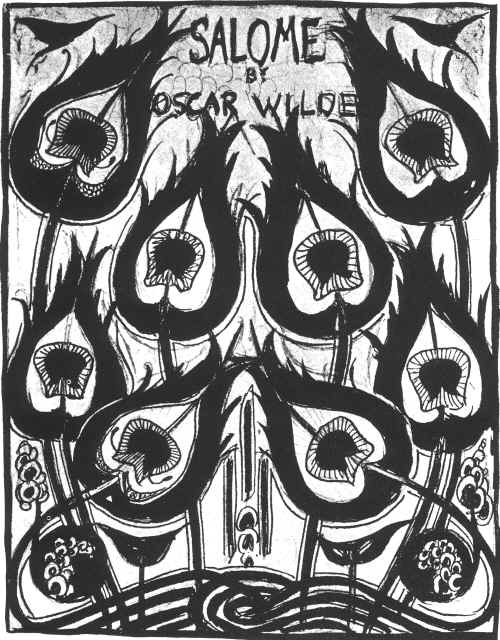
Salomé

Sketch for cover design of Salomé by Aubrey Beardsley. 1894.

  • Play Title: Salomé    
  • Author: Oscar Wilde 
  • Written (in French): 1891 
  • First published in English: 1894 
  • Page count: 65 

Summary 

Salomé is a one-act play by Oscar Wilde that is based on the biblical story of John the Baptist’s death. Wilde uses considerable poetic license in his version of what was originally a story from the gospels of Saints Matthew (14:1-12) and Mark (6:14-29). The play’s setting is the palace of Herod, and the occasion is a banquet to entertain the ambassadors of Caesar. John the Baptist is a prisoner of Herod. In brief, Salomé, who is the stepdaughter of Herod, asks for the head of John the Baptist because he has shunned her romantic advances. This tale of beheading is well known, as is the dance of the seven veils that Salomé performs. What makes Wilde’s play quite distinctive is the emphasis on symbols, most notably the moon. It is also a decadent piece of literature that focuses on the transgression of moral and sexual boundaries. Indeed, the play was originally banned in England as it ostensibly dramatized a biblical tale, but more likely due to the risqué content of the play. The artist Aubrey Beardsley supplied sixteen, now-famous illustrations to accompany the text.  

Ways to access the text: Reading/listening 

The full text of the play is available on Project Gutenberg and includes the illustrations by Beardsley. There are multiple uploads of the text on Gutenberg, but a search for “Salomé: A Tragedy in One Act by Oscar Wilde” will return one of the English language versions.  

If you would prefer to listen to the play as an audiobook, then I would highly recommend a version available on YouTube entitled, “Salomé by Oscar Wilde – Lester Fletcher.” The running time of this audiobook is 49 minutes so please note that this is an abridged version. However, it is also a professional production and preferable to the many amateur recordings online.  

Why read/listen to Salomé?  

A femme fatale  

Most people are at least vaguely familiar with the story of Saint John the Baptist, and the notorious woman who asked for his head on a silver platter. In fact, this biblical story was extremely popular in the 19th century, especially amongst French writers, so Wilde was not alone in rewriting the tale. However, Wilde depicts Salomé as an especially powerful, narcissistic, dangerous woman who oversteps so many lines that she finally shocks the reader. It is important to note how different Wilde’s Salomé is from the woman in the original biblical story. In the original, Salomé is merely Queen Herodias’ daughter and is not even named in the text; moreover, she only requests the head of John the Baptist because it is her mother’s wish. In Wilde’s play, Salomé is transformed into a far more assertive figure who is aware that her royal status and sexual allure may be used as tools to impose her will upon others. A femme fatale who originates in a bible story is certainly unusual, but the label is appropriate because Wilde depicts a woman whose actions cost the lives of two men and the ruination of a third. Few people want to read a story where the ending is already known. Therefore, it is important to point out that the moment of true depravity in Wilde’s play, the ghastly crescendo moment, is not the execution of the Saint! 

Wilde’s command of language  

Reading or listening to Salomé is a distinctive experience due to how Wilde has crafted the language of the play. This work is quite dissimilar to his more popular, comedic plays, for example, The Importance of Being Earnest. One should certainly not approach Salomé expecting light comedy or wit. It is best to emphasize that this play is symbolist in nature, and the key symbol of the moon could even be said to have its own role. Wilde also focuses on a few particularly symbolic colours in the work. Additionally, his style includes the superfluous use of similes. These observations are not made to dissuade the potential reader but to underline that Wilde creates a heady, artificial environment where the language seems laboriously ornate at times, packed with symbols, and purposely repetitive in nature. However, once one begins to appreciate the effect that the author is striving to achieve then one does not resist the language merely for being slightly unfamiliar. What the author undoubtedly achieves in the play is the steady ramping up of tension. This work is tragic, and the author creates an atmosphere of impending doom in language that perfectly reflects his own aesthetic style. Due to the unfamiliar style of language and the often elaborate and detailed descriptions of things, the reader may indeed begin to feel mesmerized. This wondrous effect is purely a consequence of Wilde’s astonishing command of language. 

Post-reading discussion/interpretation 

The Moon’s Significance

The moon is a prominent symbol in Wilde’s play. In ancient times, the Greeks worshipped the moon goddess Selene while the Romans had an equivalent goddess named Luna. The moon has long been a symbol of womanhood, and special rites accompanied the arrival of the new moon and full moon. In the opening lines of Salomé, the descriptions used by the young Syrian and the Page of Herodias serve to conflate the princess Salomé with the pale moon in the night sky. Wilde uses this literary device to highlight the importance of the moon as a primary symbol and to immediately link it to Salomé. However, the central question is what the moon signifies in the play. In this regard, Wilde’s main symbol appears strangely unstable because each character sees something quite different in the moon. The Page of Herodias ominously sees a “dead woman” who is “looking for dead things,” whereas his young friend, the Syrian, sees “a little princess who wears a yellow veil.” Herodias remarks nonchalantly that “No; the moon is like the moon, that is all,” but she warns that those who look too long upon it may go mad. It is significant that Salomé self-identifies with the moon. She tellingly describes it as “cold and chaste” and says, “I am sure she is a virgin.” It is easiest to interpret this alliance between Salomé and the moon as being indicative of her influential power over others. Salomé wields power whereas the other characters, who find highly subjective meanings in the moon, are by contrast quite vulnerable to influence. According to the key tenets of the symbolist literary movement, symbols were richly suggestive rather than explicitly restricted to one meaning. When Wilde employs the moon as a symbol, he makes it aesthetically beautiful but without any true depth. The moon has a mirror surface that will not reveal its true meaning. Similarly, Salomé hides her true character while others tend to project qualities onto her, which are just projections of their own fears and desires. The use of the moon as a symbol communicates that Salomé is a perpetually mercurial figure, an enigma. It is necessary to delve deeper into the play to comprehend this strange figure.  

Another aspect of the moon symbol is the significance of colours, specifically white, red and black. Wilde makes numerous references to these colours, so it is best to reduce an interpretation to the most essential points. For instance, Iokanaan (John the Baptist) declares a key prophecy, saying, “In that day, the sun shall become black like sackcloth of hair, and the moon shall become like blood.” The day he prophesizes is the day when the “daughter of Babylon” (Salomé) shall die, crushed beneath the shields of soldiers. Herod later recalls this prophecy, just before Salomé dances, when he notices how “the moon has become as blood.” To aid one’s overall understanding, one must note that the colours white, red, and black each symbolize specific things in the play. White is associated in the play with doves, flowers, butterflies, and snow; it is a symbol of purity and chastity. Red is associated with wine, blood, fruit, and lips; it is symbolic of sexuality. Finally, black is associated with the cistern/hole where Iokanaan is imprisoned, with the executioner, Naaman, who is described as a “huge negro,” and with the “huge black bird.” Black is, therefore, symbolic of death. Many critics divide the play into sections that correspond with particular phases of the moon, which in turn correspond with the predominance of each of the aforementioned colours. The changing colours highlight the ever-changing perceptions of Salomé. As such, the play opens with a pale, chaste, young princess. Then, after Narraboth’s blood is spilt, we enter the red phase; the moon changes colour and Salomé performs the sexual, erotic dance of the seven veils. Finally, we enter the black phase when Herod orders that all lights be extinguished, and the princess dies.  

The moon’s significance is ultimately determined by the power that each character attributes to it. Only Queen Herodias, Salomé’s mother, is immune to the influence of the moon. Herod, however, is sensitive to omens of any kind – most notably the changing colour of the moon, He is also the only character who receives the same premonitions as Iokanaan. The most significant premonition is the coming of death which is first signalled to Iokanaan when he hears “the beating of the wings of the angel of death.” Herod also hears the same “beating of vast wings.” The key question is whom Death has come to retrieve for the netherworld? Since Herod is quite fearful of the prophet Iokanaan, he first concedes that his marriage to Herodias is incestuous. Herod is now willing to appease the wrath of the prophet’s God. It may seem odd that Herod, who views Caesar as the “Saviour of the World,” rather than Jesus, is the one to carry out Iokanaan’s cruel sentence on Salomé (crushed beneath soldiers’ shields). Yet, this is how prophecy, fear, and the moon’s symbolism are brought into alignment in the story.  

Wilde constructs an intricate plot. For instance, Herod twice removes the veil from a precious symbol. Symbols have already been shown to be unstable so tampering with symbols also carries a definite risk. In the first instance, Herod steals the sacred veil from the Jewish temple and thereby potentially removes all mystery from a sacred object. The second occasion is when he requests that his stepdaughter perform a dance: a dance where she removes seven veils and transforms her identity from a chaste, virginal daughter to a potential future wife. Herod reveals his lurid fantasies about Salomé, but they are expressed obliquely through his comments on the moon’s appearance. He says ‘she’ (the moon) is a naked, drunken woman “looking for lovers.” In the last moments of the play, the moon reflects her light upon Salomé and reveals the girl’s true identity, namely a depraved necrophiliac. This shatters Herod’s plans to take his stepdaughter as his future wife. Herod is confronted with an obscenity and immediately fears reprisals from the prophet’s God, so Herod must sacrifice Salomé. It is fitting that Herod had previously cautioned, “It is not wise to find symbols in everything that one sees. It makes life too full of terrors.” It is Salomé’s downfall that King Herod interprets the moon as a symbol of what Salomé can become: his new wife. When the king’s initial interpretation is proven wrong, and the moon is blood red, and the prophet’s words of warning ring in the king’s ears, then Salomé must die.  

The moon orbits in the heavenly realm, tugging upon the tides of vast oceans and men’s hearts too. The metallic shine on her brow protects her from man’s ire, regardless of his atrocious fate. Salomé believed that she would also reign with such untouchable aloofness, but she found that she was just a mortal girl. True to the symbolist literary movement, Wilde shows how unstable and ultimately dangerous symbols can be. King Herod looks upon the moon and what is reflected back is the dark sin within his soul.  

Looking is Dangerous 

Wilde depicts the ‘male gaze’ in all its sleazy splendour through the character of Herod. Yet many characters become obsessed with others’ appearances in the play. Herod and the young Syrian stare unashamedly at Salomé, and, in turn, Salomé stares wantonly upon Iokanaan. It also seems that the Page of Herodias stares too intensely at Narraboth (the young Syrian) while warning him, “You look at her [Salomé] too much … something terrible may happen.” In modern language, the situation becomes quite meta. Wilde depicts lascivious men looking at a girl, a lascivious girl looking upon a grown man, and a sexually jealous young man looking at his male friend. Therefore, the act of staring is not hindered by issues of gender or even sexuality. Each character projects their own personal longings upon what becomes a mere object of desire. The various persons being stared at are translated into mere surface and thereby instantly robbed of their full personalities. Most notably, Iokanaan the prophet is shamelessly reduced to superlative descriptions of his body, hair, and lips by Salomé. The prophet’s core message including his religious chastisements falls on dumb ears. Salomé simply says, “I am amorous of thy body.”  

Staring induces fear because it reveals a disregard for hierarchy (Narraboth, a slave, desires a princess), or it reveals a transgression of the law of Moses (Herod’s sexual desire for his stepdaughter). It is noteworthy that those who chastise the ‘starers,’ namely Herodias and her Page, each have something to lose. Herodias may lose her crown and half a kingdom to her own daughter while the Page may lose the special friend whom he has showered with romantically charged gifts (perfume and rings). Moreover, the stare isolates characters from one another because what is visually appealing or tantalizing has the consequence of muting all warnings:  leaving language impotent. All things become surface alone, and as the play reveals, such looks can be highly deceptive. 

We comprehend that a stare reduces the looked-upon-person to a mere object. What makes staring unusually dangerous in Wilde’s play is just how far characters will transgress societal norms to attain an object of desire. In this regard, Salomé herself is unmasked as truly monstrous. In comparison, Herod’s sexually motivated gaze may be called traditional as it is camouflaged with enticements to Salomé to yield to his will. His initial order to dance soon becomes a sugared plea with promises of jewels and half a kingdom. In bleak contrast, Salomé’s will to fulfil her desires is steely, and she offers Iokanaan nothing in exchange for his cooperation. The prophet forcibly rejects her lurid advances, saying, “I will not have her look at me,” and he prefers to return to his prison cell rather than endure her obscenities. Iokanaan’s belief that a mere look is wounding echoes the mythology of Medusa. Salomé destroys this man of God just so she may experience the kiss she hungrily desires. If one heeds Herod’s wise words, then looking reveals an inner truth. In the final scene, the girl that Herod most desires is revealed to be a monster, and he says, “I will not suffer things to look at me.” Wilde daringly reveals the power of a sexualized stare, especially when it is ironically reversed and suddenly shocks.  

Works Cited

The Bible. Authorized King James Version, Oxford UP, 1998.

Wilde, Oscar. Salomé, A Tragedy in One Act. Translated by Alfred, Lord Douglas, Project Gutenberg, 2013.

Rope

Marriage chest (cassone). ca. 1480-95, The Metropolitan Museum of Art, New York.

  • Play title: Rope   
  • Author: Patrick Hamilton  
  • First performed: 1929   
  • Page count: 82 

Summary.

Patrick Hamilton’s play, Rope, begins with a murder. A young man named Ronald has been killed by two of his fellow Oxford university students, Brandon and Granillo, and they have hidden his body in a chest. The murderers who share a house in Mayfair, have invited a selection of people for drinks and snacks the same evening. The guests include Ronald’s unsuspecting father, and a young poet named Rupert Cadell. Using the excuse that the room is cluttered with books, the killers have the buffet dinner served on top of the chest that contains the corpse. The purpose of Brandon and Granillo’s actions is to enhance the thrill of having committed the perfect murder! They plan to leave for Oxford once their guests have departed. The major themes of the play are murder, homosexuality, punishment, and the English class system.

Alfred Hitchcock famously brought the play to the big screen in the 1948 classic, Rope, which starred James Stewart. Hamilton’s other famous works include the play, Gaslight, and the novel, Hangover Square.

Ways to access the text: reading/listening/watching

The play is available via the Open Library, Internet Archive, and is also on Scribd for members. The text of Rope is quite reader friendly and may be enjoyed like a thriller.

Multiple audiobook versions of the play are available on YouTube.

One may watch the movie version of Rope directed by Hitchcock but please note that the text has been adapted for the screen.

Why read/watch/listen to Rope?

The perfect murder.

Brandon and Granillo believe that they have committed the perfect crime. Its perfection is explained by the clinically uncomplicated nature of the murder: passionless, motive-less, faultless, clueless, bloodless, and noiseless (Hamilton 10). The trail is apparently cold, even for the most persistent sleuth. Ronald Kentley has been killed only so his killers may experience the immense thrill of taking another’s life. The plan is that the body will never be found, guaranteeing the killers’ immunity from the British justice system. However, the killers’ plan is enormously ambitious to the point of hubris. Despite their best efforts, some faults have been made and Hamilton brings one on a familiar journey of clue detection in his elegantly constructed plot.

The relevance of real-life inspiration.

Patrick Hamilton is often credited with basing Rope on the famous, American case of Leopold and Loeb. Nathan Leopold and Richard Loeb were students at the University of Chicago when they kidnapped and killed a twelve-year-old boy in 1924. However, Hamilton dismissed speculation that his drama was based on the notorious, criminal couple. The denial, though probably sincere, makes the similarities between the two crimes no less fascinating. Leopold and Loeb, like Brandon and Granillo, had a penchant for the philosophy of Nietzsche, and believed that their intellectual superiority to the common man gave them a degree of natural immunity from society’s prosaic rules. Most interestingly, neither of the real-life killers was sentenced to death, but instead to life imprisonment. The ending of Rope presents the destiny of Brandon and Granillo (freedom/death) as a fait accompli, but the real-life example raises an important question mark over one’s confidence that things will play out as expected!

Post reading discussion/interpretation.

The Hidden Marriage Ritual in Hamilton’s Tale of Murder.

Introduction.

In the introduction to the first publication of Rope (1929), Patrick Hamilton wrote, “I have gone out to write a horror play and make your flesh creep” (viii-ix). Not only did the author succeed in creating a gripping, suspenseful work due to a finely crafted plot, but the subject matter is indeed so horrifically perverse as to be utterly unsettling. The central allure, as with many such works, is with the character of the murderer(s). Numerous writers before Hamilton had been fascinated by murderers and their handiwork. For example, in Intentions, Oscar Wilde wrote an essay entitled, “Pen, Pencil and Poison,” about Thomas Griffiths Wainewright, a suspected, English serial-killer who had “an extremely artistic temperament … being not merely a poet and a painter, an art-critic, an antiquarian, and a writer of prose, an amateur of beautiful things … but also a forger of no mean or ordinary capabilities, and as a subtle and secret poisoner almost without rival in this or any age” (32). Of even more renown in literary terms is Thomas De Quincey’s famous satirical essay, “Murder, Considered as One of the Fine Arts.” De Quincey comically positions himself as one who seeks to expose “The Society of Connoisseurs in Murder” (188) which is a group of “Murder-Fanciers [for whom] Every fresh atrocity of that class, which the police annals of Europe bring up, they meet and criticise as they would a picture, statue, or other work of art” (188). Wilde and De Quincey focus on murderers, both historical and imagined, whose crimes are considered to have great, artistic merit. Hamilton’s famous play is perfectly positioned amid such works because he creates fictional, dandyish murderers in the London of the late 1920’s, yet they bear an astonishing resemblance to the infamous, real-life Leopold and Loeb who were a couple of handsome, Chicago killers whose own exploits had dominated news headlines just a few years earlier in 1924. Since Rope straddles the realms of fiction and reality, one may assess the work without moralistic dourness, and enjoy it as Hamilton evidently intended.

In Rope, the protagonist, Wyndham Brandon, professes to have committed, “An immaculate murder. … I have killed for the sake of danger and for the sake of killing” (10-11). However, under some scrutiny, the murder of Ronald Kentley appears to hold a tangible motive after all, even if it is expertly secreted within the text. Much like the missing evidence in Edgar Allen Poe’s “The Purloined Letter,” which was concealed, paradoxically, by being left in plain sight, Hamilton similarly hides a motive in the chest that is positioned centre stage in his play. An audience knows from the outset that the chest contains a corpse, so what else is there? In an essay about Ira Levin’s play, Deathtrap, Jordan Schildcrout gives a synopsis of that particular play which may enlighten one about Rope. He describes a “thriller about two men who must remain in the closet with two secrets: they are lovers – and murderers” (Schildcrout 44). Brandon and Granillo are self-confessed killers but are they lovers too? Or is this to overread Hamilton’s gay subtext and erroneously conflate the play with Leopold and Loeb’s story? The first major clue lies, quite literally, in the chest. In an essay by Brucia Witthoft, named “Marriage Rituals and Marriage Chests in Quattrocento Florence,” she explains that “The chests, or forzieri, were used to transport the material part of a bride’s dowry from her father’s house to her husband’s. Subsequently they became part of the bedroom furniture, serving as storage and seating” (43). The chest in which Ronald’s body is hidden is identified as a “cassone” (26) by Sir Johnstone Kentley. To clear up any possible confusion over different terms for the chest, one may refer to DuBon and Diskant who explain, “The Italian word “cassone” – from the Latin capsa – now accepted into the English language, is the name by which the Italian Renaissance chest is generally known … Other terms, known from contemporary inventories and documents, are forziere and cofano, sometimes used interchangeably with “cassone”’ (19). Therefore, the chest in Hamilton’s play is a marriage chest. In light of this information, can one assert that the body of Ronald now hidden in the cassone represents a marriage dowry? Just like Wilde and De Quincey, one must delve into the artistry of murder to discover the full significance of the chest. The thesis of this essay is that Hamilton indeed presents us with a marriage ritual at the centre of his horror play.

Since Rope is now nearing its centenary, it has been subjected to rigorous literary analysis many times. The current reading requires some considerable groundwork before the thesis may be proven. The killers must be established as queer (read homosexual), the significance of the chest must be outlined, the idea of a motiveless murder must be challenged, the dinner party (feast) must be scrutinised, Rupert as the sleuth must be critiqued, and finally, one may look at the denouement of the play.

Queer characters.

It is not possible to have a marriage ritual if the central characters are not first in love. If Brandon and Granillo are gay men and also in a relationship, then what evidence of this appears in the text? The gay subtext of Hamilton’s play has long been noted but what substantiates this observation?

One may begin rather superficially with Brandon’s and Granillo’s attire and manners – but by viewing these as marks of deception. In “Pen, Pencil and Poison,” Wilde explains that “A mask tells us more than a face” (34) and he then proceeds to describe the killer, Thomas Griffiths Wainewright, who “determined to startle the town as a dandy, … [with] his beautiful rings, his antique cameo breast-pin, and his pale lemon-coloured kid gloves” (34). One may compare this description with Hamilton’s stage directions which describe Granillo as “expensively and rather ornately dressed in a dark blue suit. He wears a diamond ring. He is enormously courteous” (15) and Brandon, who “is quietly and expensively dressed, with a double-breasted waistcoat … and perfectly creased trousers … [he has] and air of vague priggishness and self-approbation” (15). The men’s sophistication of dress and refined, even moralistic manners expertly hide the fact that they have just committed a gruesome crime by strangling a young man. The masks they wear hint at homosexuality while simultaneously hiding so much. Schildcrout points out that, “The exploitation of queer duplicity has a long and well-documented history in the theatrical thriller” (45). Hamilton presents his audience with two privileged, Oxford students who are hiding a horrible secret and their masks alert us to this potentiality. Schildcrout explains that “The sinister threat of the traditional thriller is based on the duplicity of the killer who deceptively tries to conceal her/his identity thereby creating a crisis of identity” (45). Establishing Brandon and Granillo as duplicitous characters because their polished, refined facades hide their true characters is the first step in labelling them as queer, if only in the sense that they are oddities due to the stark disjunction between impression and reality. Of course, Hamilton goes on to depict his characters in a way that allows one more assuredly to link this queerness directly to sexual practice which interconnects with the ‘queer duplicity’ to which Schildcrout refers.

The word queer is used by various characters, commencing with uses in the traditional sense of something being odd or strange, but progressing to uses that imply sexual identity and practice. For example, Leila politely challenges Brandon by observing that “this is a most mysterious and weird meal … Such a queer time, to begin with” (24). The not-quite-right feeling that the evening induces will lead Leila to suggest later, “I think they’ve committed murder, and it’s [the chest’s] simply chock-full of rotting bones” (33-34). Rupert is also attuned to the strange atmosphere of the evening and unexpectedly tells Brandon, “I have just thought of something rather queer” (43) and he reminds Brandon of his childhood obsession with telling stories which always ended with “a bloody chest containing corpses” (45). Rupert describes the coincidental overlap of Leila’s amusing hypothesis and Brandon’s childhood mania as “Oh, nothing. Just queer, that’s all. You were a morbid child” (45). However, the queerness of the stories threatens to taint Brandon’s very identity. The final step occurs when Rupert walks in on Brandon and Granillo arguing (over the Coliseum ticket). Brandon says, “You didn’t know that Granno and I behaved like that, did you, Rupert? But we often have outbursts, like this – and always about trifles … We do quarrel about queer things nowadays, don’t we, Granno?” (52; emphasis added). Brandon’s obfuscation of the real reason for the quarrel immediately and inadvertently reveals to Rupert the truth of the domestic situation of the two men. After all, Brandon and Granillo live together and have jointly hosted a dinner party, and here they are, in a moment of privacy from their guests, engaged in a blazing row, so it should not be shocking that they are indeed a romantic couple. The odd behaviour, the dramatic outburst over trifles, the queer things they fight over, are all coded references to the men’s homosexuality.

There are other incidental clues that emphasize the gay subtext of the play. For example, Sabot, who is the waiter occasionally hired by Brandon and Granillo is described as “not, perhaps, completely impersonal – his employers being in the habit of making occasional advances to him” (17). This may suggest sexual advances aka offers of work of a different nature, an argument bolstered by the fact that Rupert asks Sabot if he “had been getting into any trouble” (41) with his employers. Rupert asks due to the “hysterical noises” (41) he heard over the telephone, which incidentally are repeated later by Granillo when he “Gives a terrible, piercing, falsetto scream” (77). Even though the play is in the genre of horror/thriller, there are these elements of high camp as well as broad, sexual innuendo. Take for example, Brandon’s opening question to a distraught Granillo – “Feeling yourself, Granno? Feeling yourself again, Granno?” (10). In the context, the wording denotes the hoped for return of Granillo to a relaxed composure, but the phrase is also highly suggestive of masturbation. After all, the murder is committed for the ephemeral thrill it will induce and one should not discount a sexual element to this feeling. Also, of note here, Kenneth Raglan is later introduced as the boy who fagged for Brandon at school, and fagging refers to an English public schools’ tradition where younger boys acted as personal servants to older boys, which often led to sexual abuse. Therefore, when Rupert tells Granillo, “You look rather fagged out … What have you been doing with yourself?” (37), then the question echoes the initial question and holds the same sexual connotations, as if Granillo, as Brandon’s current servant, has been up to something that he ought not, like feeling himself! One only becomes alert to such double meanings when one is already alert to the presence of queer duplicity.

Of great importance to a reading of the play is the fact that Rupert is also a coded, gay character. There are quite subtle hints at first, for instance the fact that Brandon describes him as “fastidious” (14). In Hamilton’s stage directions one finds the following description of Rupert – “He is enormously affected in speech and carriage…His affectation almost verges on effeminacy, and can be very irritating” (27). Such a description is an old-style stereotype of the homosexual male. Confirmation of Rupert’s sexuality may be seen in his response to Brandon’s question, if he had broken the 7th commandment (You shall not commit adultery). Rupert responds, “Committed. Since infancy” (62). All forms of sexual activity done outside of marriage, including homosexuality, are seen as breaking the 7th commandment. Since homosexuality is not a choice but a sexual orientation from birth then Rupert’s response seems to confirm his homosexuality. However, the 7th commandment for Catholics is – Thou shalt not steal – and Rupert goes on, after an interesting pause, to refer to stealing property, yet it is far more likely the true reference is to the 7th commandment as observed by the Church of England, namely adultery. Hamilton’s sleight of hand here may be interpreted as further obfuscation. Rupert’s sexuality becomes a crucial factor in how he eventually deals with Brandon and Granillo.

The fact that Hamilton depicts three of his characters as homosexual does not of course automatically make them killers. On the other hand, as Schildcrout has outlined, queer duplicity is a popular motif in dramas, even if it is derogatory and prejudicial. The apparent link between the characters’ sexuality and the crime may be inferred from the case of Leopold and Loeb. One may compare the fictional Brandon to the real-life Leopold who Edward J. Larson describes – “Leopold was bookish, scholarly, easily offended and attracted to virile young men” (127). Ronald Kentley was an athlete and thereby matches the victim profile. Larson goes on to describe how the real-life killers were “Psychopathically dependent on each other, they had entered into a secret pact in which Leopold assisted Loeb to commit crimes in return for sexual favours” (141). While Brandon and Granillo are clearly not identical to Leopold and Loeb, the comparison allows one to begin to contemplate what motive, sexual or otherwise, may have been behind the murder of Ronald Kentley.

The marriage chest (cassone).

The chest that holds the corpse, situated at the centre of Hamilton’s play, is normally seen as a mere receptacle rather than a vital clue. This peculiar item of furniture is the focal point of the stage play and yet has received so little attention in critical terms. By choosing a marriage chest, surely Hamilton wanted to arouse our interest and impart some clever, hidden message. The chest is first identified by Sir Johnstone Kentley as follows:

“Sir Johnstone (peering at chest). That’s not a Cassone, is it?

Brandon. No, sir. It’s not genuine, it’s a reproduction. But it’s rather a nice piece. I got it in Italy.”

(Hamilton 26)

Brandon explains that it is not an original cassone, but an imitation. An imitation can be read as a sign that this is part of a mock marriage ritual or in other words, a gay marriage since homosexual practices were still illegal in Britain in 1929. Therefore, the fake nature of the item does not rob it of relevance but rather adds to its meaning. Since Brandon purchased the chest in Italy then it is far more likely he is aware of how the item was used traditionally.

Extracting meaning from the chest require some insights into how they were used in the marriage ritual. Witthoft explains that “Florentine Renaissance wedding chests were usually bought by the groom’s family” (43). As previously outlined, the chest would have held the new bride’s dowry. The macabre dowry now concealed in the chest is Ronald’s dead body and one may still interpret it as an offering from bride to groom, or in this case, groom to groom. Furthermore, there is a tantalizing hint that Brandon as the purchaser of the chest (groom’s side) receives the dead body as Granillo’s dowry which makes Granillo the true murder! This helps to explain Brandon’s almost perfect composure versus Granillo’s flustered, defensive state and subsequent over-reliance on alcohol to calm his nerves. Additionally, it shows that Granillo needs to bring an offering to secure the mock marriage, a proof of his merit.

The chests were usually quite elaborate, “Their shape (large, narrow, coffin-like boxes) was appropriate for keeping linens; their flat tops made them easy to sit on; but the iconography of their painted side panels was determined by the nature of the marriage procession” (43). The eerie, coffin-like shape of the chest makes Brandon’s words more arresting – “And here is a chest, from which we’re going to feed” (26), especially if one interprets the dinner buffet as a wedding feast. There is no indication that Brandon or Granillo held any prior grudge against Ronald Kentley so the feasting at his symbolic grave indicates a grievance by the couple against society in general. This hidden hatred, possibly the hatred of men whose lives are constantly restricted due to their sexuality, explains the drive required to commit such a heinous act.

There is also a link between the chest and Brandon and Granillo’s Nietzschean leanings. Witthoft writes that, “Marriage chests became classical in inspiration because they were chosen by men whose humanist education stressed ancient writings as moral guides” (54). Despite the fact that we receive no information on the chest’s decoration, the denigration of Ronald’s body as a party-piece reflects Brandon’s reading of Nietzsche because some gifted individuals are understood to be above the general masses and therefore not subject to the same laws. A modern text becomes the moral guide for killers to seal their mock marriage.

The planning of a perfect murder, as Brandon labels it, takes expert planning. The logistics of a marriage and murder are quite similar in this regard. When cassone were in use in Italy, “Examples drawn from ricordi and from published sources show that three to six months commonly elapse between the giuramento [legal agreement to marry] and the consummation of the marriage” (Witthoft 44). Leopold and Loeb put meticulous planning into their infamous murder and Brandon and Granillo evidently planned Ronald’s death well in advance given that they sent prior dinner invitations and have arranged to leave for Oxford on the night of the murder. There is nothing haphazard about the scene.

Dismantling a motiveless murder.

Brandon recounts the day’s events to Granillo, saying, “That is the complete story, and the perfection of criminality – the complete story of the perfect crime” (13). On the surface, Brandon and Granillo’s crime quite strangely lacks a motive. However, murder is generally motivated by some gnawing need or uncontrollable passion; it is rarely carried out in a dispassionate manner. Oscar Wilde once wrote that, “Crime in England is rarely the result of sin. It is nearly always the result of starvation” (47). Of these two options, Hamilton’s killers are clearly sinful rather than needy, and sin implies free will and therefore a conscious choice to do a certain thing. Due to their claim of perfection, the sin is not simply that of murder but of pride too (the seven deadly sins). The concept of perfection is equally suggestive of artistry, and De Quincey explains how, “People begin to see that something more goes to the composition of a fine murder than two blockheads to kill and be killed—a knife—a purse—and a dark lane. Design, gentlemen, grouping, light and shade, poetry, sentiment, are now deemed indispensable to attempts of this nature” (191). Thomas Griffiths Wainewright, who considered himself an artist and certainly no common criminal, murdered his wife’s mother, a Mrs. Abercrombie, but “Why he murdered Mrs. Abercrombie is not ascertained. It may have been for a caprice, or to quicken some hideous sense of power that was in him, or because she suspected something, or for no reason” (Wilde 44). The motivation for Brandon and Granillo’s killing of Ronald Kentley is similarly undetermined, explainable only as the pursuit of a thrilling sense of power and the result of excessive pride. However, is this answer sufficient for an audience? Pride usually comes before a fall. For example, is this a very human murder i.e., a flawed one? The real motive may become clear after the mirage of perfection has been removed.

The perfect crime does not exist. Brandon realises the couple’s weakness when he exclaims to Granillo – “Look at this! The boy’s Coliseum ticket. It was on the floor. We could hang on that!” (16). Similar to the Leopold and Loeb case, a simple error threatens to disqualify the murder from the claim that it is perfect. Larson recounts that, “The first major lead in the investigation came from the eyeglasses found near Franks’ [the victim’s] body” (126). These glasses belonged to Leopold and soon led the investigators directly to the murderous pair. In Rope, Rupert’s suspicion is aroused by the Coliseum ticket and Granillo’s generally defensive responses. While both couples were first time murderers and therefore mistakes would likely occur, their crimes still tentatively claim the title of perfection due to the disinterested manner in which the victims were chosen. We know from the trial of Leopold and Loeb that, “They had decided to murder someone, it did not matter who” (Larson 128). During their trial, a psychiatrist testified that, “It was a desire on the part of Richard Loeb to commit a perfect crime, a desire on [Leopold’s] part to do whatever Richard Loeb wanted him to do” (143). If one superimposes this scenario onto Brandon and Granillo’s case, then the murder is indeed a strengthening of the relationship bond between the men. The “motiveless murder” (63) is chiefly an “engrossing adventure” (63) that the men enter into to impress one another. Does this mean the motive is love?

The dark and macabre gift that lies inside the wedding chest is Ronald’s dead body. How can love be interpreted as a motivation for such an act? Rather than a random victim, Ronald was chosen as the victim for a specific reason. Brandon’s boastful claim that the murder is motiveless is a sham. In fact, the murder of Ronald is motivated by the marriage ritual. The first clue rests in Kenneth Raglan’s uncanny resemblance to Ronald Kentley. Brandon tells Kenneth, “he is the living image of yourself … Same age. Same height. Same colour. Same sweet and refreshing innocence” (21). At a later point in the evening, Sir Johnstone confirms the likeness, prompting Kenneth to say, “I’ve a double apparently” (31). The only significant difference is that Brandon tells Kenneth that he is “getting positively fat … Nothing like the little boy who used to fag for me at school” (21). This history between Brandon and Kenneth is important since fagging in school often led to sexual exploitation of a younger boy under the command of an older boy. There are definite hints of Kenneth’s old adoration and possible infatuation with Brandon when he remembers how he thought Brandon an “absolute hero in those days” (22). When Kenneth tremulously tries to get the key to the chest from Brandon on Leila’s request (59), one witnesses the sort of homoerotic, rough and tumble of boys’ games, but Brandon is still by far the stronger of the two men. The crux of the matter is that Kenneth Raglan is a classic doppelgänger of Ronald Kentley with even their initials reversing like in a mirror image (K.R – R.K). The killing of Ronald is symbolic because he is a substitute for the now chubby Kenneth, who was likely Brandon’s first sexual experience. The murder represents the sacrifice of a former love who is now stashed in a marriage chest, signalling the consecration of a new, homosexual relationship. The corpse becomes the dowry that Granillo presents to Brandon to prove his love, or vice versa.

Rupert also asserts that a motiveless murder does not exist. He says, “Vanity. it would be a murder of vanity … the criminal would be quite unable to keep from talking about it, or showing it off – in some fantastic way or another” (63). Rupert only partially recognises the killers’ motivation since he does not appreciate the true significance of the chest and the dinner.

The wedding feast.

Is the dinner party truly the wedding feast of a duplicitous, queer couple? One is tempted to accept Rupert’s claim that a murderer would wish to expose his horrible deed due to vanity. The truth is quite the contrary, because when Brandon explains that “the entire beauty and piquancy of the evening will reside in the party itself” (12-13), he is referring to the thrilling experience only he and Granillo will share. Yes, his guests will come “for regalement” (12) but the joke will be on them. For instance, Sir Johnstone Kentley who is a kindly, harmless old man is viewed quite differently by Brandon, who says – “It is he, as the father, who gives the entire macabre quality of the evening” (13). One understands why Kenneth has been invited since he is a doppelgänger. Additionally, on account of his awkward flirtations with Leila, Kenneth represents the silly, unintellectual world of heterosexuals! Rupert sarcastically refers to the pair as “Love’s Young Dream.” (68). The assorted guests are merely puppets in a twisted game created chiefly by Brandon.

The chest is both a coffin and a banquet table. Prompted by Leila’s fanciful suggestion that it is a murder chest, the following exchange occurs which is rich in dramatic irony.

“Sir Johnstone: But surely your murderer, having chopped up and concealed his victim in a chest – wouldn’t ask all his friends round to come and eat off it.

Rupert (slowly): Not unless he was a very stupid, and very conceited murderer.”  

(Hamilton 34)

It is correct to assume that Brandon and Granillo wish to keep the murder a secret, otherwise they will face the law. As intelligent men, they wish for a thrill but not to the point of risking their safety. What is more, the privilege of viewing the contents of the chest is solely the preserve of Brandon and Granillo. The chest holds many secrets because, as Witthoft explains, “About half of those chests surviving whole are decorated on the inside of the lid with a more intimate kind of marital symbolism” (52). This included male and female nudes and “The nuptial significance is meant to be concealed, and to show itself only to the betrothed pair. This contrasts with the public nature of the outside of the chests” (Witthoft 52). The corpse corresponds with the idea of intimate material for several reasons. First, Ronald is Kenneth’s double and therefore his body constitutes a taboo offering from one lover to another. Second, since Ronald died by strangulation, the corpse may display priapism and may also be naked, much like a traditional painting on the inside of a cassone. The eventual reopening of the chest will be done by the couple on their own and signifies the commencement of their marriage.

The couple plan to take the chest with them when they drive to Oxford that same night. Their beds have already been dismantled in the Mayfair house so there is nowhere to sleep (53). As the last act in their marriage ritual, they will leave to begin their mock honeymoon with a very symbolic and important piece of furniture that will likely adorn a new bedroom. The utter thrill of the evening was constituted by the fear of being exposed as murderers. Like a newly married couple on their wedding day, the men felt like the centre of attention except that the reason was quite secret. Granillo says of Rupert, “I thought he got on to it” (69) and Brandon responds, – “But that’s what gave piquancy to the evening” (69) followed by an assurance that they were safe. Rupert turns out to be a more competent investigator than Brandon expects.

The sleuth.

Rupert is the sleuth who will finally expose the killers’ secrets. Brandon describes his dinner guests in advance of their arrival, saying that Rupert is “intellect’s representative” (14) at the party and “is about the one man alive who might have seen this thing from our angle, that is, the artistic one” (14). The killers perceive an alliance with Rupert because they are socially bonded through their elite, educational backgrounds but also their homosexuality. The amateur detective will be forced to take a side when he challenges his friends. Hamilton constructs the plot so that one fully comprehends what dirty secrets Rupert is potentially going to expose. As per one’s expectations of a character with a superior intellect, Rupert says, “I’m coming to the conclusion that there’s some ulterior motive about this chest picnic” (33). However, Brandon’s meticulous planning means that the killers never perceive Rupert as a major threat. Brandon knows Rupert and having assessed his character, has decided not to include him in the murder because, “He could have invented and admired, but he could not have acted” (14). Rupert is evidently brilliant but impotent too. This calculation of Brandon’s comes fully to light at the close of the drama when he tells Rupert, “You can’t give us up. Two lives can’t recall one. It’d just be triple murder … You’re not a murderer, Rupert” (84). Hamilton exposes Brandon’s grievous miscalculation by making Rupert the hero who indeed acts against the two men and decisively so too.

There is a quite significant message of homophobia embedded in the justice achieved at the close of the play. As a gay man, Rupert is alert to the minefield of living a double life, the complications of living differently in public and private realms, façade versus truth. Therefore, when Brandon is threatened by Rupert’s persistent questioning, he cunningly attempts to side-line Rupert’s suspicions about murder by offering a proxy confession of homosexuality which was a crime in 1920’s England. Brandon is relying on the expectation that Rupert is unlikely to pursue the issue due to his own compromised position. Brandon appears to expose a major vulnerability to his friend, but it is little more than a Trojan horse to disarm Rupert. Brandon is playing on the stark reality that, “Marginalized minorities are more easily intimidated as long as they are stigmatized, ashamed, and afraid of public exposure – in short, in the closet” (Schildcrout 43). It is as though Brandon is letting a trusted friend in on a secret. Surprisingly, Rupert is not dissuaded by, nor sympathetic to Brandon’s pleas of a domestic issue, a “certain trouble” (77) between him and Granillo, which does not concern others.

“Rupert: No, Brandon, it may not be anything to do with me. But it may possibly be something to do with – with the public in general – and I’m its only representative in this room. Won’t you tell me?”

(Hamilton 78)

The confrontation is cleverly structured by the playwright so that the crimes of murder and homosexuality are totally conflated. It is true that Rupert suspects murder, but he has only a gut feeling and Brandon’s defensive tactics mean the secret could just be a homosexual relationship. Rupert is shown to reject either reason as a private matter. Rupert is suddenly depicted as a representative of proper masculinity with his swordstick (78) and a representative of moralistic society with the whistle he got from a police officer (79). Brandon persists in hinting that he and Granillo are a couple, telling Rupert, “I imagined you’d got on to the real truth – which’d have been devilish awkward” (80). When Rupert nonetheless insists on seeing inside the chest then it represents a revelation of the couple’s bedroom secrets, the piquant scene. The contents of the marriage chest are for the newlyweds alone, but Hamilton exposes it to a third party and Rupert is “contemptuous and horror-struck” (82). It may be viewed as poetic justice from conventional society’s point of view that the queer couple are betrayed by a fellow gay man. However, there is an unmistakable cost to Rupert too.  

As a fictional tale, one may appreciate the art of the scene with the red curtains and upholstery of the room (9), and an ornate marriage chest at the centre. The dead body is just one aspect of a much more complex, perfectly arranged plan which constitutes the killers’/lovers’ dark art. De Quincey writes about how, “Everything in this world has two handles. Murder, for instance, may be laid hold of by its moral handle, (as it generally is in the pulpit, and at the Old Bailey;) and that, I confess, is its weak side; or it may also be treated æsthetically, as the Germans call it, that is, in relation to good taste” (192). Rupert grasps murder exclusively by the moral handle and even makes a distinction between “being brought to the Old Bailey … [and] being brought to justice” (60). The main reason that Brandon and Granillo are exposed, their Achilles heel, is the contrived ritual of the entire evening which is solely and secretly a means of solidifying their homosexual relationship. The marriage chest, the victim who resembles an old love, the feast; these make up the artistry of the murder. Rupert is the homosexual insider who rejects all this to cleanse himself of any possible association. The cost of his heroism is sexual repression. He becomes the somewhat soured, closet homosexual who sneers at heterosexual couples like Kenneth and Leila and holds equal condemnation for those like him.

Conclusion.

Hamilton’s horror play is literally about murder, but implicitly a tale of gay marriage sealed with an elaborate, ritualistic killing. Just like in Levin’s Deathtrap, an audience is presented with a male couple with two key secrets. The action of the play, most notably Rupert’s moralistic stance against Brandon and Granillo, shows how conventional society will win out in the end. The gay subtext of the play then becomes an afterthought, even though it is central to one’s understanding of what motivated the murder. In the Chicago case of Leopold and Loeb, Larson explains that “Although the Hulbert-Bowman report detailed the sexual practices and preferences of both defendants, including their mutual masturbation and Leopold being exclusively attracted to men, at the time even writers with access to it did not mention these matters in their published articles and books” (147). Reminiscent of such censorship, Hamilton relies on an audience’s covert understanding that the men who commit the murder are also morally corrupt aka homosexual without ever saying it outright. It is now an outdated, dramatic tactic but had long been effective in associating crime with so-called sexual deviance.

The ending of Rope foresees a tragic, albeit just fate for Brandon and Granillo, yet, it remains unwritten, unconfirmed, a blank last page. The couple who sought the ultimate, depraved thrill now receive their just desserts since their fears mount anew on account of their undetermined punishment. Rupert states, “It is not what I am doing Brandon. It is what society is going to do. And what will happen to you at the hands of society” (85). De Quincey explains that in a case of murder, “old women, and the mob of newspaper readers … are pleased with anything, provided it is bloody enough” (222). The obscener the crime then the more draconian the court’s likely response. Rupert, as the voice of the masses, tells the two men – “You are going to hang, you swine! Hang! – both of you! – hang!” (86). The immense threat is that the two privileged, upper-class, secretly queer men will be exposed to mob justice, the crowd baying for blood. However, we never see the men hang. If one looks to Leopold and Loeb, the prosecutor trying their case, Mr. Crowe, boasted – “I have a hanging case and would be willing to submit it to a jury tomorrow” (128). Yet, neither man was hanged! As per Hamilton’s own protestations, this is not a biographical play, but a work of pure fiction and one may therefore admire the art of murderers just like Wilde and De Quincey. The revelation of a marriage ritual at the spotlighted centre of Hamilton’s play is as unexpected and thrilling addition to the traditional murder plot. One’s flesh creeps just a little to think that it may all have happened on account of love.  

Works Cited.

De Quincey, Thomas. The Collected Works of Thomas De Quincey. Pergamon Media, 2015.

DuBon, David, and Eda Diskant. “A Medici Cassone.” Philadelphia Museum of Art Bulletin, Vol. 73, No. 317, 1977, pp. 18–24.

Hamilton, Patrick. Rope. Constable and Company Ltd., 1957.

Larson, Edward J. “An American Tragedy: Retelling the Leopold-Loeb Story in Popular Culture.” The American Journal of Legal History, Vol. 50, No. 2, 2008, pp. 119–56.

Poe, Edgar Allan. The Purloined Letter and Other Works. Halcyon Press, 2013.

Schildcrout, Jordan. “The Closet Is a Deathtrap: Bisexuality, Duplicity, and the Dangers of the Closet in the Postmodern Thriller.” Theatre Journal, Vol. 63, No. 1, 2011, pp. 43–59.

Wilde, Oscar. Intentions. Rowland Classics, 2009

Witthoft, Brucia. “Marriage Rituals and Marriage Chests in Quattrocento Florence.” Artibus et Historiae, Vol. 3, No. 5, 1982, pp. 43–59.