
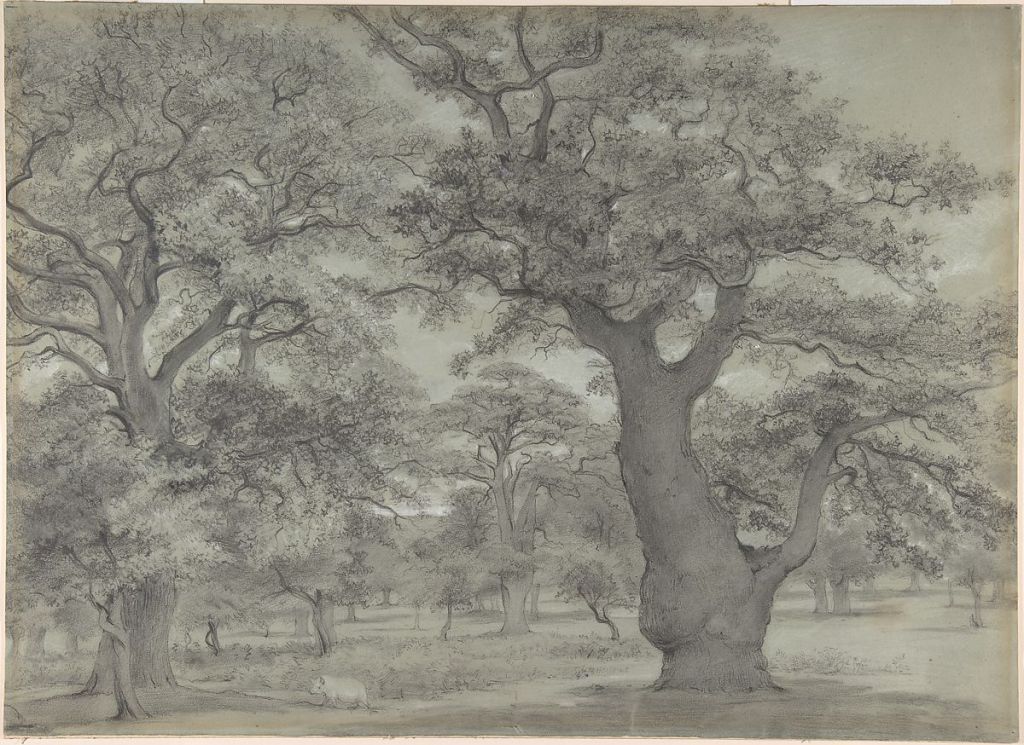
Anonymous British artist. Oak Forest. 19th century.
- Play title: Under Milk Wood: A Play for Voices
- Author: Dylan Thomas
- Written: 1954
- Page count: 64
Summary.
Under Milk Wood is a radio drama written by Dylan Thomas. The subtitle of the play is “A Play for Voices,” and it was originally commissioned by the BBC Third Programme. The events of the play span one spring day in the fictional Welsh town of Llaregyb. Thomas relies on two main narrators to set the scene, namely, First and Second Voices. These narrators guide the listener through the evolving nighttime dreamscape and then the subsequent daydreams of the various inhabitants of the town. The play consists of narration, dialogues, songs and monologues. This radio play’s audience is given a privileged view of not just the physical landscape of the Welsh town, but more significantly: a view inside the minds of its inhabitants. The play impresses through the rich, descriptive, and poetic language used by Thomas, which serves to bring the small Welsh community to vibrant life.
Ways to access the text: Listening/reading.
As the play was written for voices, it is perhaps best to listen to the original radio recording. This is available on Vimeo under the title “Richard Burton reads Dylan Thomas’ ‘Under Milk Wood’ (1954)”. The length of the recording is 1 hour and 34 minutes. Alternatively, one may check YouTube where it may also be possible to find the full recording.
If you wish to read the text, it is available online via Project Gutenberg Australia.
Why listen to Under Milk Wood?
A pleasurable experience.
The radio production of the play is a pleasure to listen to and best suited to evening listening. In total, the play consists of 63 individual characters, so there are a host of wonderful actors’ voices. Richard Burton, a Welsh native, takes the prominent role of first narrator and his mellifluous voice adds significantly to the listening experience. Also, it is a testament to Thomas’ writing skills that he managed to create so many rich characterizations, which all stand distinctly apart from one another. The effect is a true sense of a diverse rural community full of rogues, eccentrics, prudes and preachers. To say that the scene is idyllic is a fair assessment. Indeed, the character Mary Ann Sailors sometimes dreams of the Garden of Eden and considers her town to be the “Chosen Land.” The language of the play is noteworthy not alone for being delivered by rich Welsh accents that please the ear but also due to the imaginative and poetic skills of Thomas. For example, Thomas describes how the night moves through Donkey Street – “trotting silent, with seaweed on its hooves,” whereas when the night enters the local bakery, it is “flying like black flour.” Thomas creates equally wonderful analogies when describing the play’s characters by linking their personalities with their environments.
Entering a dreamscape.
One of the most distinguishing aspects of Under Milk Wood is the initial invitation made to the listener to voluntarily enter an elaborate dreamscape. Since a radio play is a tapestry of voices, it is unhindered by the normal limitations of stage or television productions. A radio play is superbly fluid in its transitions between different scenes and characters. This absence of naturalism is immediately evident and demonstrates to the listener that anything is possible, including great flights of fancy. Guided by the First and Second Voice narrators, the listener is given special, even unusual, access not just to one person’s inner dreams and thoughts but to those of an entire community. It is insufficient to describe the many and varied characters’ soliloquies and dialogues as imaginative because they are truly captivating. What makes the dreamscape of the town’s inhabitants even more interesting is that we get to follow each character as they emerge from sleep the following day. At night, the unconscious mind is immersed in a dream world but one which nonetheless reflects aspects of a character’s everyday life. In the daytime, the conscious mind is dominant, but the remnants of a dream world still play idly beneath the surface. Thomas shows us both domains of night and day. The mind has a cyclical motion of dreams and thoughts that constitute the most fascinating characters.
Post-reading discussion/interpretation.
Just a fun play or more?
What is the plot of Under Milk Wood? This question cuts to the core of what one can learn from the play. Numerous situations within the play certainly do not progress to any sort of conclusion. A few key examples concerning the themes of love and death will adequately demonstrate this point. First, Gossamer Beynon and Sinbad Sailors are each madly desirous of the other, yet neither of them ever finds out this secret. Secondly, Mr Pugh has purchased a book called “Lives of the Great Poisoners” and plans to kill his wife, who is unflatteringly described as his “needling stalactite hag,” but this murder never comes to pass. Thirdly, Lord Cut-Glass with his house full of clocks patiently awaits death, “the Last Black Day,” but death does not arrive. In fact, the list is even longer: Mog Edwards does not marry Miss Price, Mae Rose Cottage does not meet Mister Right, and Polly Garter does not mend her wayward habits. One may partially explain and excuse the lack of action as being due to the play’s restricted time frame of just one day. It is also relevant to consider that one is listening in on characters’ dreams and thoughts that may never translate into physical actions no matter what the timeframe. The omniscient narrators have figuratively opened up the minds of the town’s residents to us listeners. One peeps into the realm of thought and emotion and secret motivation, so there is often no externally perceptible action. As listeners privileged with these insights, we are allowed to gain an appreciation for a selection of well-rounded characterizations. However, if there is no actual plot then surely the play has only mere entertainment value.
To better understand the play, one must carefully consider what Dylan Thomas has depicted. Let us begin with the town’s unusual name, originally spelt Llareggub. When one reverses the spelling then the result is – “bugger all,” – an ironic name for an idyllic place. Thomas based this fictional town on Laugharne where he lived. The fictional Llareggub is certainly a sleepy town because the only visitor is a birdwatcher to whom Mrs Ogmore-Pritchard refuses accommodation in her guest house. So yes, it seems a mundane place that outsiders may all too easily dismiss as having bugger all to offer. Thus, the value of the place is understood only by its residents. Thomas emphasizes this point using the “voice of a guide-book” as one of the narrators. It describes the town dismissively as a “backwater of life” that only the contemplative may be attracted to visit due to its “picturesque sense of the past.” This contrasts sharply with the Reverend Eli Jenkins’ lifework, namely the “White Book of Llaregyb,” which contains lovingly collected, extensive data and the history of the town. There is even a note of one of its lowliest current residents, Bessie Bighead, a farm worker. It is also the Rev. Jenkins who greets the day with a poem of praise for this little town, and in the evening time he recites his sunset poem – “I ask a blessing on the town.” Thomas is communicating to the listener the value of a sense of community and a sense of place. Mary Ann Sailors, possibly the oldest resident at 85 years, 3 months and 1 day, thinks that her town is “Heaven on earth.” There is indeed something to be said for a place where even the pigs “smile as they snort and dream” in the midday sun. When the Rev. Jenkins says “We are not wholly bad or good / who live our lives under Milk Wood” then we sense that this is a place where eccentricities and misdemeanours are tolerated. What Thomas has created in Under Milk Wood is an ode of sorts to quiet, sleepy Welsh towns like Llareggub. The wonderful revelation of the play is that in a place where bugger all happens, one paradoxically finds the most interesting of stories and people.
Thomas takes us far from the metropolitan areas of the United Kingdom and back to a place that feels like home for him and many others. As listeners, we are exposed to the townspeople’s quirks and daily rituals in a manner that elevates this way of life into something to be pondered and valued. Only a true cynic would think this anything less than an endearing view of life.
Sexuality celebrated.
Considering that Thomas finished writing this play in 1954, it has an exceptionally joyous and liberated view of sexuality. This speaks, in part, to the true relevance of the play. The playwright contemplates the sex lives of his characters and depicts sexual exuberance without prudery or judgment. Aside from the theme of death in the play, sex is the predominant theme encompassing – romance, desire, denial/satisfaction, birth, infidelity, and jealousy. There are certainly multiple aspects to how Thomas looks at sex in this small community. One fascinating contrast is the tension between sexual frigidity and sexual exuberance and how these fit within the cycle of life in Milk Wood. It is not accidental that the most romantically and sexually charged location in this little town is Milk Wood itself, where lovers go at night. As such, the title of the play puts an unashamed focus on the most popular location for lovemaking.
The sexually restrained are an exceptional group in the community. For example, Jack Black the cobbler is quite interestingly the only one in the community who is said to have nightmares. These consist of his expeditions in dreams, “chasing the naughty couples” in the wood. Thomas is, of course, depicting Jack as a hypocrite who when cobbling Mrs. Dai Bread Two’s shoe, tries not to consider the shapely leg of its owner. Jack also needs to sleep in “religious trousers, their flies sewn up with cobbler’s thread,” evidently to stop his own wandering hands at night. The second, great prude of the town is the widow Mrs Ogmore-Pritchard who wears an “iceberg-white” nightgown and sleeps “under virtuous polar sheets.” She sleeps snugly between the ghosts of her two dead husbands and, therefore, strangely mirrors the licentious Dai Bread with his two wives. When we meet the character of Mrs Ogmore-Pritchard on the second night, she saucily directs her two dead husbands to remove their pyjamas before entering her bed, saying “You must take them off.” Thomas’ humorous message about sexual urges seems clear: even though they may well be resisted or denied, they are nonetheless inevitable and natural.
In contrast, the sexually liberated of the play are represented by those who feast on thoughts of sex like Sinbad Sailors and Gossamer Beynon and those who have considerable real-life experience like Polly Garter. Thomas’ text consistently refrains from judgement and nudges one toward celebration instead. In fact, the Rev. Jenkins supplies one of the most quoted lines of the play, “Praise the Lord! We are a musical nation” in response to Polly Garter’s song enumerating her extensive list of lovers. This crucial moment communicates an acceptance of human foibles, even by a clergyman. Though Polly must inevitably endure the small-mindedness of her village, she confidently ignores the “dumb goose-hiss of the wives” and carries on, unhindered, in her life of sexual freedom. The depiction of the bubbling sexuality of youth is magnificently captured in the characters of Sinbad and Gossamer. Their language is playful yet also quite explicit. Gossamer thinks of Sinbad and says that she wants to “gobble him up” and hopes that he is “all cucumber and hooves.” The additional reference to Sinbad’s “goat-bearded hands” signals a clear allusion to forest fauns of mythology or even to the more sexual image of the Greek satyr. These images complement the idea of sexual freedom in Milk Wood. The play bubbles with life due to such depictions.
Finally, there is a convincing depiction of a cycle of life in the play despite the short timeframe of 24 hours. Just as the thoughts and dreams by day and night are cyclical, so too is life itself. Thomas shows this by the juxtaposition of images of childhood kissing games with their adult parallels. The incorrigible philanderer, Mr Waldo, has a dream where his adult misconduct with various women is merged with his childhood memories like when he asked little Matti Richards to “give us a kiss” and she asked for a penny. The dream world, which is not bound by the restrictive logic of time, shows how Waldo was, in essence, always the character that he finally turned into. Later, we witness the children’s present-day schoolyard games when little Gwennie says “Kiss me in Milk Wood Dicky / or give me a penny.” At the end of the play, Mr Waldo and Polly Garter rendezvous in the woods. This clever mix of images and scenes created by Thomas shows consistency in human behaviour and sexual curiosity from childhood innocence right through to adult adventures. The woods are a symbol of the regenerative life force of this community and vibrant sexuality. As the play closes and night falls again, we are told of how “Milk waking Wood” springs to life again!
Works Cited.
Thomas, Dylan. Under Milk Wood: A Play for Voices. New Directions Publishing Corporation, 1954.
 Why Read Plays