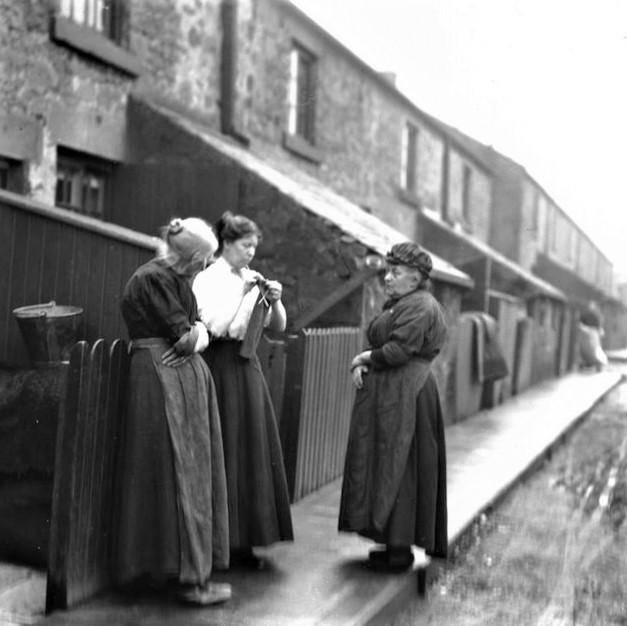
Coal miners’ wives, England, circa 1912.
- Play title: The Daughter-in-Law
- Author: D. H. Lawrence
- Written: 1913
- Page count: 111
Summary
The Daughter-in-Law is one of D. H. Lawrence’s early plays, which was never published or performed in his lifetime. The play’s setting is a mining community in the English East Midlands. Lawrence depicts the lives of Mrs Gascoigne and her two adult sons with the only other major character being Minnie Hetherington who marries into the family. The focus of the play is the relationship between Luther Gascoigne and his domineering mother and how this overshadows his marriage to Minnie. The major events of the play cover both the public and private spheres, like a miners’ strike as well as a pregnancy out of wedlock. All the scenes are played out in kitchens, either Mrs Gascoigne’s or Minnie’s. Indeed, Lawrence’s play fits the definition of a British kitchen-sink drama, but his work predates the movement by approximately 40 years. The play is written in the style of naturalism and several characters speak in a midlands dialect. In a letter to his literary adviser, Lawrence described The Daughter-in-Law as “neither a comedy nor a tragedy – just ordinary.” Lawrence is best known as a novelist, and this play bears a strong thematic resemblance to his famous work Sons and Lovers.
Ways to access the text: reading
The full text of The Daughter-in-Law is available to read online via Project Gutenberg Australia. A second possibility is the Open Library which holds several copies but most are part of anthologies, so one should search under D. H. Lawrence plays.
There is no audiobook version of the play to my knowledge.
If you would like help in conjuring up the atmosphere of the play then please watch the short theatre promo for the play on YouTube, entitled, “D.H. Lawrence’s The Daughter-In-Law – Library Theatre Company.”
Why read The Daughter-in-Law?
English Regional Dialect
Lawrence wrote the dialogue of several of the main characters in the Nottinghamshire dialect. This was originally an obstacle to staging the play, and it also serves to frustrate a reader unfamiliar with English texts written mostly in dialect. While difficult, the language quickly becomes familiar to a persistent reader. But why should a reader initially trudge through a text that many people would consider obscure in any case? The primary answer is that Mrs Gascoigne’s use of Nottinghamshire dialect is an essential part of her character; it reveals a woman whose rhetoric is richly expressive, full of wonderful turns of phrase, and witticisms. Her speech and also that of her sons represent their working-class roots, and Lawrence refused to simplify or sanitize such speech for the predominantly middle-class theatre audiences of his time. The use of a dialect versus standard English also serves to differentiate Mrs Gascoigne from the younger, more educated woman Minnie. However, standard English versus regional speech does not automatically correspond to a hierarchy of power, intelligence or success. Lawrence depicts several formidable women whose speech signals their backgrounds and individual characters. Without dialectical speech, this play would seem inauthentic, but that is a realization that one makes only after reading it. Though unfamiliar territory, a reader who comes to grips with the written dialect in the play will be rewarded by what he/she discovers.
Family Dynamics
The title of Lawrence’s play lays focus on the inevitable changes caused by marriage in a close-knit family. A key question is if the young man involved is truly ready for marriage. Just like in his novel Sons and Lovers, Lawrence takes a close look at the lasting consequences on men’s lives when a strong and charismatic yet domineering woman has raised them. Mrs Gascoigne’s husband died in a mining accident leaving her sole parent to six sons. Just Luther and Joe still live at home. When Luther marries Minnie, then the family is forced to adapt to the changes. Lawrence excels in depicting a complex set of family relationships: mother with son/s, newlyweds with one another, mother-in-law with daughter-in-law, and single brother with sister-in-law. The playwright explores how a son may ostensibly rebel against his mother yet remain securely under her thumb, and why a newlywed woman must not become subservient to her husband’s mother, especially when that woman is used to exercising her maternal influence. Crucially, Lawrence shows instances where compromise is vital and the consequences when there is no such compromise forthcoming. The ending of Lawrence’s play is somewhat ambiguous, and one is left wondering if a domineering mother has simply been replaced by a domineering wife or have the central characters demonstrably evolved and matured. At the core of the play is Lawrence’s contemplation of the theme of power; who gets to wield power and who must alternately resign power in the context of a family dynamic.
Post-reading discussion/interpretation.
Independence from Mother
Introduction
The Daughter-in-Law is a naturalistic play that gives a detailed account of the Gascoignes, a mining family in Nottinghamshire, England. Many readers have noticed that the theme of a mother-and-son relationship echoes Lawrence’s renowned novel Sons and Lovers, which was written just before the play. D. H. Lawrence also wrote Psychoanalysis and the Unconscious and Fantasia of the Unconscious, which were originally published in 1921 and 1922, respectively. These non-fiction works tackle such topics as human consciousness, childhood development, and parental love. Lawrence dismisses many of Sigmund Freud’s theories on the unconscious yet largely agrees with the famous psychologist on the significance of sex and parental influence. What is especially relevant to readers of Lawrence’s novels and plays is the obvious interest the author had in the human mind. He wrote, “The goal of life is the coming to perfection of each single individual” (55). In The Daughter-in-Law, the crux of the problem is how a son is to gain independence from his mother. As Lawrence tackled the topic of motherly love in both fiction and non-fiction works, these distinct perspectives may be used as an obvious access point for any reader to gain a true grasp of authorial intent. The Daughter-in-Law shows how a family dynamic can somehow go wrong and it is the unravelling of the origin of the flaw that is both fascinating and arduous. With the aid of Lawrence’s non-fiction writings along with insights garnered from other writers of the time on psychology, such as Sigmund Freud and Carl Gustav Jung, one may assuredly pinpoint the cause of the problem.
Lawrence’s ponderings on psychology came some ten years after he wrote the play. As he states:
“The novels and poems come unwatched out of one’s pen. And then the absolute need which one has for some sort of satisfactory mental attitude towards oneself and things in general makes one try to abstract some definite conclusions from one’s experiences as a writer and as a man.”
(Lawrence 71)
Significantly, Lawrence looked back at his works as the raw material from which he could later draw conclusions, much like a psychologist would discuss a patient’s life to unearth key experiences and discover their meanings. Lawrence was indisputably preoccupied with the theme of motherly love and gave shape to his ideas in dramatic form. He approached the topic of motherly love with the aim of portraying its effects within real-life situations. It is relevant to note that Lawrence had a particularly close relationship with his own mother Lydia, who incidentally was an educated woman who married a miner. In Lawrence’s non-fiction works on the unconscious, he comes to conclusions about why particular familial relationships have specific outcomes. This essay will utilize quotes from the play The Daughter-in-Law and additional material from Lawrence and other writers to set out the core points and interpretative conclusions one can credibly make about the Gascoigne family dynamic. It is hoped that the interpretation will not stray from the message Lawrence was aiming to communicate in his depiction of a poor mining family. The structure of the essay is that the main characters of Mrs Gascoigne, Luther, Minnie, and Joe will be discussed individually at some length, before concluding with a brief general overview of the play’s key points.
Mrs. Gascoigne
D. H. Lawrence depicts Mrs Gascoigne as an impressively powerful figure. In his work Fantasia of the Unconscious, Lawrence goes into quite some detail about the relationships between mothers and sons. He quotes a line from the poet William Ross Wallace that epitomizes a mother’s power: “The hand that rocks the cradle rules the world” (170). Given Lawrence’s obvious interest in psychology, one may approach the play from the aspect of mother and son interactions and influences. An analysis of Mrs Gascoigne may be supported by Lawrence’s own writings on psychology, as well as references to works by Carl Jung. At the outset, it must be admitted that the analysis will look at Mrs Gascoigne’s influence solely in her role as a mother – as the one who shapes her sons and ultimately impedes on their adult relationships with women. Yet, this is precisely how Mrs Gascoigne’s character is highlighted in the play. Minnie blames her for Luther’s faults and indeed Joe’s too. A key question is what lies at the root of Mrs Gascoigne’s personality – why does she act as she does? She is undeniably an assertive and domineering woman, but she exhibits these traits most clearly in her primary role as a mother. Carl Jung wrote about the “mother archetype” (82), and one finds an invaluable description of women who suffer from “hypertrophy of the maternal instinct” (87). Jung explains this term as follows:
“The exaggeration of the feminine side means an intensification of all female instincts, above all the maternal instinct. The negative aspect is seen in the woman whose only goal is childbirth. To her the husband is obviously of secondary importance; he is first and foremost the instrument of procreation, and she regards him merely as an object to be looked after, along with children, poor relations, cats, dogs, and household furniture. Even her own personality is of secondary importance; she often remains entirely unconscious of it, for her life is lived in and through others, in more or less complete identification with all the objects of her care. First she gives birth to the children, and from then on she clings to them, for without them she has no existence whatsoever.”
(Jung 87)
This description matches one’s impression of Mrs Gascoigne. She is the mother of six sons and prides herself on how she has provided a stable home for them, even after her husband died in a mining accident many years ago. She is apparently selfless. She is kept busy with household chores but also guides as best she can her two sons who remain living at home. When Mrs Gascoigne advises Minnie about men, she makes an observation that corresponds with Jung’s classification of such women as obsessive carers who treat adult men in much the same manner as children. Mrs Gascoigne advises Minnie that:
“Children they are, these men, but, my word, they’re revengeful children. Children men is a’ the days o’ their lives. But they’re master of us women when their dander’s up, an’ they pay us back double an’ treble — they do — an’ you mun allers expect it.”
Mrs Gascoigne’s words prove to be complex when scrutinised fully. She presents herself as one in eternal servitude to her menfolk, which crucially means that she is also the eventual target of their tantrums. Indeed, it is as though her life has no purpose outside of caring for her menfolk, which requires her to play a supporting role rather than the person at the forefront. However, Mrs Gascoigne is also infantilizing the men by viewing them as eternal, unruly children despite their mature ages. As such, her advice to Minnie rings false because it comes from such an assertive, controlling woman. Jung reveals the emotional price attached to such intense mother-and-son relationships, explaining that the bond is almost poisonous.
“Women of this type, though continually ‘living for others,’ are, as a matter of fact, unable to make any real sacrifice. Driven by ruthless will to power and a fanatical insistence on their own maternal rights, they often succeed in annihilating not only their own personality but also the personal lives of their children.”
(Jung 88)
It may seem strange that Lawrence, a man who had an unusually strong bond with his own mother and who also came from a working-class coal mining district, should so blatantly critique a character like Mrs Gascoigne. The playwright’s depiction of Mrs Gascoigne strongly resembles Jung’s psychological profile of such women who have a “ruthless will to power.” Lawrence evidently wishes to dismantle a seemingly invincible woman through an exposition of her faults and thus reveal to the audience the problems of such women’s influence over their sons. The writer is critiquing mother love, and he shows that it is not always benign. In Fantasia of the Unconscious, Lawrence ponders the initial causes of the distortions in mother and son relationships. He argues that a woman who is unhappy or unsatisfied in her marriage, “throws herself into a last great love for her son, a final and fatal devotion, that which would have been the richness and strength of her husband and is poison to her boy” (201). In this way, Lawrence is confronting the toxic side of motherly devotion, which Jung, focusing on the archetypes of the unconscious mind, describes as follows:
“On the negative side the mother archetype may connote anything secret, hidden, dark; the abyss, the world of the dead, anything that devours, seduces, and poisons, that is terrifying and inescapable like fate.”
(Jung 82)
Fortunately, Lawrence does not make Mrs Gascoigne into a lazy caricature of the old, domineering crone. Instead, he reveals the hundred-and-one ways that her influence, which is a manifestation of her core personality type, has subtly injured her two sons. In this way, the play provides valuable insight into a common family dynamic clearly based on the Oedipal complex. It is a realistic portrayal of an individual coal mining family and a crucial insight into the psychology of the situation. What Lawrence does is reveal a more objective view of mother love, showing that it is not always a wholly positive influence. Jung summarizes the stereotype of mother love, which is that of near saintliness.
“The positive aspect of the first type of complex, namely the overdevelopment of the maternal instinct, is identical with that well-known image of the mother which has been glorified in all ages and all tongues. This is the mother-love which is one of the most moving and unforgettable memories of our lives, the mysterious root of all growth and change; the love that means homecoming, shelter, and the long silence from which everything begins and in which everything ends.”
(Jung 92)
Some supposedly God-given truths must be tackled. In The Daughter-in-Law, the playwright gives free rein to dissenting voices. Minnie’s voice is the most prominent, but Joe also begins to challenge the ideal of mother love. Such a challenge may seem outdated to present-day readers, but Lawrence was tackling this issue in 1913 and within the context of a working-class family where many would view other issues as far more significant. Mrs Gascoigne lies at the heart of a cause-and-effect dilemma, and one which makes readers slightly uncomfortable because the primary carer is also the person excoriated as the source of all problems! It is initially through her oldest son Luther’s perceived faults that we begin to view Mrs Gascoigne in a different light.
Luther Gascoigne
One of Luther Gascoigne’s most prominent traits is his lack of expressiveness. A reader relies heavily on the descriptions and often harsh critiques that others apply to Luther. It is of interest that Lawrence chooses to portray a physically robust miner in such a way, emphasizing his character’s submissive nature. Luther’s lack of assertiveness is one of his core weaknesses, and his taciturn nature and passive character make him difficult to assess because he reveals so little. Just like with Mrs Gascoigne, it is best to investigate what possible reasons lie behind Luther’s character traits. Lawrence, Jung, and Freud all write about the topic of mother and son relationships, and each has a distinctive approach, but all three tend to agree that when a parent forms too close of a bond with their child before puberty, then it often leads to lifelong problems. We know that Mrs Gascoigne’s husband died leaving her as sole parent, and we also know that Minnie criticizes Mrs Gascoigne for all of Luther’s faults, but is it legitimate to lay the blame on an elderly mother? One may take quotes from all three writers, Lawrence, Jung, and Freud, to discern the problems of what Lawrence himself calls “the bond of adult love” (196), which sometimes forms between mother and son.
“It is a sort of incest. It is a dynamic spiritual incest, more dangerous than sensual incest, because it is more intangible and less instinctively repugnant.” (Lawrence 196)
“For the son, the anima is hidden in the dominating power of the mother, and sometimes she leaves him with a sentimental attachment that lasts throughout life and seriously impairs the fate of the adult.” (Jung 29)
“Of course, too much parental tenderness becomes harmful because it accelerates the sexual maturity, and also because it ‘spoils’ the child and makes it unfit to temporarily renounce love or be satisfied with a smaller amount of love in later life.” (Freud 97)
A summation of these views leaves one with the figure of a domineering mother who engages in a form of bonding with her son/s that may be classified as “spiritual incest,” which potentially leads to relationship problems in adult life. Luther does exhibit the character traits of a boy who has an indulgent mother, and as Lawrence writes, “then the child will be all gentle, all tender and tender-radiant, always enfolded with gentleness and forbearance, always shielded from grossness or pain or roughness” (112). Luther has evidently not learned to assert himself, defend himself, or express himself in an adult fashion. It is difficult to objectively critique the mother love exhibited in any family setting, but we do witness Luther’s problems as an adult. Through a series of observations, one concludes that Luther’s problems are indeed rooted in his childhood and are caused by his overbearing mother.
It is possible to classify Luther’s shortcomings under three headings: career, assertiveness, and marriage. Luther is a 31-year-old miner but as his mother tells Joe, “There’s Luther nowt b’r a day man yet,” which signifies his lack of career progress. Minnie similarly criticizes her husband when he says that he is going on strike. She sarcastically asks – “and will this strike make a butty of you?” Minnie comments that other men make progress because they have some “go in them,” but that Luther’s satisfied with a low-level job because, “that’s what your mother did for you — mardin’ you up till you were all mard-soft.” This criticism links to Luther’s lack of assertiveness in all areas of his life as assessed by those closest to him. For example, Joe comments derogatorily on Luther’s obvious lack of enthusiasm when courting Minnie, saying “I reckon he niver showed the spunk of a sprat-herring to ‘er [Minnie].” Later, when Minnie sees her husband covered in coal dust, all black-faced, she says, “You don’t look nearly such a tame rabbit, in your pit-dirt.” Luther’s brother and wife have unflattering perceptions of him as a man with no drive and tame like a pet. Indeed, Luther is always the docile party, both in his marriage and with his mother. Not only does Luther take on board his mother’s advice that he is too young for marriage at 22, but he leaves it to his fiancé Minnie to propose to him. When Luther tries to defend himself to Minnie by saying that he proposed twice previously, she retorts, “Axed me! It was like asking me to pull out a tooth for you.” It is noteworthy that once Luther is married to Minnie, he complains about his marriage to Joe and to Mrs Purdy. He even expresses some regret about marrying Minnie, but he never admits this to his mother. With his wife, Luther always adopts a passive or passive-aggressive attitude, even when she threatens to leave him over the Bertha affair; he just responds, “I non care what ter does. If ter leaves me.” His marriage is not a success, and he cannot confess this to the one person who warned him against marrying Minnie, namely his mother who remains the most important influence in his life. Ironically, the woman responsible for many of Luther’s faults and by extension for his marriage problems seems nonetheless to have been right about his misguided choice of partner. However, one must appreciate that for Mrs Gascoigne the thought of losing her sons to marriage is the equivalent of losing a part of herself. For that reason alone, she devalues such a union by advising, “Marriage is like a mouse-trap, for either man or woman. You’ve soon come to th’ end o’ th’ cheese.” It is difficult not to view Luther’s shortcomings as anything other than the result of a mother who wishes never to see her son gain independence and who metaphorically clipped his wings so that he would be incapable of ever leaving her.
The crux of Luther’s difficulties falls under the heading of manhood. Ideas of manhood and masculinity have changed significantly since Lawrence wrote the play in 1913. However, in terms of Lawrence’s own writings, Luther is an unusually passive character and seems to have adopted the passive role in his marriage, formerly seen as the typically female role. Lawrence had firm views that men should be masculine and women feminine.
“A child is born with one sex only, and remains always single in his sex. There is no intermingling, only a great change of roles is possible. But man in the female role is still male.”
(Lawrence 174)
Therefore, in Lawrence’s portrayal of Luther, he is signalling a fault as he would have understood it. The indications that Luther is not acting in an assertive, manly fashion are his passive acceptance of Minnie’s marriage proposal, and later, his equally passive acceptance that she may leave the marriage if she so wishes. Marriage signifies a new stage in a person’s adult life, so entering or leaving such a union as a disempowered figure, almost a bystander, is undoubtedly a sign of a problem. Minnie also ceaselessly chastises and belittles Luther in the marriage by telling him that he “talk[s] like a fool,” is “lazy,” and is a “coward.” However, the main insult arrives when Minnie tells Luther, “No, you’re not a man.” This derogatory remark is soon explained by Minnie’s additional comment, “It’s your mother’s doing. She mollycoddled and marded you till you weren’t a man — and now — I have to pay for it.” When Minnie learns that Luther has impregnated Bertha Purdy, she dismisses the girl as a mere simpleton and asserts that it is probably not even his child. According to Minnie, Bertha chose Luther not because he was the real father but due to him being “so soft,” and that he would be flattered by the idea of his male prowess. Yet Luther never retaliates in word or action to any of these insults, even though he does get angry at times. When Luther complains to Joe about Minnie, we glimpse how another man would deal with the situation because Joe says, “By the Lord, she’d cop it if I had ‘er.” The marriage is lopsided regarding who has power and control. Lawrence warns that “with wife or husband, you should never swallow your bile. It makes you go all wrong inside” (280). Overall, Lawrence depicts a man who has not matured sufficiently to cope with the challenges of adult life. In traditional terms, he has not become a man. Yet if Luther is indeed such a weak, unambitious character, then why does someone like Minnie choose to marry him at all?
Minnie Hetherington
Minnie is the daughter-in-law referred to in the play’s title. Her importance may be negatively gauged by the level of imposition felt by her new family, the Gascoignes. Minnie has obvious advantages like an education and a career, but she also has a strong personality. She comes from the same town as the Gascoignes, but she is considered supercilious by the locals. Mrs Purdy describes Minnie as “haughty” and in somewhat more colourful language, she adds that she’s “a stuck-up piece o’ goods as ever trod.” A more objective assessment might be that Minnie is a proud young woman. Before marrying Luther, Minnie worked as a nursery governess for several years in Manchester, and she speaks standard English rather than the local dialect. More importantly, Minnie is an independent woman not only due to her career but also due to a small inheritance of one hundred pounds from her late uncle along with some savings of her own. When she is first introduced in the play, the description of her is, “a tall, good-looking young woman.” While Minnie’s poise and refined speech may seem arrogant to those in the mining town, she is without doubt an intelligent and attractive young woman. This contrasts sharply with the assertion first made by Mrs Gascoigne that Minnie settled for Luther because she could not find a better man – “an’ when she fun as nob’dy was for sale but our Luther, she says, “Well, I’ll take it.” The key question of why Minnie married the unambitious and taciturn Luther becomes a refrain in the play.
The young couple’s courting history is long and complicated. Mrs Gascoigne reveals that Luther proposed to Minnie when he was twenty-two years old, but Minnie declined his offer and pursued her career instead. Mrs Gascoigne had been consistently against the match. Initially, this was on account of Luther’s youthful age, but later Mrs Gascoigne contradictorily decided that Minnie had waited too long and had simply been unable to get herself the right sort of husband – “A town johnny, a Bertie-Willie an’ a yard o’ cuffs.” When Luther reveals the news of Bertha’s pregnancy to Minnie, she angrily responds, “So — this was what I waited for you for!” The statement indicates that Minnie was always the pursuer in the relationship. The proof is that her final marriage proposal made via letter to Luther was the successful one. However, the lingering doubts about Minnie’s true motivation for getting married are not based solely on Mrs Gascoigne’s scurrilous assertions that Minnie settled for Luther. Indeed, during a previous argument with Luther, Minnie criticizes Luther’s work ethic along with his half-hearted marriage proposals until an exasperated Luther legitimately asks why she did marry him. Her sharp response is – “because I could get nobody better.” Nevertheless, one must ask if such a statement is wholly credible. One suspects that Minnie must have swallowed her pride not only to marry a man who showed little enthusiasm for the match but also because she had to propose to him to finalize the match. When Luther subsequently reveals he got Bertha Purdy pregnant, Minnie does not automatically threaten to leave him, as one might expect, but only broaches the topic of separation in response to Luther’s total apathy. Minnie desired the marriage and intended to stay in the marriage, but Luther’s passivity is a constant obstacle. Minnie’s assertions that she could do no better than him seem little more than antagonistic remarks to hurl at her docile husband. Yet one must question the marriage further to reveal its hidden allure for Minnie.
Though Minnie and Luther’s marriage is strained, there is certainly a mutual sexual attraction. This partially explains Minnie’s strong bond with Luther. Let us not forget that Minnie has previously worked in Manchester and is friends with educated men like her former employer Mr Westlake who assisted her in choosing the three art prints she later bought. She has her own career as a governess and may return to this work if she chooses. She is noticeably different because she speaks in standard English rather than the dialect of her hometown and region. Such a woman would normally gravitate towards a more refined man rather than a manual labourer. Luther is certainly not an obvious match for her because he is an uneducated coal miner with little or no ambition. Minnie still chooses Luther, and their sexual chemistry is the apparent key to this choice. In Act One, scene two, one witnesses how the couple exchange compliments at home, and how Minnie is fascinated by Luther in all his pit dirt and coal dust when he returns from the mine. She notes how red his lips are and how they contrast with his blackened face. Luther adds a description of himself as though he inhabits Minnie’s thoughts – “It ma’es you look like a nigger, i’ your pit-dirt — th’ whites o’ your eyes!” Luther’s description conjures up the old stereotype of Black men and sexual prowess. The description was prompted by Minnie’s initial focus on the redness of Luther’s lips and the whiteness of his teeth, “It’s your mouth — it looks so red and bright, in your black face.” Minnie is aroused by her husband’s appearance since she adds the piquant remark that “It’s almost like having a stranger.” Luther’s identity as a hard-working coal miner is read by Minnie as a sign of true masculinity, and for a moment, he is not the “tame rabbit” she had begun to label him. Many writers of the era, Lawrence included, noted the physical beauty of miners’ bodies, which was a result of their hard physical work. It is important to note that sexual attraction plays a key role in the bond between the newlyweds, especially since they are not an obvious match in other respects. One could view Minnie’s constant haranguing of Luther as an attempt to ignite a more obvious masculine response in him: to arouse a more formidable character with whom she can spar both outside the bedroom as well as within it.
Minnie had known Luther for at least nine years before marrying him. One presumes that she could have married a middle-class gentleman or even a different coal miner given that she is young, intelligent, and good-looking. Mrs Gascoigne’s speculation that Minnie settled for Luther does not withstand much scrutiny. However, sexual attraction alone does not seem a sufficient reason for waiting so long for Luther, especially given his lacklustre responses during courtship. Then once the couple is married, Minnie’s expectations of Luther contrast sharply with her knowledge of him gained over the many years. This begs the question – what does Minnie want of Luther? When Minnie argues with Mrs Gascoigne over Luther’s shortcomings, she states, “I’ll have a man, or nothing, I will.” Minnie holds Mrs Gascoigne responsible for Luther’s faults.
“It was your fault. You held him, and persuaded him that what he wanted was you. You kept him, like a child, you even gave him what money he wanted, like a child. He never roughed it — he never faced out anything. You did all that for him.”
To understand such a charge, one may return to what Lawrence wrote about parents who establish too close a bond with their children – “You have got your child as sure as if you had woven its flesh again with your own. You have done what it is vicious for any parent to do: you have established between your child and yourself the bond of adult love” (196). Lawrence goes on to explain the detrimental consequences for such children’s later adult relationships, writing, “You will not easily get a man to believe that his carnal love for the woman he has made his wife is as high a love as that he felt for his mother or sister. The cream is licked off from life before the boy or the girl is twenty” (205). Minnie recognizes the ill effects of Luther’s over intoxication with mother love. Minnie enumerates how Mrs Gascoigne bossed Luther, took decisions for him, and made him overly dependent on her. Of course, Mrs Gascoigne defends her son out of love but also because by defending him she also defends herself. Mrs Gascoigne tells Minnie, “I canna see as you’re so badly off. You’ve got a husband as doesn’t drink, as waits on you hand and foot, as gives you a free hand in everything. It’s you as doesn’t know when you’re well off, madam.” In fact, both women know Luther’s character exceptionally well, and what Mrs Gascoigne says is not contradicted by Minnie. The issue here is fundamentally about control because Minnie complains, “How is a woman ever to have a husband, when the men all belong to their mothers? It’s wrong.” At the conclusion of the play, Minnie is in conversation with Mrs Gascoigne, and she says “Don’t keep him [Luther] from me. It leaves me so — with nothing — not even trouble.” Minnie seeks to break the incredibly strong bond between Mrs Gascoigne and Luther, but she vitally makes the request of the person she understands holds the power. Minnie desires to control Luther without interference. Lawrence writes very insightfully on the crucial difference between the submissive love a mother may supply within a family versus the love a married woman expects in her marriage.
“No woman will give to a stranger that which she gives to her son, her father, or her brother: that beautiful and glamorous submission which is truly the wife- submission. To a stranger, a husband, a woman insists on being queen, goddess, mistress, the positive, the adored, the first and foremost and the one and only. This she will not ask from her near blood-kin. Of her blood-kin, there is always one she will love devotedly.”
(Lawrence 205)
This interpretation of the potency of mother love as understood in the context of Lawrence’s play leads one to a grave conclusion. Minnie enters verbal combat with Mrs Gascoigne with the chief aim of gaining full control of Luther. This does not discount the sexual chemistry between Minnie and Luther, and one must indeed acknowledge their long courtship. However, it is implausible that Minnie does not know what kind of man Luther is, and therefore, she has indeed chosen him precisely for the good points that his mother makes about his character. The thorn in Minnie’s side is Luther’s steadfast attachment to his mother and the resulting split in his loyalties, namely between his biological family and marriage. Luther’s character will not change now regardless of his adult relationship with his mother, so one suspects that many of Minnie’s major criticisms of her husband will be repeated to infinity. Through Minnie’s negotiations with Mrs Gascoigne, she is signalling that she is indeed replacing the older woman in Luther’s affections, and thus one domineering woman is replaced by her younger rival. What Minnie sees in Luther is someone who will abdicate his power to her, just as he did with his mother, and so the cycle continues. This is an unromantic reading of the situation but seems to follow the message of Lawrence’s play, which is a caution against close family relationships of the mother and son variety. Luther’s choice of a partner with Minnie’s personality is not a puzzle – she is an image of his mother to which he is unconsciously drawn.
Joe Gascoigne
Joe Gascoigne is one of the most compelling figures in Lawrence’s play. Joe is Mrs Gascoigne’s youngest son. He is approximately 26 years old and of handsome appearance. In comparison to the passive, even apathetic Luther, the younger brother Joe is assertive, ambitious, and seems unaffected by the negative aspects of motherly love. This young miner has plans to emigrate to Australia and is considered somewhat of a ladies’ man. However, Lawrence shows that even though families may contain individuals of contrasting characters, an overbearing mother will still unavoidably shape her children. Carl Jung writes, “The effects of the mother-complex differ according to whether it appears in a son or a daughter” (85), and he notes that one of the effects on sons is the emergence of what he labels “Don Juanism” (85) where the son “unconsciously seeks his mother in every woman he meets” (85). Freud proposes a similar theory that sons seek replacements for their mothers in romantic relationships, writing, “It is not without good reason that the suckling of the child at its mother’s breast has become a model for every amour. The object-finding is really a re-finding” (95). Luther confirms that Joe is promiscuous when he recalls his own lack of sexual activity but says, “Our Joe wor more that way than me.” Even though Joe may be quite sexually active, he is also apparently discerning in his choice of women. The evidence of this comes when Minnie berates Luther about Bertha Purdy: the so-called “sawney” or simpleton. Minnie says that Joe would never settle for such a woman. Minnie’s statement confirms that Joe prefers intelligent and articulate women, women like his own mother who are redoubtable. However, “Don Juanism” is not the only indication of Joe’s bond with his mother. In the opening scene of the play, one sees Mrs Gascoigne cutting Joe’s dinner meat and then spoon-feeding her adult son. One could feebly excuse this act given that Joe’s right arm is in a sling, but it is noteworthy that Mrs Gascoigne initiates the role play since it was not done at Joe’s request. Lawrence is depicting an obvious case of infantilization, and the playwright underscores the relevance of the scene with Mrs Gascoigne’s joke: “It’s a rum un as I should start ha’in’ babies again, an’ feedin’ ’em wi’ spoon-meat.” This scene perfectly encapsulates the relationship between mother and son, especially when Mrs Gascoigne proceeds to quiz Joe on his attempts to secure accident pay and then critiques, albeit jokingly, his actions and negotiating skills. There is an unusually close bond between Joe and his mother.
Lawrence makes Joe a distinctive character in several respects, but one key point is that Joe is painfully aware of his unhealthy link with his mother. This is not revealed until Minnie is arguing with Mrs Gascoigne, and she remarks, “Your elder sons you let go, and they are husbands. But your young sons you’ve kept.” As the topic is Mrs Gascoigne’s control over her sons then Joe is naturally brought into the discussion with Minnie commenting that he is not fit to get married. Surprisingly, Joe agrees with Minnie’s criticism of him. Joe exhibits true insight into his predicament as he understands it. He addresses his mother as follows:
“Tha knows I couldna leave thee, Mother — tha knows I couldna. An’ me, a young man, belongs to thy owd age. An’ there’s nowheer for me to go, Mother. For tha’rt gettin’ nearer to death an’ yet I canna leave thee to go my own road. An’ I wish, yi, often, as I wor dead.”
It is a striking confession from a man who otherwise seems such a well-rounded adult. For much of the play, one may comfortably presume that Joe is a capable and soon-to-be independent young man. However, by finally stripping away Joe’s façade of confidence, Lawrence is drawing attention to the ill effects of what is essentially an Oedipal complex. Additionally, Lawrence makes Joe the truth-teller of the play, and the fact that the young man has a good insight into his flaws means that he may be treated by the reader as an objective voice.
Joe is instrumental in bringing the plot of The Daughter-in-Law to its resolution. One may view this young man’s influence under three key headings: information, argumentation, and confrontation. Information becomes a weapon in the play as proven by Mrs Gascoigne’s desire to use the news of Bertha’s pregnancy to punish Minnie. Mrs Gascoigne commands that, “Mrs Purdy, give it her [Minnie]. It’ll take her down a peg or two, and, my sirs, she wants it, my sirs, she needs it!” Yet Mrs Gascoigne is regularly deprived of information by her secretive sons, which signals their fear of her. Only Joe has a comprehensive overview of all that is truly happening in the family. He holds three crucial pieces of information which he shares with his mother but only at a strategic moment when such revelations are necessary for his own aims. These revelations are, firstly, that Luther and Minnie already have marital problems even prior to Bertha’s news, secondly, the contents of Luther’s letter in reply to Minnie’s marriage proposal, and thirdly, the confirmation by Joe of Mrs Purdy’s story about Luther and Bertha’s affair. The information is not provided to win favour with his mother but instead to create a solid and convincing counterargument to Mrs Gascoigne’s. It is Mrs Gascoigne’s intent to orchestrate a horrible scene where Minnie is confronted with the news of Luther’s unfaithfulness. Mrs Gascoigne feels that Minnie deserves this fate because she made Luther wait too long before marrying him. Mrs Gascoigne’s attempts to use Mrs Purdy’s daughter’s misfortune to punish Minnie are grossly unjust in Joe’s view.
Mrs Gascoigne’s chief argument rests on timelines – primarily the inordinate waiting period before the young couple’s marriage. Luther’s mother cleverly absolves herself of responsibility for her son’s errors, saying, “My son’s my son till he takes him a wife,” an’ no longer.” But the timeline tells a different truth. The couple are married just six weeks and Minnie’s proposal was three months ago, but Bertha is already four months pregnant. Luther was still a single man and living with his mother when he had a tryst with Bertha Purdy. Since Joe disagrees with his mother’s argument, he uses vital information, including some comments derogatory to Luther, as a means of convincing Mrs Purdy not to follow his mother’s advice. He criticizes Luther instead of Minnie for the slow marriage because his brother “slormed,” meaning that his courtship lacked vigour. Joe goes on to name the gang of friends who frequented “Th’ Ram” bar and says, “Jim Horrocks is ter blame fer couplin’ ‘er [Bertha] onter our Luther, an’ him an’ her’s ter blame for the rest. I dunno how you can lay it on Minnie.” Joe also quite reasonably asserts that Luther had no way of knowing that Bertha would fall pregnant. In short, Joe tries to avert disaster by convincing Mrs Purdy that the whole sorry affair is the result of Luther’s lackadaisical character, a bad crowd, and bad luck. Minnie is the innocent party in Joe’s presentation. It is a robust argument that expertly tackles each aspect of his mother’s rhetoric. Additionally, Joe actively seeks a solution to the problem by suggesting a payment to Mrs Purdy’s daughter, negotiating the appropriate sum, offering to pay it himself, and always emphasizing the importance of secrecy to Mrs Purdy. In fact, Joe solves the problem except for one major obstacle – Mrs Gascoigne controls both her sons’ savings. She refuses to release the money to Joe, even though it is his own money.
Even though Joe appears sadly beholden to his mother, he is not afraid to contradict and even confront her at times. Mrs Gascoigne becomes increasingly exasperated with Joe’s contradictory stance to hers concerning Minnie’s responsibility and she attempts to silence her son using her power as the matriarch, saying – “What has thee ter say, I should like to know? Fed an’ clothed an’ coddled, tha art, an’ not a thing tha lacks.” It is manipulative for a mother to use her son’s dependency as a coercive tool, especially when the last thing she wishes is for him to become independent. Despite Joe’s best efforts, Mrs Purdy does finally agree to Mrs Gascoigne’s plan, but Joe never ceases arguing his point that Minnie should not be told of Bertha’s pregnancy. Mrs Gascoigne’s annoyance is obvious, and she chides Joe, saying, “I could fetch thee a wipe ower th’ face, I could!” As Joe’s initial plan has failed, he cleverly goes to Luther’s house the following day with the intention of making Minnie so angry, by breaking her crockery, that she exits the house before Mrs Purdy arrives. In this scene, Joe is shown to outmanoeuvre Minnie for her own good, then he breaks the news of Bertha to Luther as well as instructs his brother on the agreement to make with Mrs Purdy. In short, Joe succeeds in dismantling his mother’s malign plan. It is only because of Luther’s drunken revelation that Minnie finds out about Bertha’s pregnancy, not because of any flaw in Joe’s meticulous planning.
The key turning point of the play involves a final confrontation that eventually secures a lasting peace in the family. The scene is set when Joe acts upon Luther’s suggestion that a woman may be hired to do the housework instead of Minnie who has apparently abandoned her husband. Joe’s departure from the house to arrange the services of “Lizzie Charley” infuriates not only his mother but Minnie too. In a clever comparison, Joe says Luther may hire someone to do his housework just as the mine bosses hire “blacklegs” to do the miners’ work. The metaphor of a strike breaker works well in the domestic debacle. Joe advises Mrs Gascoigne not to play the role of blackleg i.e., not interfere in the young couple’s marriage. Also, Minnie’s home labour is covertly given a monetary value. Regarding Mrs Gascoigne, Joe is effectively telling her that she needs to stop interfering in Luther’s married life, which is a long overdue rebuke. For Minnie, the effect of the insult is quite different because by placing a monetary value on the household duties of a wife, Joe cleverly deflates Minnie’s exaggerated sense of her own importance by coldly showing her that she can be replaced easily and at a meagre cost too. As soon as Lizzie Charley has been advised that her services are not needed, Minnie instantly re-assumes her domestic role, suggesting, “We’ll have some tea, should we?” Also, Minnie unusually refers to Mrs Gascoigne as “mother” while engaging her in polite conversation. Joe, who is just an ordinary miner, is shown to be exceptionally cunning because he manipulates the situation to force a result that finally sets everything in its proper place.
Conclusion
Lawrence’s play provides an engaging critique of mother love in the context of a poor, mining family. The playwright portrays two quite different men who have one thing in common: an unhealthy attachment to their mother. The story that Lawrence presents to his readers is a variation on an old theme of mother and son relationships. Carl Jung writes of the potency of the mother and son relationship as follows:
“The mother is the first feminine being with whom the man-to-be comes in contact, and she cannot help playing, overtly or covertly, consciously or unconsciously, upon the son’s masculinity, just as the son in his turn grows increasingly aware of his mother’s femininity, or unconsciously responds to it by instinct.”
(Jung 85)
It is very revealing that Mrs Gascoigne compares her role as the carer of her sons with that of a new wife who will replace her. She says of Minnie’s relationship with Luther, “Let her make him as good a wife as I made him a mother! The comment seems innocuous until much later when Luther is drunkenly arguing with Minnie and he says, “‘er wor nice wi’ me, which is a thing tha’s niver bin,” which Minnie strangely misinterprets as a reference to his mother and responds, “You only want your mother to rock you to sleep.” However, the woman Luther is referring to is the woman he got pregnant, Bertha Purdy. In the context of the play, Minnie’s presumption that Luther is speaking of his mother when he is actually speaking of his illicit lover helps emphasize the incestuous nature of the too-close mother-and-son bond. As already discussed, it is common for sons of domineering women to seek a partner who reflects their mother. As Lawrence himself states, one is not referring here to sexual relations between mother and son but rather an unusually close, sympathetic bond that is gravely harmful. Also, Mrs Gascoigne’s view that she is being replaced leads to a heightened defensiveness of the bond she has held with her adult sons; a bond that is even more insidious since it has existed since their births. When Minnie argues with Mrs Gascoigne over her control of Luther, the older woman retorts to Minnie, “You talk like a jealous woman,” which also signals that both women are vying for Luther’s love.
Even though Luther turns out to be a taciturn, introverted character who leaves his mother only to live with a woman who is equally assertive and domineering, Joe is quite different. In Joe, Lawrence presents us with a handsome, intelligent, resourceful, masculine figure but one whose life ambitions are blighted by his bond with his mother. One may more easily dismiss Luther as a failure, but Joe’s example demands that a reader look more closely at the influence of the often-unquestioned love of the mother figure. If the play has a single message, then it is that a man’s whole life may be overshadowed by a type of motherly love that acts as a poison rather than nourishment.
The ending of the play is sometimes read as a depiction of a family at peace, which has been bought at the price of compromise. Mrs Gascoigne and Minnie certainly appear to have reached a truce, but both women have merely accepted certain realities as opposed to any show of genuine compromise. There is little true evidence of any characters compromising or transforming at all. One possible exception is the men’s action against the mine bosses in the closing scenes. Joe is the instigator of the attack, saying, “But we non goin’ ter ha’e it, are we, Luther, these ‘ere blacklegs goin’ down interferin’.” Then, both men go out at night to thwart the blacklegs in the mining district, and as Luther says when he returns home, all bloodied, “We stopped them blacklegs — leastways.” As such, Joe, and more surprisingly, Luther, give an eventual show of traditional masculine bravery. This may indeed be interpreted as a transformation of Luther given that he has been repeatedly accused by his wife of not being a real man. Lawrence had, as mentioned, very traditional views on male and female roles in marriage, and he believed a good marriage was only possible if the man has a clear goal in life outside of the home. As Luther and Joe go out to stop strikebreakers with the ultimate goal of improving miners’ wages and conditions, then they are enacting their political beliefs as normal working men. Lawrence believed that a man should not look to his wife as the major interest in life, writing that:
“No man ever had a wife unless he served a great predominant purpose. Otherwise, he has a lover, a mistress. No matter how much she may be married to him, unless his days have a living purpose, constructive or destructive, but a purpose beyond her and all she stands for; unless his days have this purpose, and his soul is really committed to his purpose, she will not be a wife, she will be only a mistress and he will be her lover.”
(Lawrence 283)
As Mrs Gascoigne is the one who originally emasculated her sons, then she is not the one to rectify the problem. Luther’s “predominant purpose” as Lawrence calls it becomes the welfare of the mining workers for whom he fights. Yet this awakening of masculinity is prompted by his younger brother Joe who suggested the action. We also witness Minnie’s actions where she seeks to force a change in Luther’s character. Minnie deliberately transforms her cash savings into material objects. She buys an engagement ring and three art prints on the pretence that it puts her in “the same boat as other men’s wives now.” Her goal is to make a man of Luther. She intends to force him to provide for her and her ultimatum is professed in front of all the family – “If he can provide, he must, and if he can’t, he must tell me so, and I’ll go back into service, and not be a burden to him.” Mrs Gascoigne astutely reads Minnie’s act as being “high and mighty” and chastises Minnie regarding Luther’s feelings, “tha doesna care how he takes it.” Clear demands are being made on Luther to change.
The play closes with an image of Luther who has been wounded after the attack on the blacklegs and is in tears due to the emotional strain of the previous days. He is held in his wife’s arms, and she has just said, “Trust yourself to me. Let me have you now for my own.” In the other household, Joe goes home and his mother follows him to take care of him. She knows that he will never leave her. In both houses, a man’s life is ruled by a more assertive, domineering individual, be it a wife or mother. In regard to characters transforming or compromising, the only character who is asked to change is Luther who is ironically the most docile and accommodating of all. As such, Lawrence’s depiction of mother love is of something quite malign and oppressive, but it is also practically invisible until one looks at the long-term repercussions like Luther’s marriage. The price to be paid by both sons, as made clear in The Daughter-in-Law, is a total loss of freedom.
Works Cited
Freud, Sigmund. Three Essays on the Theory of Sexuality, David De Angelis, 2018.
Jung, C. J. The Archetypes and the Collective Unconscious. The Collected Works of C. J. Jung Volume 9, Part 1, edited by Sir Herbert Read, Princeton University Press, 1980.
Lawrence, D. H. Psychoanalysis and the Unconscious and Fantasia of the Unconscious, Dover Publications, 2005.
Lawrence, D. H. The Daughter-in-Law. Complete Works of D. H. Lawrence, Delphi Classics, 2015, pp. 8653-8764.


 Why Read Plays